LINE ID japanroyalservice
+817013781777 click here
+817013781777 click here
Many accomplished travellers tell our team at Japan Royal Service the same thing. They tried Soba in Japan and felt… underwhelmed. The noodles were fine, the room was busy, and the meal ended before it began.
That is not a soba problem. It is a context problem.
In our experience, Soba becomes unforgettable only when you understand what you’re tasting, choose the right setting, and time it with shun—Japan’s precise sense of seasonality. This guide gives you a clear quality ladder, verified options for private soba-making, and a calendar-led way to build an itinerary beyond the Golden Route—without turning the craft into a gimmick.
We plan Soba experiences the way we plan art or architecture. Start with the system. Then choose where you want to touch it—hands-on, at the counter, or in a regional food culture that locals protect.
Here is the simple map our concierge team uses.
This is where luxury becomes real. Not gold. Not noise. Precision, calm, and access to shokunin who normally stay out of view.
You do not need jargon. You need clarity.
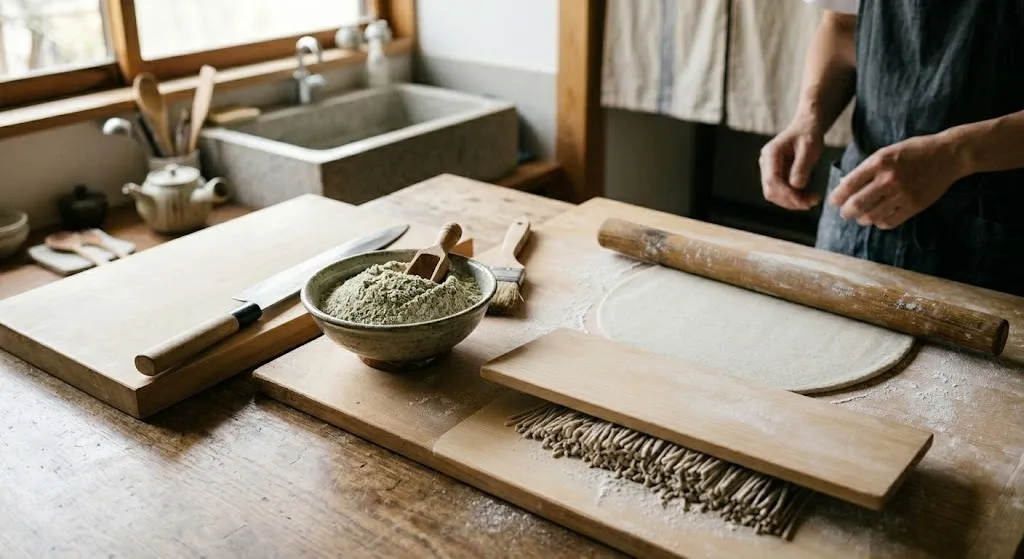
In a serious soba shop, the answer is direct. If noodles are made in-house, the team can usually describe the day’s workflow with quiet confidence, because the craft is part of their identity. That is your first signal.
Soba varies by blend. You’ll often hear juwari (100% buckwheat) and nihachi (a common blend ratio) discussed in soba circles.
What matters for travellers is simple. Juwari can be more aromatic and delicate. Nihachi can be more elastic and forgiving. Neither is “better” in all contexts. The best choice depends on the shop’s skill and the season’s buckwheat character.
Cutting gets the attention. Boiling decides the texture.
Timing, water volume, and the shape of the cooling step shape the bite. In a master-led setting, this is often the moment you remember. It is quiet work. And it is easy to ruin when rushed.
If you want a clean, efficient “learn it properly” session in Tokyo, we steer guests toward experiences with strong lineage and transparent logistics.
One verified option is Wabunka’s private soba-making experience in Tokyo, led by Toranosuke Katayama. The listing states: ¥239,000 per group, 180 minutes, private, for 1–20 guests. That range works well for a couple, a family, or a corporate group that values discretion.
Wabunka also notes that Mr. Katayama is the chairman of the Soba Preservation Association of Japan. On his official website, he states that he established Nihon Soba Hozonkai (Japan Soba Preservation Association) on June 5, 2007. These are the kinds of verifiable details we look for before we recommend anything to HNW travellers.
For many guests, Tokyo is the best place to learn the fundamentals. It’s logistically easy. You can pair it with a private museum morning or a quiet bar evening. And you can still keep the day gentle.
Tokyo teaches technique. Nagano gives soba air.
InsideJapan Tours offers a verified “Soba noodle making” experience in Matsumoto. They note it is arranged as part of a complete tailor-made travel package, not booked as a standalone activity. We respect that model. It usually means operational control and a smoother guest experience.
Matsumoto also works well for travelers seeking a calmer base with a clear purpose. The pace is different. The mornings feel sharper. And the craft story lands more naturally when you’re not threading through city crowds.
Some soba moments are not “anytime” moments. They belong to a date.
Togakushi is one of those places where soba and spiritual culture sit side by side. The Togakushi Tourism Association announced that Togakushi Shrine’s “Tsuina-sai” rite was held at Togakushi Shrine Chusha on February 3, 2026 (15:00). They also announced limited-time “Setubun soba” menus offered at participating soba shops from January 24 to February 3, 2026.
This is the one detail most travelers miss. It is also exactly where omotenashi appears—in local shops and the shrine community moving in sync, without needing to advertise loudly.
Our approach here is wabi-sabi. Warm layers. Unhurried walks. A schedule with air in it. If you want a winter journey that feels distinctly Japanese, this is a strong anchor.
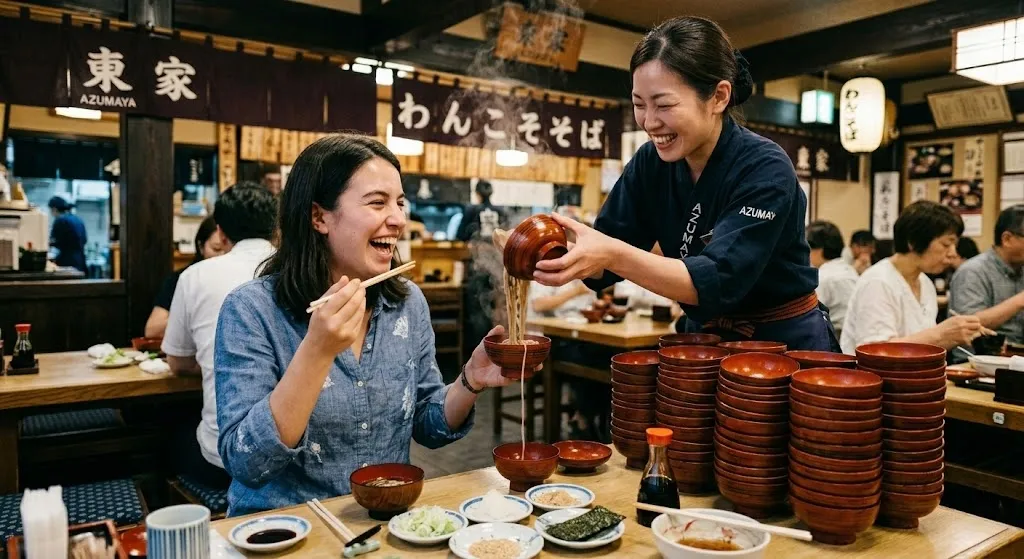
Wanko soba can look playful from the outside. Done well, it is a hospitality ritual.
Azumaya explains wanko Soba as an all-you-can-eat soba dish served in Iwate as an omotenashi meal. Their official page states that 15 small portions equal one normal bowl and lists a price of ¥4,500.
This is not about eating “a lot.” It’s about being hosted. The servers keep time and mood. You learn the rhythm. Your group laughs, then grows quiet, then laughs again. It becomes oddly ceremonial.
For families, it’s an easy win. For couples, it’s surprisingly memorable if you frame it as culture-first. For VHNW and UHNW guests, we keep it private where possible and pair it with a deeper regional context so it never feels like a tourist dare.
For an educational angle, the official Iwate tourism guide lists a program titled “Try serving Iwate’s famous Wanko Soba!” This is useful if you want a more structured, learning-forward version of the tradition.
This is the safest choice if your time is tight. You want clean instructions and a controlled setting.
For guests who want more “hidden-Japan” energy, we look for private or semi-private setups in rural towns.
A verified example is a KKday listing for a “Sugakawa Soba” soba-making experience in Yamanouchi Town, Nagano Prefecture, described as a private experience (one group per time slot) with a soba master, with optional interpreters available for a fee.
This kind of structure is useful. It gives you space. It protects the craft. And it lets our concierge plan the day so you arrive calm, not rushed.
This is where Shun becomes the main character.
Wanko soba in Morioka is exactly that. You can eat Soba anywhere. You cannot recreate this omotenashi rhythm in your own city.
These are not rigid tours. They are planning templates our team uses for HNW travellers who want craft depth and smooth logistics.
Short. Clean. Very effective for busy schedules.
This version is wabi-sabi in itinerary form. Nothing is overpacked.
If you want a deeper regional arc, we combine winter shun in Nagano with Iwate’s somotenashi dining culture.
For HNW guests, we usually recommend private formats or groups with clear caps. Not because of status. Because focus matters in craft learning, and discretion matters everywhere.
Some experiences offer optional interpreters (the KKday listing for Yamanouchi mentions this as an option for a fee). When language is handled well, the day feels effortless. When it isn’t even a beautiful workshop, it can feel tiring.
Do the class early. Your palate improves afterwards.
Once you’ve rolled and cut Soba yourself, you notice the texture, aroma, and temperature with sharp awareness. Then restaurant meals become more rewarding, not less.
Soba is easy to dismiss if you meet it in the wrong place, on the wrong day, in the wrong mood. But when you approach it as a master system—ingredients, technique, service ritual, and region—it becomes one of Japan’s most refined meals.
Tokyo gives you precision and access. Nagano offers you both Shintō shrine culture. Iwate gives you omotenashi in motion. Each is different. Each is real.
That is why we plan Sobaa like we plan any serious art encounter. Quietly. Carefully. With respect for the people who keep the craft alive.