In this guide
- 01What Shirakami-Sanchi Is, And Why Most Of It Stays Unwalked
- 02The Nishimeya Side: Visitor Center, Beech Trail, Anmon Gorge
- 03The Fukaura Side: Jūniko And The Blue Pond
- 04Summer: Rain, Heat, And Bears
- 05Reaching It: A Hirosaki Base And The Resort Shirakami
- 06How Japan Royal Service Plans A Shirakami Summer
- 07Frequently Asked Questions
- 08Why Choose Japan Royal Service
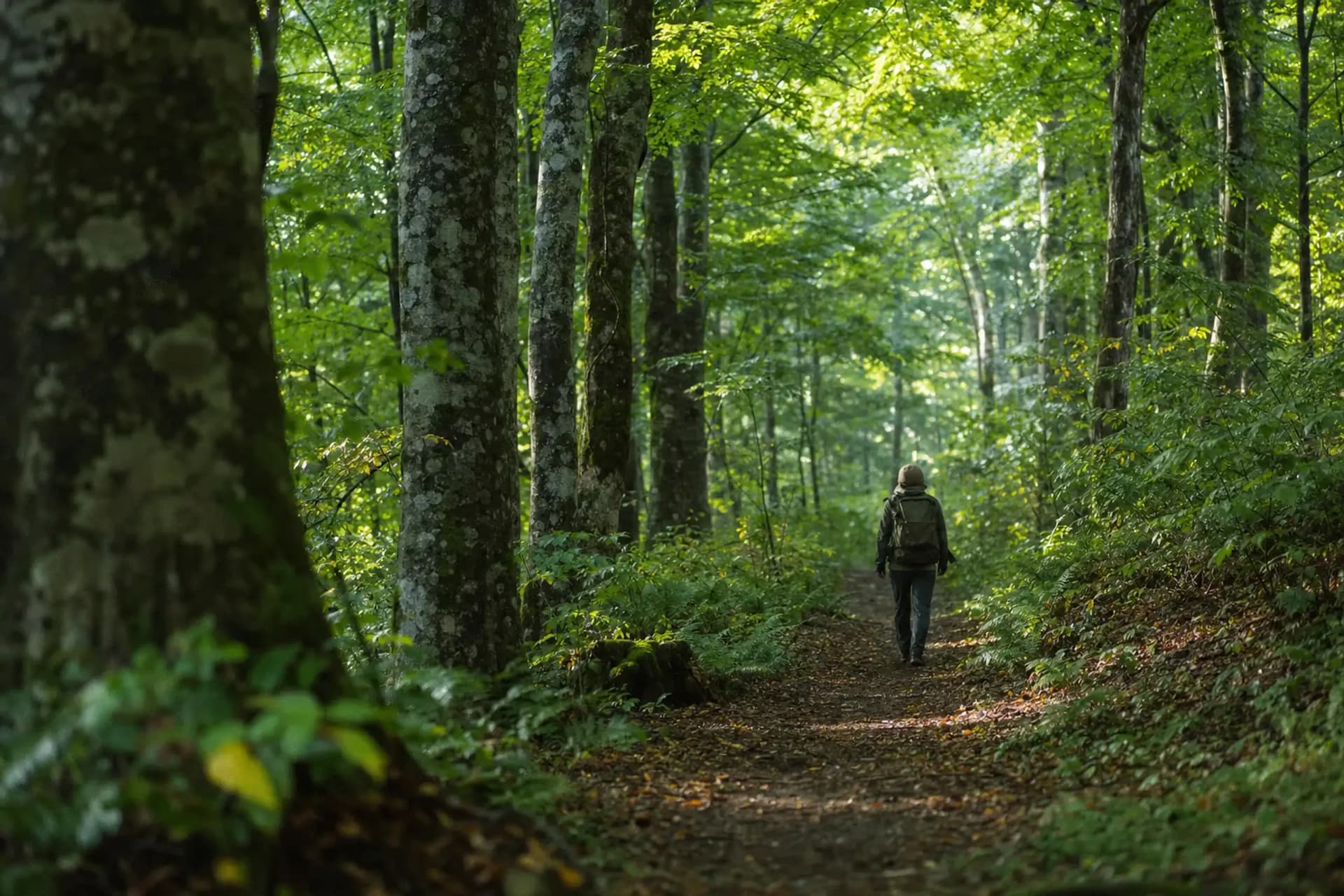
Rain moves through the beech canopy before you hear it reach the ground. First a hush, then a steady drip from one broad leaf to the next, the whole forest ticking quietly as water finds its way down. Fagus crenata holds the hillsides here, trunks pale and smooth, roots gripping ground that has held forest for a very long time. You stand on a short trail and listen. That listening is most of what Shirakami-Sanchi gives an ordinary visitor. The rest of it stays out of reach, on purpose.
Our team at Japan Royal Service plans summer visits to this UNESCO beech forest for travellers who want quiet over spectacle. This guide covers what you can honestly walk, what you cannot, and how the two prefectures — Aomori and Akita — divide the experience into separate days.
What Shirakami-Sanchi Is, And Why Most Of It Stays Unwalked
Shirakami-Sanchi holds, in UNESCO's exact words, "the largest remaining virgin beech forest in East Asia." It was inscribed in December 1993 under natural criterion ix, alongside Yakushima — among Japan's first natural World Heritage sites. The property covers roughly 16,971 hectares, straddling the border of Aomori and Akita prefectures.
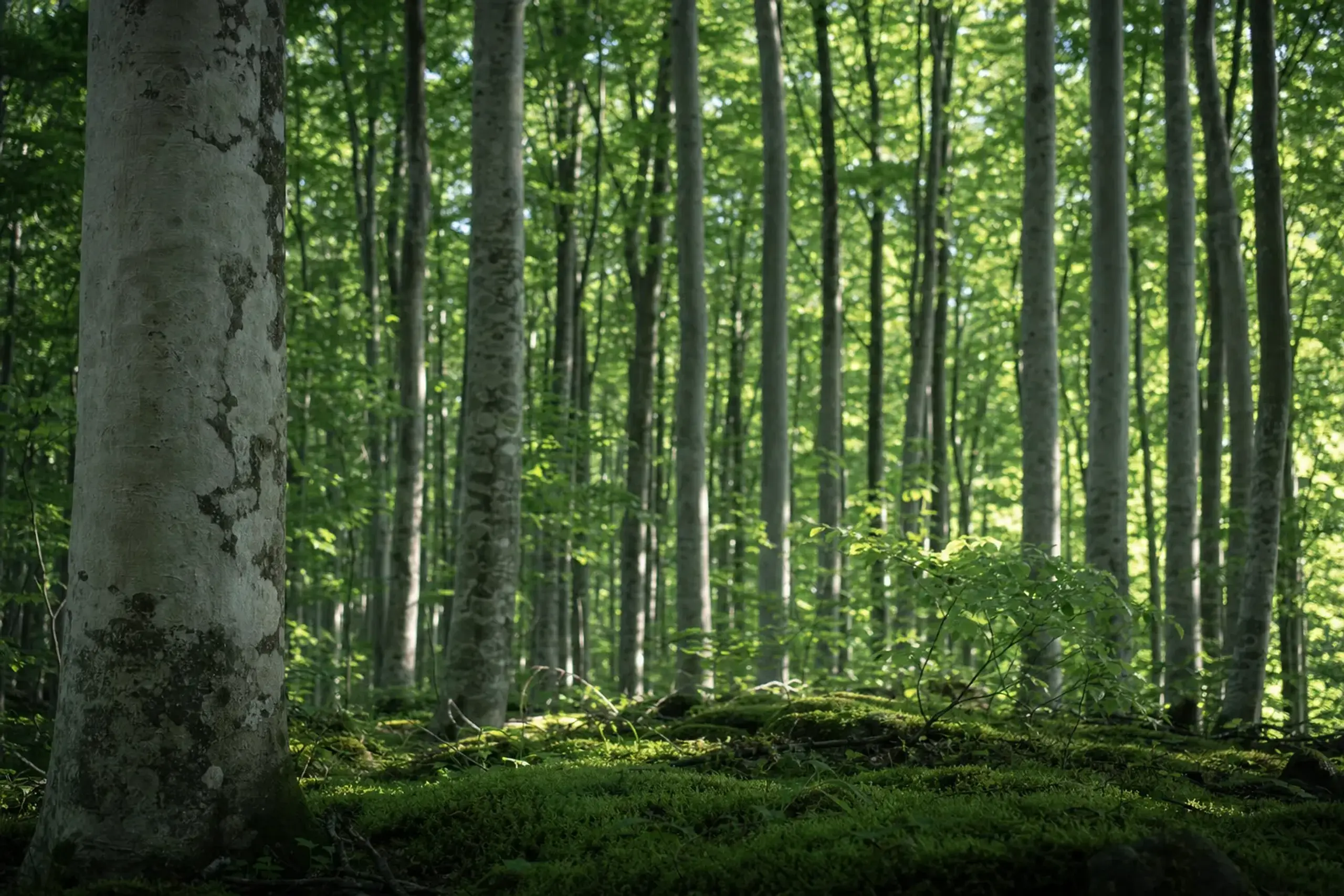
The beech here is Siebold's beech, Fagus crenata, a species found only in Japan. This forest remnant is thought to date back somewhere between 8,000 and 12,000 years. Serow pick through the understorey. The black woodpecker, kumagera, drums somewhere out of sight. Asiatic black bears live across the whole range.
The point of the place: The forest is famous because people stay out of most of it. The core zone is regulated, not promoted. That restraint is the experience, not a limit on it.
On the Aomori side, the core zone permits only existing trails plus 27 designated routes — unsigned, unmaintained, and requiring an entry procedure filed with the forest office.
The Akita side asks climbers simply not to enter. None of this is ordinary hiking. For almost every visitor, the real itinerary sits at the edges: a visitor center, a short beech trail, a gorge walk whose status follows the rain, and a blue pond near the coast. No paperwork with the forest office is needed for any of those.
The Nishimeya Side: Visitor Center, Beech Trail, Anmon Gorge
Nishimeya Village, on the Aomori side, is the usual gateway. Start at the Shirakami Visitor Center (白神山地ビジターセンター), opened in 1998 and run by the Aomori Prefectural Forestry Association Federation. Entry to the exhibition hall is free, and a 33-minute film sets the forest in context before you walk anything. Note the name carefully — this is not the Ministry's World Heritage Center Nishimeya Hall, nor the Fujisato Hall over in Akita.
The Beech Forest Trail
The Beech Forest Trail (世界遺産の径・ブナ林散策道) is the gentle introduction. It runs about one to two hours with little elevation, split into a short loop and a long loop.
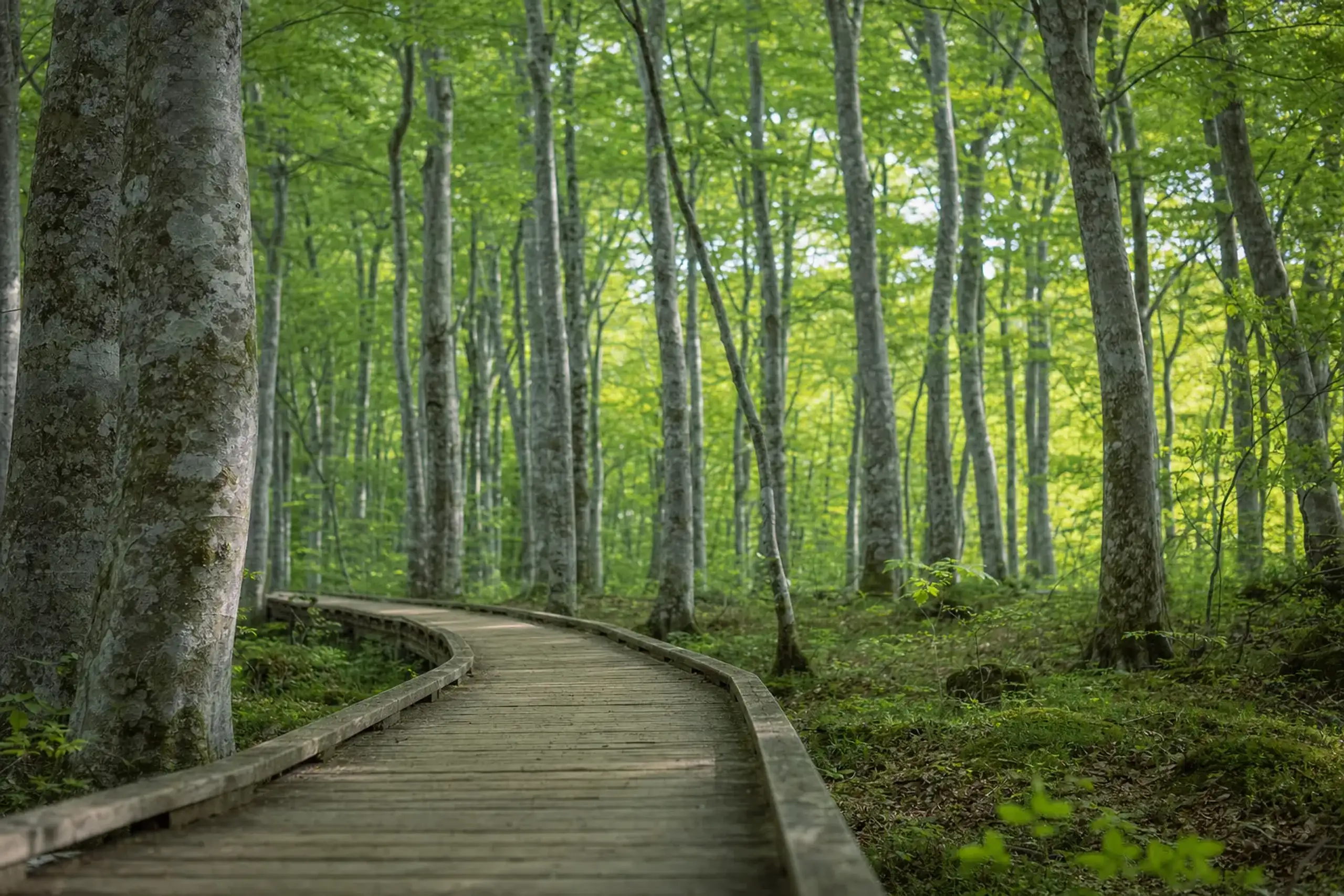
In the 2026 season, notices showed the long loop repaired after a collapse — a small reminder that even the maintained paths move with the land.
This is the walk to do slowly. Sunlight comes down filtered and green. The ground is soft. You are inside the beech forest the world protects, on a path built so you can be.
Anmon Falls And The Gorge Route
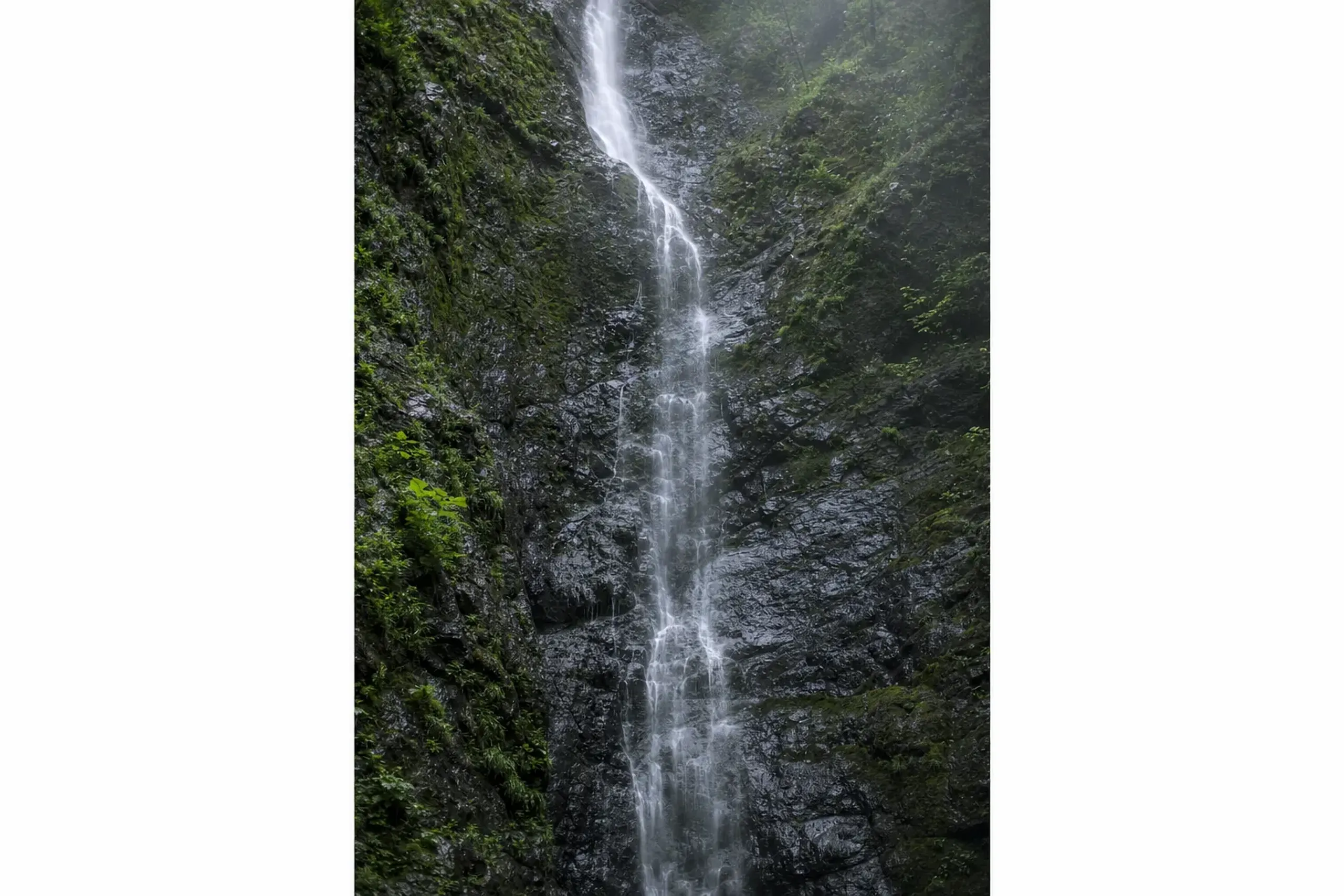
Anmon Falls is three falls, not one: 42 metres, 37 metres, and 26 metres. You reach them by the Gorge Route, an unmaintained riverside walk with stream crossings. A helmet is recommended and available to rent; rockfall and flooding are real risks. From the entrance, you meet the third fall first, then the second, then the first.
- Third fall: roughly 90 minutes round trip (approximate)
- Second fall: roughly 120 minutes round trip (approximate)
- First fall: roughly 150 to 180 minutes round trip (approximate)
Status changes with rain; the visitor center posts it. In the 2026 season, flooding closed sections on 15 and 25 August, and the third fall reopened on 5 September, with later status unverified. We never promise all three falls to a guest. Before any visit, our concierge team checks the official status page (shirakami-visitor.jp, visitor center 0172-85-2810) on the client's behalf, so the day is planned around what is actually walkable.
The Fukaura Side: Jūniko And The Blue Pond
Over on the coast, in Fukaura, the forest meets water in a different mood.
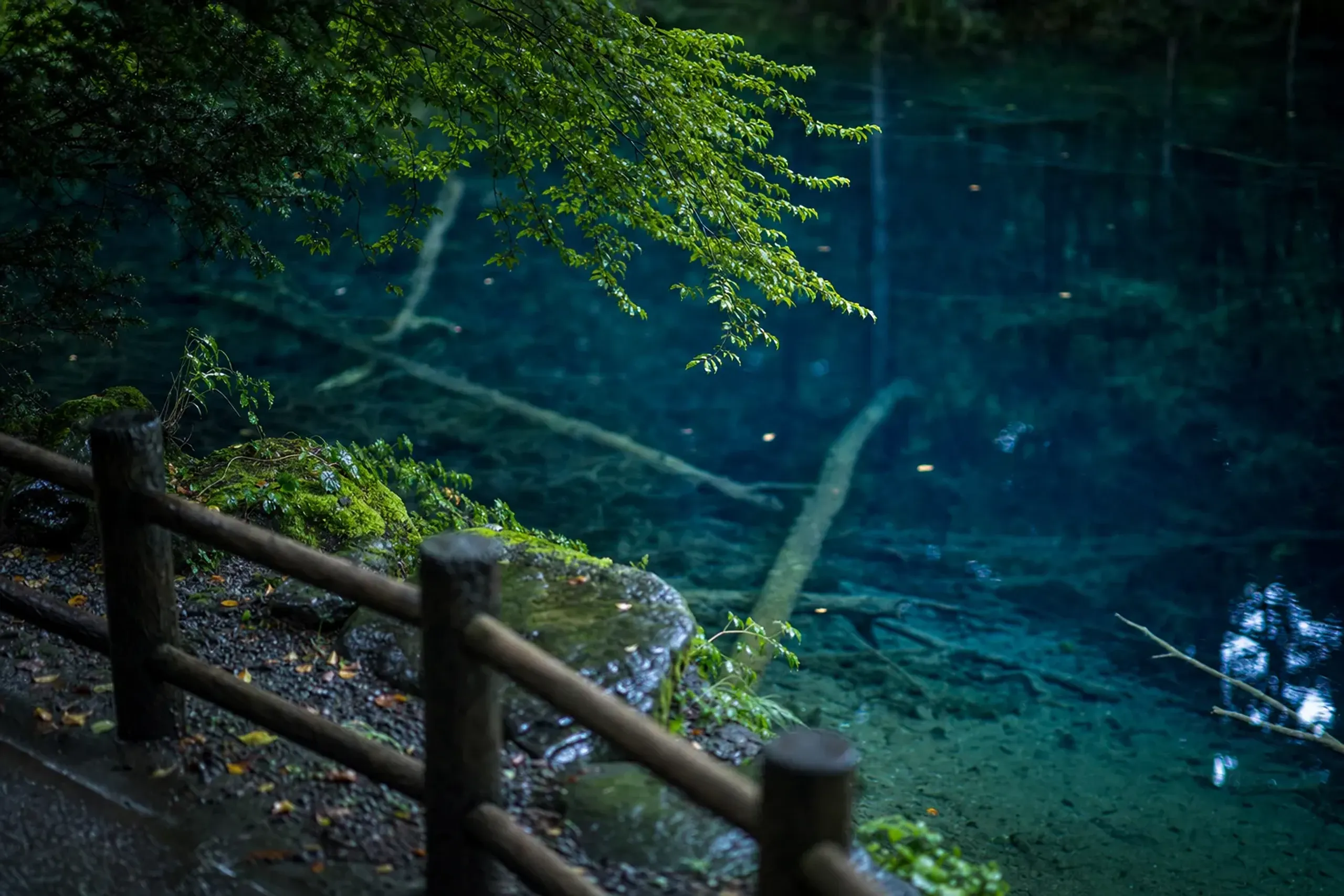
Jūniko means "twelve lakes," though the area holds 33 lakes and ponds. The name comes from the twelve large lakes visible from the Ōkuzure viewpoint. They were born of landslide: an earthquake in 1704 dammed the streams, and the water pooled into the ponds you walk among today.
Aoike, The Blue Pond
Aoike is the reason most people come. In sunlight it turns a cobalt blue so deep it looks dyed, clear enough to show sunken trees resting on the bottom. The cause of the colour has never been scientifically established. It is best seen from April to August, when the sun sits high. From the Kyororo building, Aoike is about a 10-minute walk.
The Longer Loop
If you want more than the pond, the loop through beech forest and past Wakitsubo Pond (沸壺の池) — a prefecture-designated "famous water" — runs roughly 40 to 60 minutes. The full round trip up to the Ōkuzure viewpoint takes about 3 to 4 hours. The whole Jūniko area is open April to November.
Summer: Rain, Heat, And Bears
Summer here is cooler than central and southern Japan, which is part of why it draws travellers escaping the heat of Kyoto and Tokyo. But the forest sets terms. Rain reshapes the Gorge Route without warning, which is why no serious plan treats Anmon as guaranteed.
Bears are the standing caution.
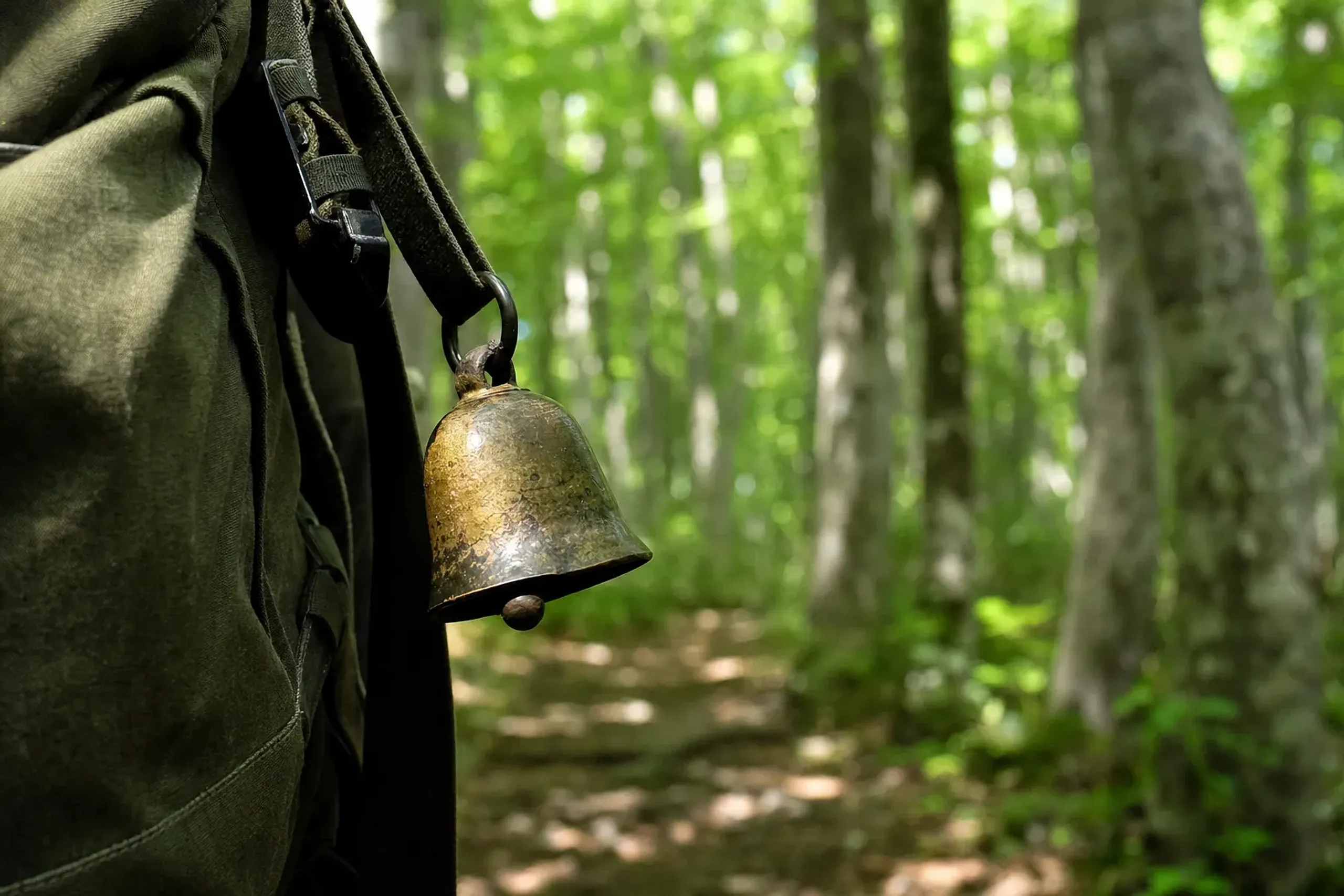
In the 2026 season, alerts ran across both prefectures — Aomori from 20 April to 30 November, Akita through 30 September and then a continuing caution. Treat it as a permanent fact of the forest, not a forecast:
- Carry a bell or talk as you walk
- Move in groups of two or more
- Avoid dawn and dusk, when bears are most active
The visitor center rents bear spray for a fee. It is not mandatory, but many guests choose to carry it.
Reaching It: A Hirosaki Base And The Resort Shirakami
We usually base guests in Hirosaki for the Nishimeya side. From Tokyo, it is about 3 hours 20 minutes to Shin-Aomori by Shinkansen, then roughly 40 minutes on the JR Ōu Line to Hirosaki. From Hirosaki, the visitor center is about 50 to 55 minutes by bus or 35 to 45 minutes by car, and Anmon sits roughly 50 to 70 minutes away by car depending on the route.
The Fukaura side is a separate world logistically. Aomori City to Jūniko is about 2 hours 40 minutes by car. The nearest airports are Aomori and, on the Akita side, Odate-Noshiro.
Plan the two sides as separate days. A prefectural notice dated 28 May 2026 still listed the Shirakami Line road between Nishimeya and Fukaura as closed by disaster, with no reopening date. Do not assume a single drive links them — confirm status first, or build two days.
For scenery, the Resort Shirakami is JR East's sightseeing train along the coastal Gonō Line, with the Sea of Japan on one side and the mountains behind.
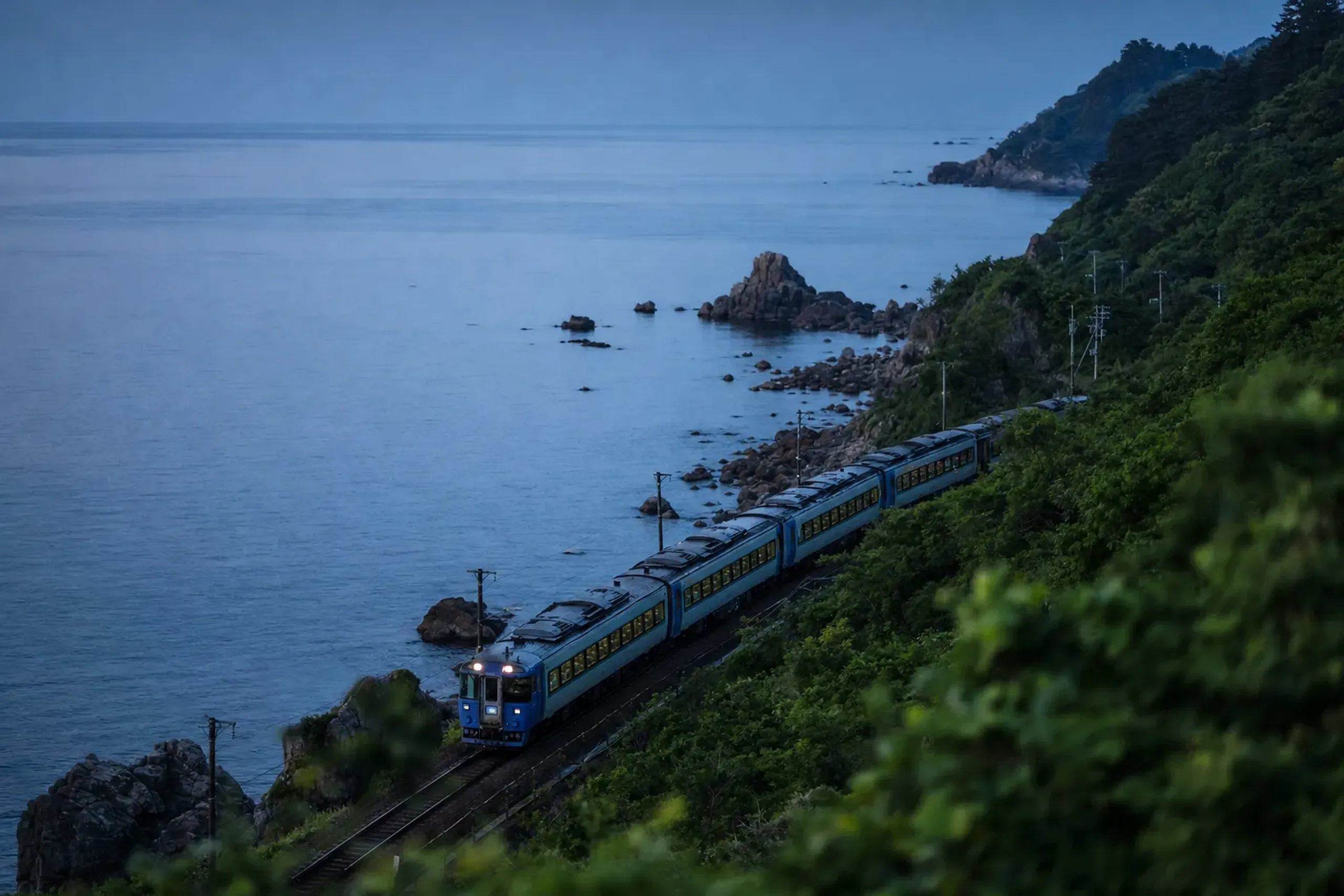
All seats are reserved and a seat charge applies; reservations open at 10:00 one month before departure. The timetable shifts year to year — in the 2026 timetable, only two of the six trains served the Hirosaki end, and which trains stop at Jūniko Station was unverified. We tell guests plainly: check before you count on it. This is the kind of reservation detail our team confirms as part of a bespoke itinerary so the rail leg actually connects to your day.
How Japan Royal Service Plans A Shirakami Summer
Our approach is honest about what the forest allows. We coordinate a cultural interpreter guide, private chauffeured transfers through our partner fleet, accommodation in Hirosaki or on the coast, meals, and the shape of each day. We do not arrange core-zone permits, special trail openings, or licensed nature-guide entry into the regulated forest — that is not ours to promise. Where a local nature guide adds real value, our concierge team checks available options on your behalf ahead of the visit.
In our experience, the planning rule that works is simple: choose one base, pick one side per day, and leave room for a closure. A morning on the beech trail, an afternoon held loosely in case Anmon is open.
A separate day for Aoike, timed for high sun. Between walks, Hirosaki's apple orchards run their harvest from early August to mid-November, and Fukaura is known for a tuna steak bowl — small pleasures we fold into the day's rhythm. For travellers building a wider Tohoku route, this pairs naturally with our seven-day Tohoku summer itinerary or a quiet morning along the Oirase Stream.
Frequently Asked Questions
Can you hike into the core zone of Shirakami-Sanchi as an ordinary visitor?
No. The core zone is regulated. On the Aomori side, only 27 designated, unsigned, unmaintained routes are allowed, and each requires an entry procedure filed with the forest office. The Akita side asks climbers not to enter.
Ordinary visiting happens at the edges — the visitor center, the Beech Forest Trail, Anmon Gorge, and Jūniko — none of which need forest-office paperwork.
Will all three Anmon Falls be open when I visit in summer?
There is no guarantee. The Gorge Route is unmaintained and its status changes with rain; the visitor center posts current conditions. In the 2026 season, flooding closed sections in late August before the third fall reopened in early September.
We check the official status page before any visit and plan the day around what is actually walkable, rather than promising all three falls.
Do I need a guide to walk the Anmon Gorge Route?
A guide is recommended rather than universally required, and one source lists a guide as required beyond the second fall.
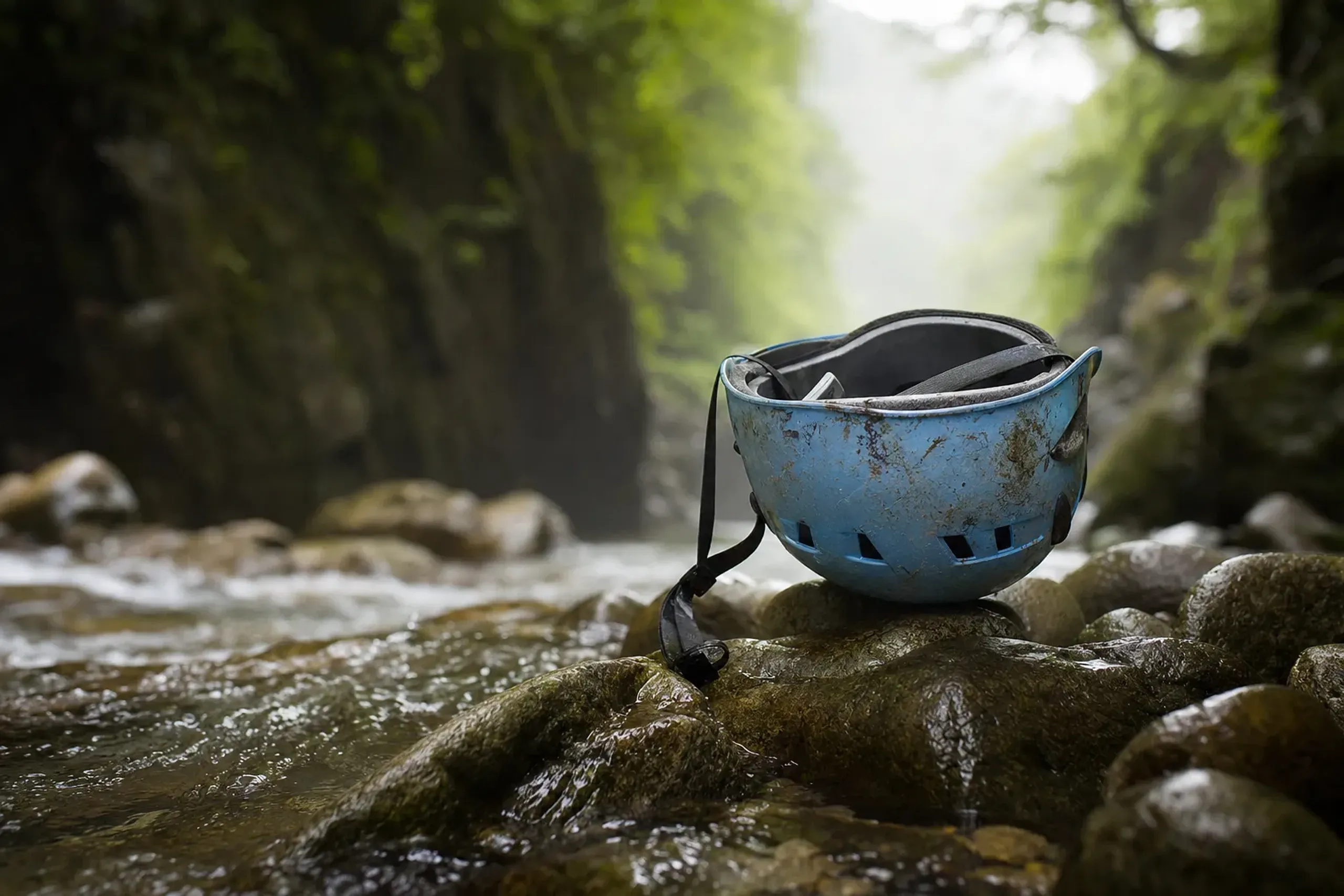
Given stream crossings, rockfall, and changeable water, many guests choose one. Helmets are recommended and available to rent.
Are bears a real concern in the Shirakami beech forest in summer?
Yes. Bear alerts covered both prefectures through the 2026 summer. Walk with a bell or voice, move in groups of two or more, and avoid dawn and dusk. The visitor center rents bear spray for a fee.
Why Choose Japan Royal Service
Shirakami rewards a planner who tells the truth. Weather closes trails, roads stay shut between seasons, and the best part of the forest is the part nobody walks. We build around all of that. Our team at Japan Royal Service designs a day that holds together even when Anmon is flooded or the Resort Shirakami timetable shifts — a quiet beech walk, a blue pond under high sun, a careful base in Hirosaki, and transfers that actually connect.
We work in English, Japanese, Thai, and Filipino, with a Tokyo-based concierge and an in-house approach to discretion. No leaked identities, no leaked itineraries. Just a forest, walked well, within the honest limits that make it worth protecting.
To plan a summer in Shirakami-Sanchi, reach our team privately via WhatsApp or LINE, or contact us here.