In this guide
- 01The name it was given
- 02The bathhouse it is attached to
- 03Yūshinden: the imperial wing
- 04What can be viewed, and what cannot
- 05First the copy, then the original
- 06Public bath, or private one
- 07How booking works
- 08What Japan Royal Service arranges
- 09What else Matsuyama reaches
- 10Frequently Asked Questions
- 11A quiet invitation
- 12Access notes
There is a bathhouse in Matsuyama built in 1899 for a single family. It has been used only a handful of times across its history. It is described in Japanese sources as the only imperial bathing facility of its kind in Japan — and, with advance reservation, you can be shown through it.
To understand why that matters, begin not with who it was built for, but with a phrase carved into a washbasin three thousand years ago.
The name it was given
Yūshinden takes its name from the Daxue, the Confucian classic: “If you can renew yourself for a day, renew yourself daily, and keep renewing.” The line is said to have been carved by King Tang of Shang on the basin in which he washed each morning, so that the discipline of renewal met him at the start of every day, water in hand.
Consider what that name is doing. A bathhouse dedicated to daily renewal, built beside a spring said to be three thousand years old, at the oldest hot spring in Japan. The idea outlasts any question of who bathed there. It is the frame for everything that follows — and it is a quieter, truer thing than any list of guests could ever be.
The bathhouse it is attached to
Come to Dōgo at dawn, before the town wakes, and the Honkan stands three storeys of dark timber against a pale sky, the Shinrokaku drum tower crowned by its white heron figure catching the first light. Steam lifts from vents in the roofline. This is the building of 1894 that made the town famous, and it is a working public bath still doing the job it was built for — not a museum with the water turned off.
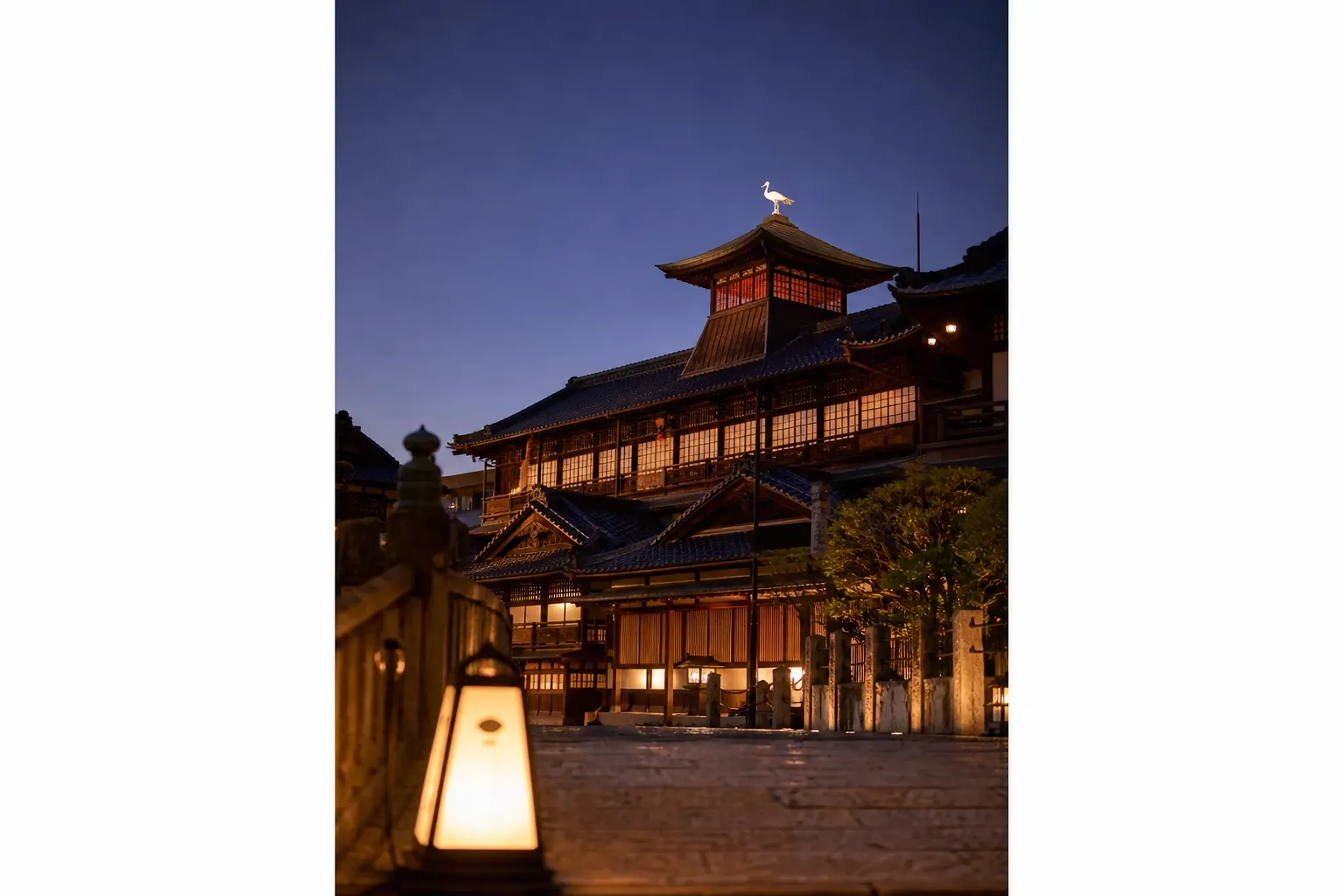
Dōgo Onsen claims roughly three thousand years of history and is commonly called Japan’s oldest hot spring. The spring itself is old beyond records — it appears in the eighth-century chronicles and in the Man’yōshū poetry anthology, which puts documented use at something over a thousand years and legendary use considerably further back. Natsume Sōseki taught school here and set the bathhouse in his novel Botchan, and the Bocchan-no-Ma commemorates that connection — which is why every Japanese schoolchild knows the name of a town most foreign visitors have never heard of.
In December 1994 the Honkan was designated an Important Cultural Property, the first public bathhouse in Japan to be so honoured. Then, from January 2019, it entered a six-year programme of preservation and repair — the building operating in part throughout, so the water never quite stopped. That work completed on 20 December 2024, and the Honkan is now fully open. A building named, through its imperial wing, for the discipline of renewal, having just completed six years of literal renewal: the coincidence is worth pausing on.
The water
Inside are two bathrooms, Kami-no-Yu and Tama-no-Yu, offering six bathing courses between them. The water is an alkaline simple spring, and here lies a quiet technical achievement most bathers never notice. It is drawn from multiple sources at temperatures ranging from 20 to 55°C, then blended by season and by hour to arrive at roughly 42°C in the bath. No heating. No water added. This is genuine kakenagashi — free-flowing spring water — brought to bathing temperature by the judgement of those who blend it, reading the season and the time of day the way a chef reads shun. It is an unusual claim, and a checkable one.
Yūshinden: the imperial wing
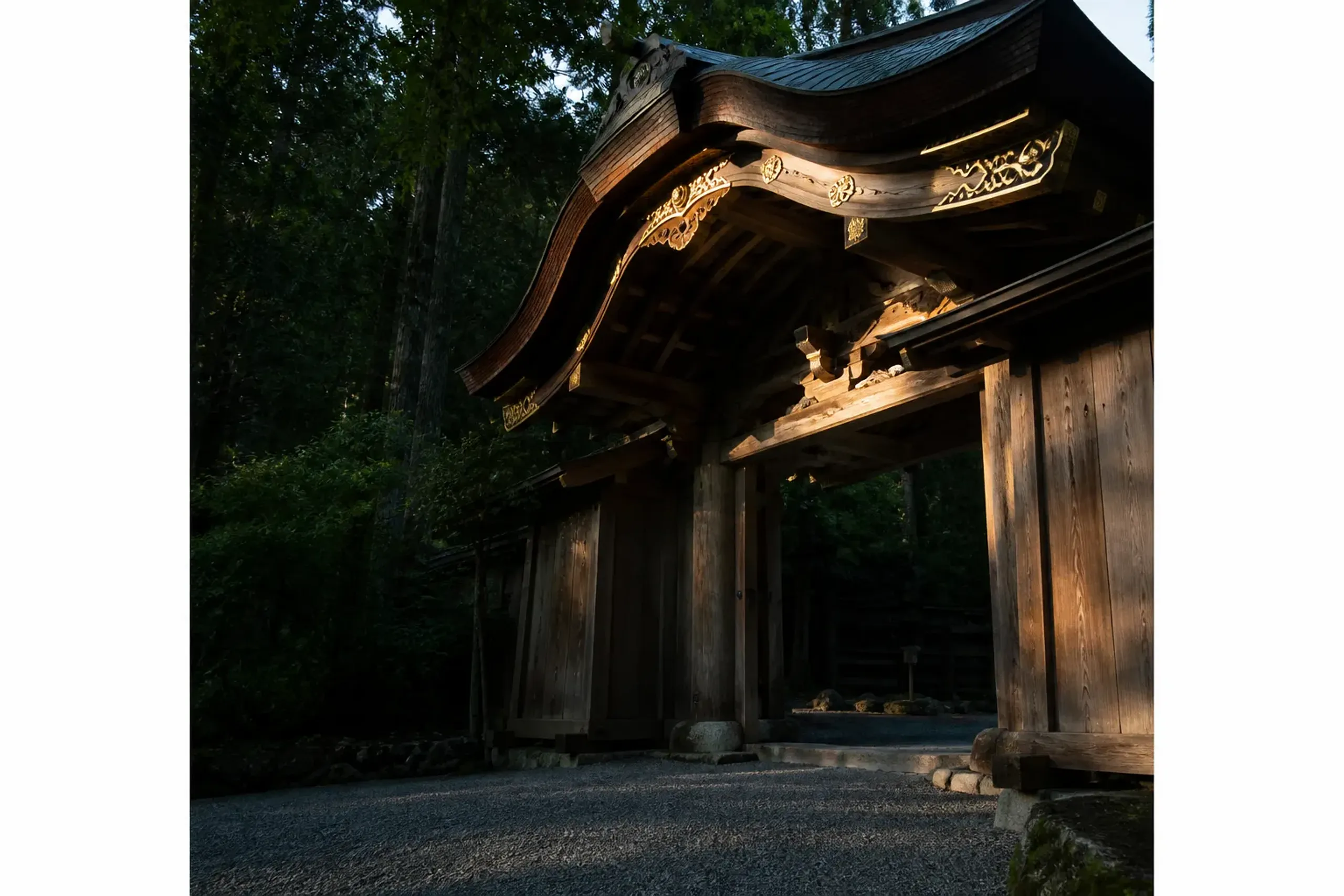
When the town rebuilt its bathhouse at the close of the nineteenth century, it added, in 1899, a separate wing for the imperial family. Yūshinden is that wing, and it was built to a standard a municipal bathhouse had no business reaching.
The builders, Isaniwa Yukiya and Sakamoto Matahachirō, raised a three-storey timber structure of knot-free domestic wood, selected the way a shrine’s timbers are selected. It comprises an antechamber, an imperial sitting room, the throne room, and a musha-kakushi — a concealed space from which guards could watch unseen. The throne room is worked in gold leaf with the phoenix, the chrysanthemum and the paulownia, the emblems of the imperial house. The bath itself is cut from Aji stone, quarried in neighbouring Kagawa — the same exceptional granite we write about in our post on Kagawa stone and lacquer, and the connection here is material rather than decorative.
Because the room was used so rarely, nothing in it is worn. The wood has not been rubbed smooth by a century of shoulders. It is a room preserved by disuse — restraint of a kind money cannot buy, only time. Public viewing resumed in January 2022 after roughly three years’ closure, following the first major restoration in more than 120 years.
What can be viewed, and what cannot
A guest will always ask the obvious question: can I bathe in it? The honest answer is no. Yūshinden is viewed, never used. Viewing is a ticketed public arrangement, open to anyone who reserves a place, given in timed slots with limited numbers. It is free to guests on qualifying bathing courses and a modest fee for those viewing only; fees and slot arrangements should be confirmed at the time of booking. The tour is conducted in Japanese, so an interpreter is not optional if you want the room read to you rather than simply walked through.
We say this plainly because it is better to answer the question than to leave it hanging: Japan Royal Service arranges the reservation, the guiding and the surrounding stay. Nothing beyond the public viewing route. What we can offer instead of the impossible is genuinely better.
First the copy, then the original
Nobody bathes in Yūshinden. So the town did the next best thing. At Asuka-no-Yu, the annexe opened in 2017 a few minutes’ walk away, a special bath recreates the imperial one. Here guests bathe wearing a yukatabira — the garment that preceded the yukata — in the manner of the ancient nobility. The rooms sit away from the communal baths, each with its own relaxation room, taken privately: your party and nobody else.
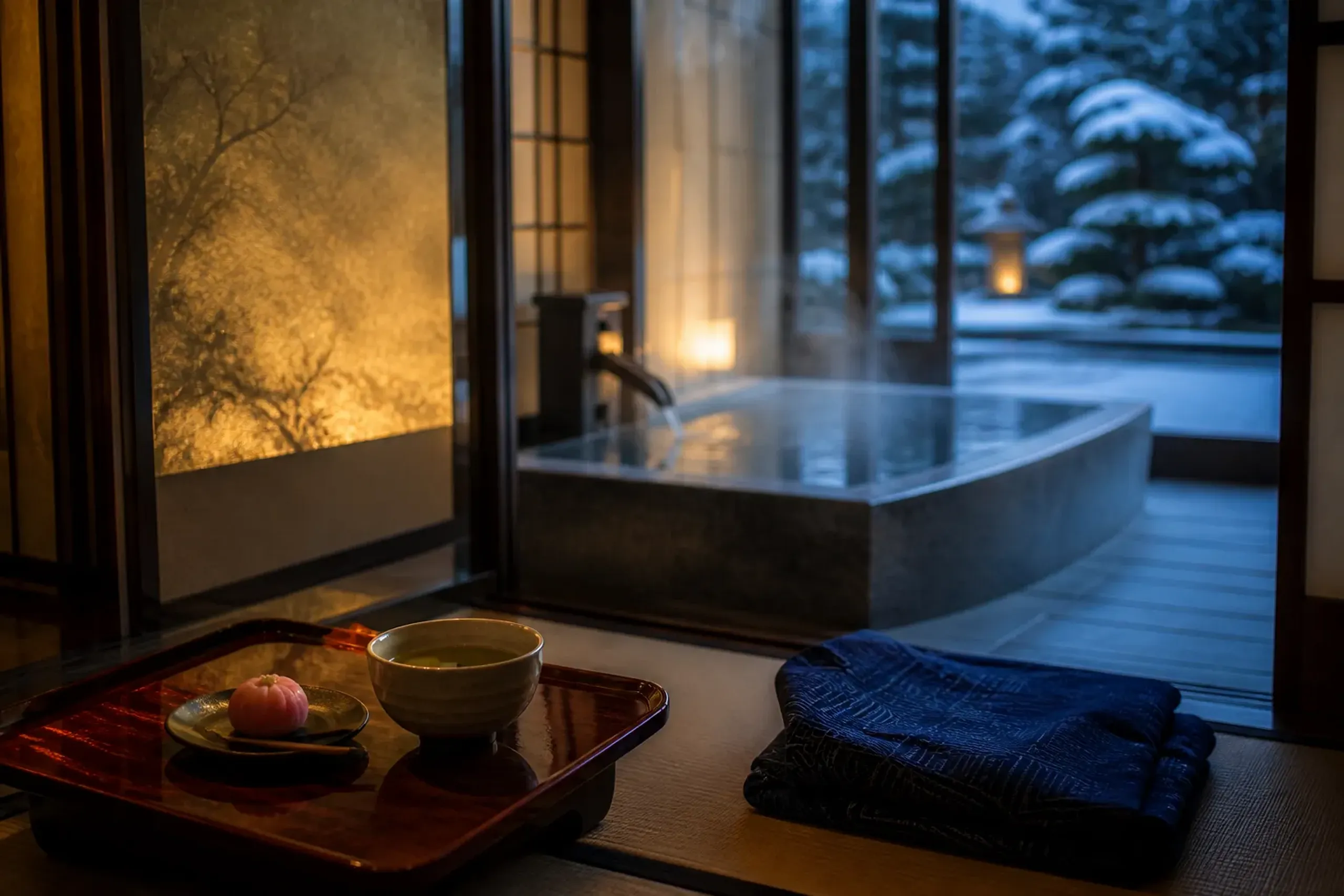
You can actually enter the water. That is the whole difference. Washi, screens and gold leaf around you; the room a careful reading of the one the imperial household used; and afterwards yukata, tea and a sweet in a space that is yours for the duration.
Then you walk to the Honkan and are shown the original.
That sequence is deliberate. See Yūshinden first and it remains a beautiful room behind a rope. Bathe in its recreation first, then stand before the thing it was copied from, and it becomes something you carry as a physical memory. The excursion is one sentence long: experience the tradition, then step inside the original.
Public bath, or private one
The Honkan is a working public bath, and it is busy — full of people from the town, which is precisely the point of it. Some guests want exactly that, and should have it.
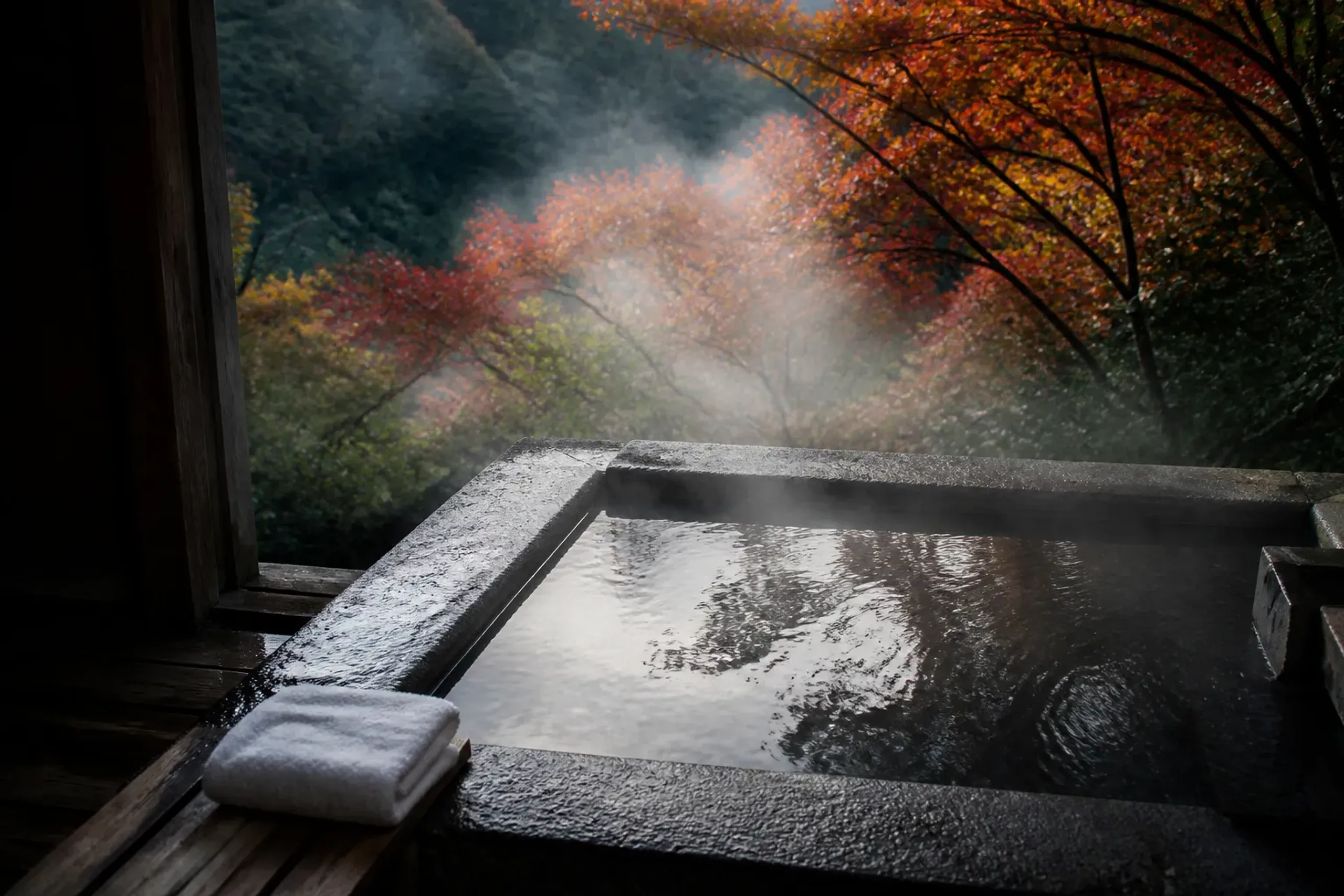
Others would rather not undress in company, and for them the answer is not a grander public bath but a private one: the special rooms at Asuka-no-Yu above, or, for a longer afternoon, a ryokan inland from the town whose rooms have their own open-air baths and whose larger baths can be reserved so that nobody else is in the water.
How booking works
This is the practical part, and it is genuinely useful. The Honkan does not generally take reservations. Guests buy a ticket at the fudaba on arrival and are seen in order; where there is a wait, a call-back ticket system operates, and current waiting times are shown on the official website. Almost everything here is walk-in.
Two things are not, and those are the two worth planning. The exceptions requiring advance reservation are the two private rooms added on the third floor in 2024 — Shirasagi-no-Ma and Hishō-no-Ma, near the Shinrokaku drum tower — and the Yūshinden viewing. Both open 90 days ahead online, with same-day booking by telephone. That 90-day window is the single practical constraint on the day; everything else can be decided on arrival.
Bathing hours vary by course. The ground-floor Kami-no-Yu runs latest, to 23:00, with last tickets at 22:30; the third-floor private rooms close earlier in the evening. Plan around that pattern rather than the full timetable, which changes.
What Japan Royal Service arranges
We handle the ryokan accommodation, the guiding, the private bathing arrangements, and the Yūshinden viewing reservation. The Yūshinden tour we accompany with an interpreter, because it is given in Japanese and the whole interest of the room is in what is being pointed at. The private hour at Asuka-no-Yu, timed to suit your day. And, when the timing allows, the third-floor private rooms of the Honkan — where you sit on tatami in yukata with tea and a sweet, inside the historic building rather than in the shared hall below, looking up at Shinrokaku with its white heron on the roof.
The whole day can be built into a tailor-made itinerary, moved between Dōgo, the annexe and the ryokan by private car and chauffeur, with an honest recommendation about which of these is worth your time given how the rest of your visit is shaped. Nothing beyond the public viewing route at Yūshinden; everything else, arranged around it.
What else Matsuyama reaches
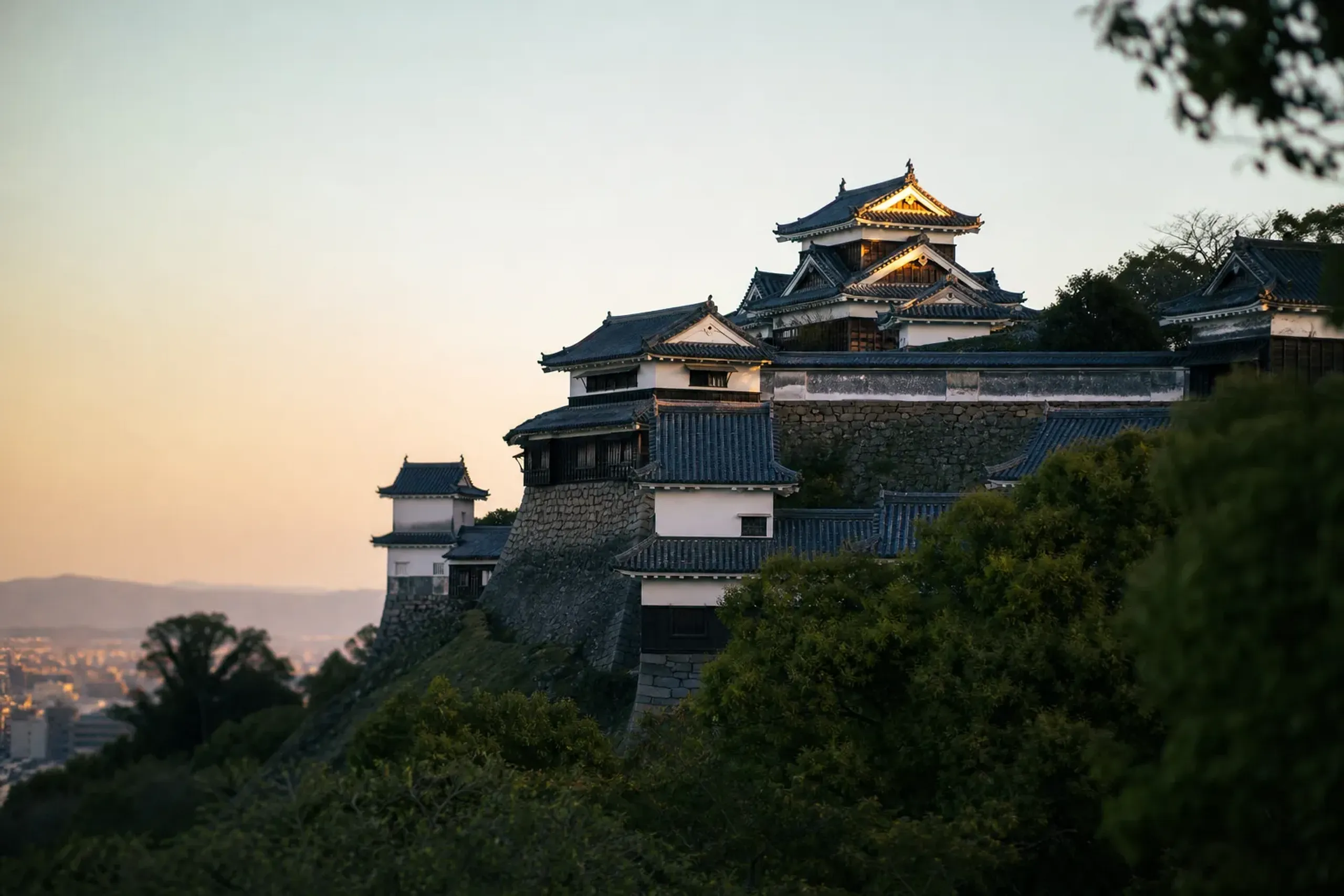
Matsuyama Castle stands on the hill in the middle of the city — one of the twelve original keeps in Japan never destroyed and never rebuilt, reached by ropeway. And an hour inland is the castle you can sleep in, the strongest single thing this region reaches, which belongs to its own page.
Frequently Asked Questions
Can Yūshinden actually be visited?
Yes — by advance reservation, in timed slots with limited numbers. Viewing is a public arrangement open to anyone who books it. The tour is given in Japanese, so an interpreter is not optional if you want the room explained rather than simply walked through.
How far is Dōgo from central Matsuyama?
The town itself is close to central Matsuyama. The ryokan in the hills behind it are roughly forty-five minutes to an hour away.
Can you actually bathe in the imperial bath?
Not in the original — Yūshinden is preserved and shown, never used. But a special bath at Asuka-no-Yu, the annexe nearby, recreates it, and there you bathe privately, wearing a yukatabira in the manner of the old nobility. The sequence we build is the recreation first, then the original.
Do you need to reserve anything in advance?
Only two things: the Yūshinden viewing and the Honkan’s two 2024 third-floor private rooms, which open 90 days ahead. The main baths are walk-in.
A quiet invitation
A bathhouse named for the discipline of renewal, at a spring three thousand years old, with an imperial wing you may be shown through and its recreation you may bathe in. We arrange the reservation, the guiding and the stay around it — discreetly, in Japanese, with the people who hold these places. To begin planning, contact us here.
Access notes
We asked these questions of each place directly, and the answers are specific to it. Most guests will have no use for them; they are here because somebody will.
The Honkan is an 1894 wooden building with stairs, thresholds and wet stone floors, and it does not adapt. The alternative is not a grander public bath but a private one: rooms with their own open-air baths, and larger baths reservable so that nobody else is in the water, in the hills behind the town.