In this guide
- 01The Myth That Still Shapes Takachiho’s Nights
- 02What Is Takachiho Gorge, And Why Does It Look So Unusual?
- 03How Do Takachiho Gorge Boat Rentals Work In 2026–2027?
- 04Amano Iwato Shrine: Seeing The Cave Without Treating It As A Sight
- 05What Is Amano Yasukawara, And How Long Should You Spend There?
- 06Takachiho Shrine And The Nightly Kagura: A True Excerpt, Not The Whole Cycle
- 07What Is The Full Yokagura Season In Takachiho, And Is It Worth Planning Around?
- 08Etiquette And Restrictions That Matter In Takachiho’s Sacred Sites
- 09What A Well-Paced Day In Takachiho Actually Looks Like
- 10How Far Is Takachiho, Really? Honest Travel Planning From Kyushu Gateways
- 11Season Notes: When Takachiho’s Ritual Calendar Becomes The Itinerary
- 12Practical Notes For A Calm Visit: Crowds, Weather, And Backups
- 13How To Place Takachiho Inside A Tailor-Made Kyushu Itinerary
- 14Frequently Asked Questions
- 15Why Choose Japan Royal Service
You can visit Takachiho as scenery with a story attached. Many people do. It works, right up until it doesn’t. Because here, the story is not decoration.
Takachiho is where Japan’s earliest chronicles place the descent of Ninigi-no-Mikoto, and where the sun goddess Amaterasu is said to have withdrawn into a sealed cave. The cave remains closed. The dance that called her back is still performed at night.
This is not a theme. It is practice.
The Myth That Still Shapes Takachiho’s Nights
In the Kojiki and Nihon Shoki, Takachiho is tied to two linked moments: the world’s darkness, and the return of light. First comes rupture. Amaterasu, grieved and angered by her brother Susanoo’s rampage, hides herself in the cave called Amano-Iwato.
The result is simple and brutal. Darkness falls over the world. Crops fail. Disorder spreads.
The assembled deities gather to respond, not with force but with choreography and wit. Ame-no-Uzume performs a dance that draws laughter, commotion, and curiosity. Amaterasu opens the cave. Light returns.
Takachiho’s second mythic anchor follows. Ninigi-no-Mikoto, grandson of Amaterasu, descends from the heavens here to rule the earth, establishing the mythological origin point of Japan’s imperial lineage.
For a visitor, it is tempting to treat this as a good tale told in a beautiful valley. In our experience, Takachiho makes more sense when you reverse that order. The valley is beautiful because it has been held as a setting for meaning, over a very long time.
What Is Takachiho Gorge, And Why Does It Look So Unusual?
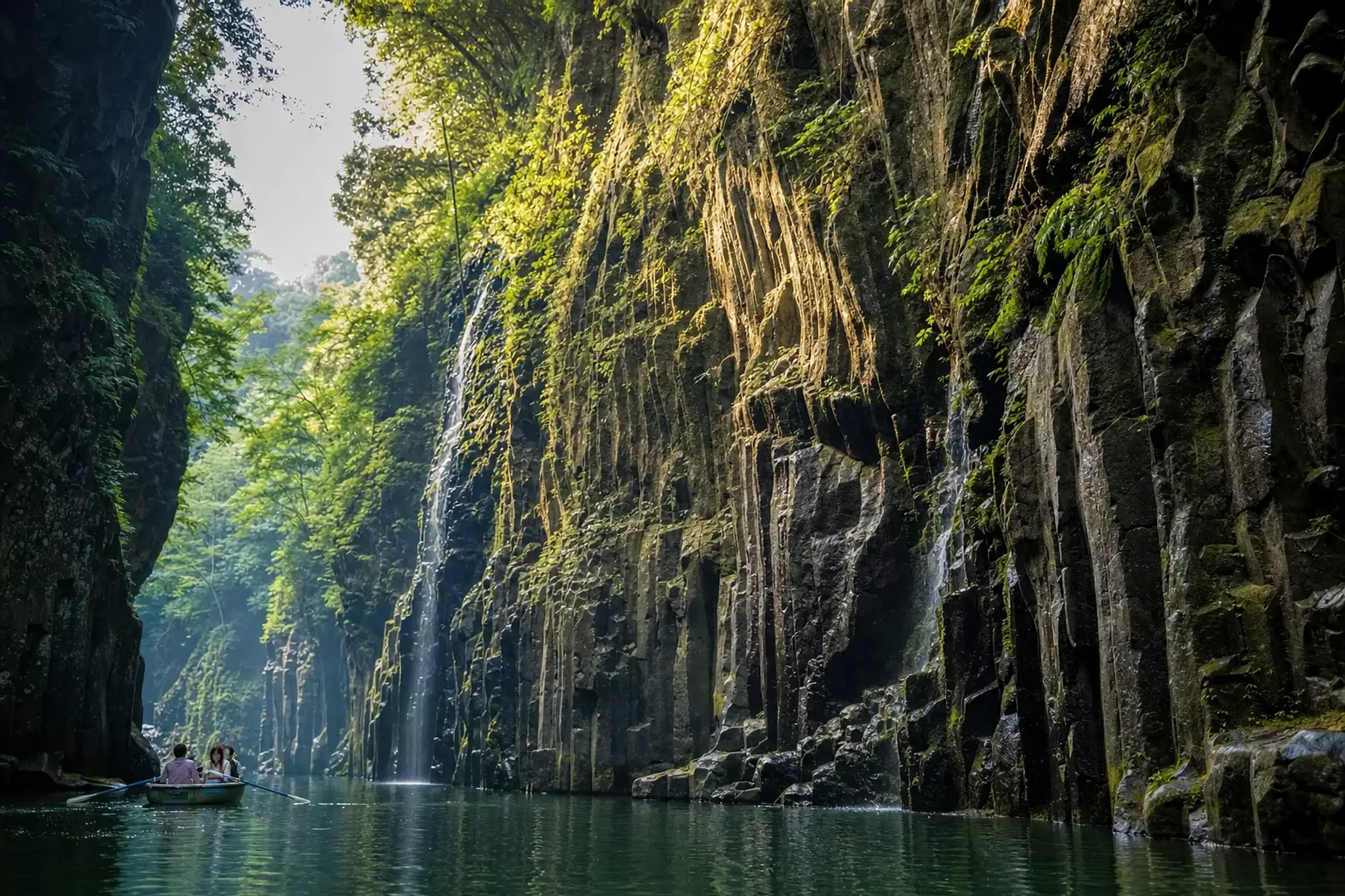
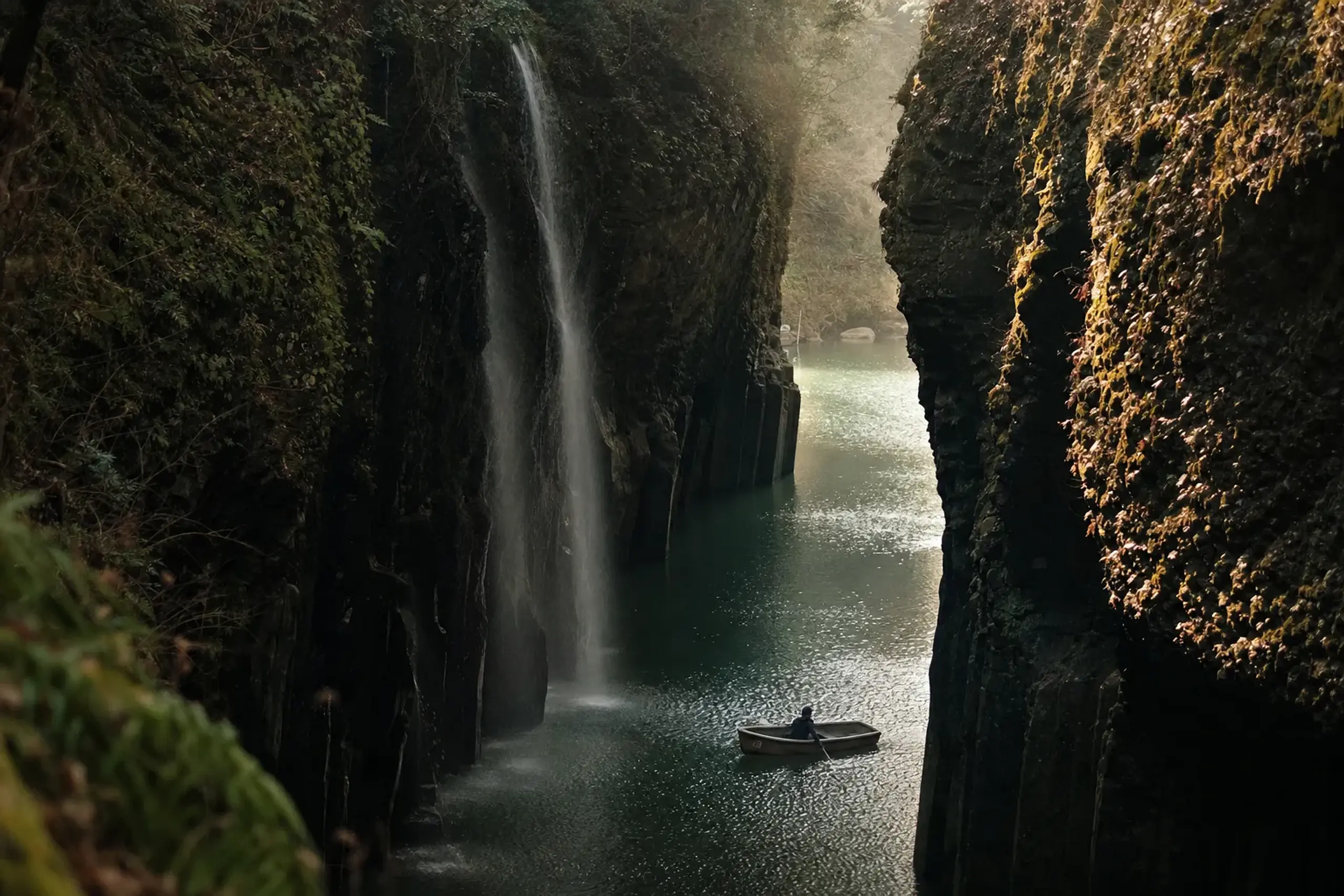
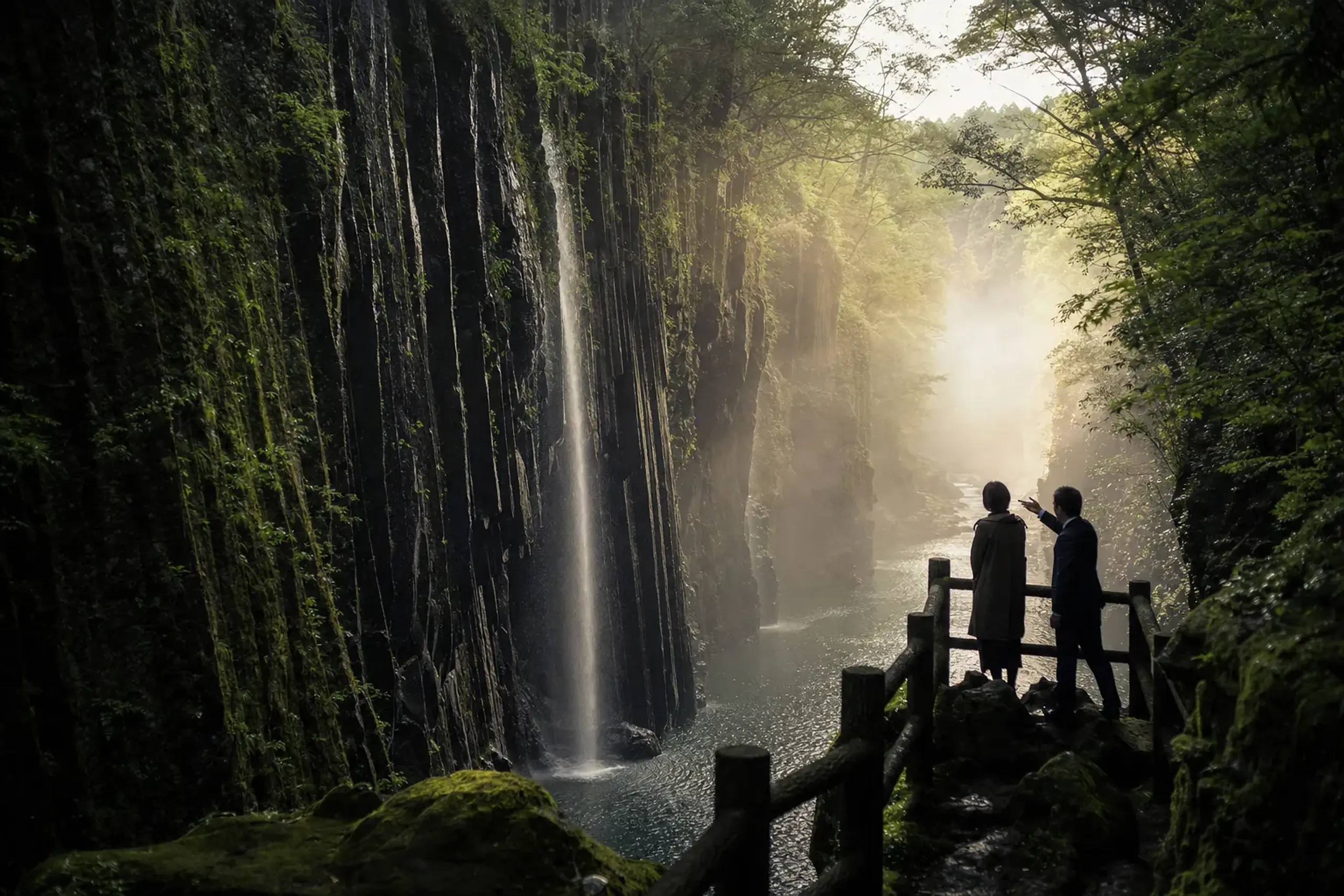
Takachiho Gorge is a columnar basalt canyon formed by pyroclastic flow roughly 120,000 years ago, later carved by the Gokase River into cliffs about 80–100 meters deep.
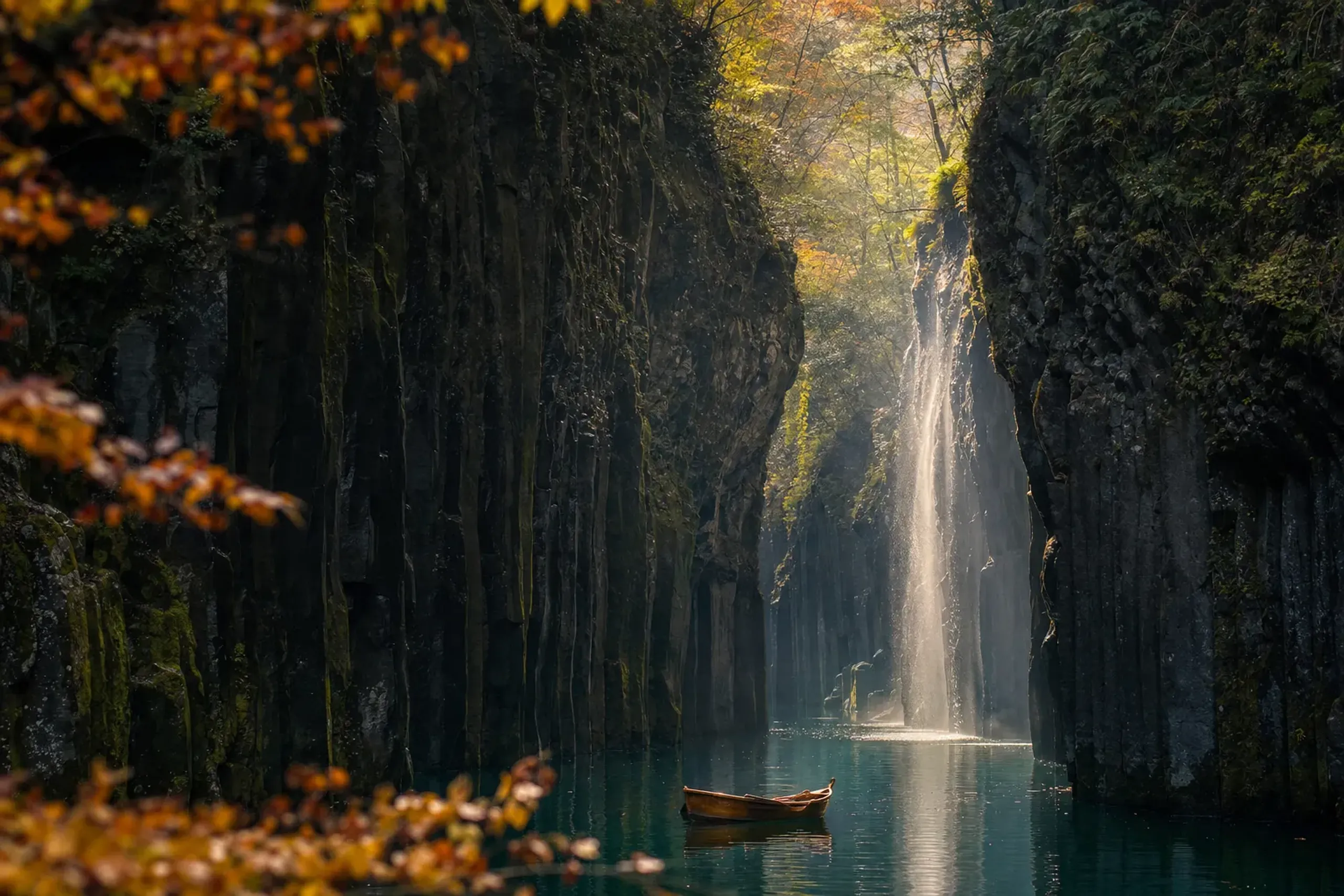
That single sentence explains the geometry your eyes will keep returning to. Basalt that cools in place can crack into vertical columns, creating a tight, ribbed wall that reads as both natural and strangely architectural. In daylight, the cliff face can look almost planed, like it was cut with a blade.
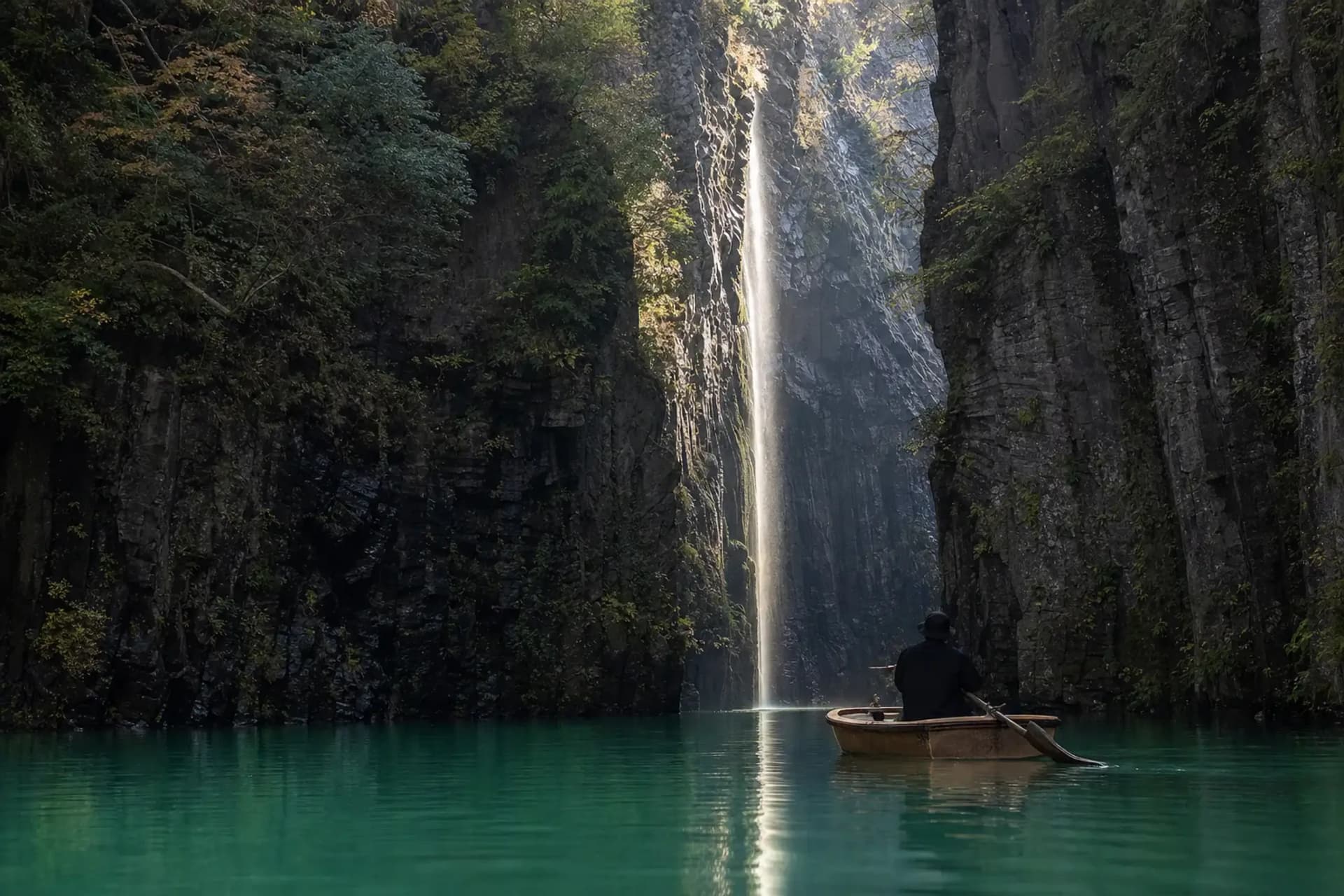
Manai Falls drops about 17 meters into the gorge. The water lands in a pocket of green-blue that shifts with weather and season. Mist hangs low on humid mornings. On quiet days, you hear oars before you see boats.
The gorge’s main pleasure is scale at close range. Not a distant viewpoint. Water-level intimacy.
How Do Takachiho Gorge Boat Rentals Work In 2026–2027?
Takachiho Gorge boat operations are controlled by the official Takachiho Town Tourism Association, with daily status updates around 8:00 and advance reservations accepted online only within the published window.
This matters because many visitors arrive assuming they can phone ahead or “sort it out on the day.” The official rule is clear: phone reservations are not accepted. Same-day tickets, when offered, are sold at the boat reception on the morning of the visit, subject to availability.
If you are planning around a tight schedule, that uncertainty is the real friction point. A high-end Takachiho day is not about rushing. It is about having a plan that stays calm even when the gorge is busy or conditions change.
Key fact: The official boat page publishes the operating status and the reservation rules; it is the primary authority for what runs today, not what “usually” runs.
Our concierge team plans Takachiho with two tracks: the ideal track (boat at water level) and a dignified alternative (gorge promenade plus a different time anchor), so the day still feels whole if the boats are unavailable.
Amano Iwato Shrine: Seeing The Cave Without Treating It As A Sight
Amano Iwato Shrine (Amano Iwato-jinja) is dedicated to Amaterasu and is associated with the myth of her hiding in the cave. The cave itself is the shrine’s sacred object (goshintai). It is not a place to enter.
Visitors view the cave only from a designated platform across the river, on a guided visit led by a Shinto priest. The guidance is described by official sources as being provided in Japanese. It is a small but important detail, because it sets expectations about pace, tone, and what questions can be asked in the moment.
Photography of the sacred cave is prohibited. No exceptions are implied. Please do not test the boundary; it changes the atmosphere for everyone, and it misunderstands what a goshintai is.
When you approach this site with restraint, Takachiho’s character sharpens. This is wabi-sabi in practice: a deliberate limit that creates depth. You do not consume the object. You acknowledge it.
What Is Amano Yasukawara, And How Long Should You Spend There?
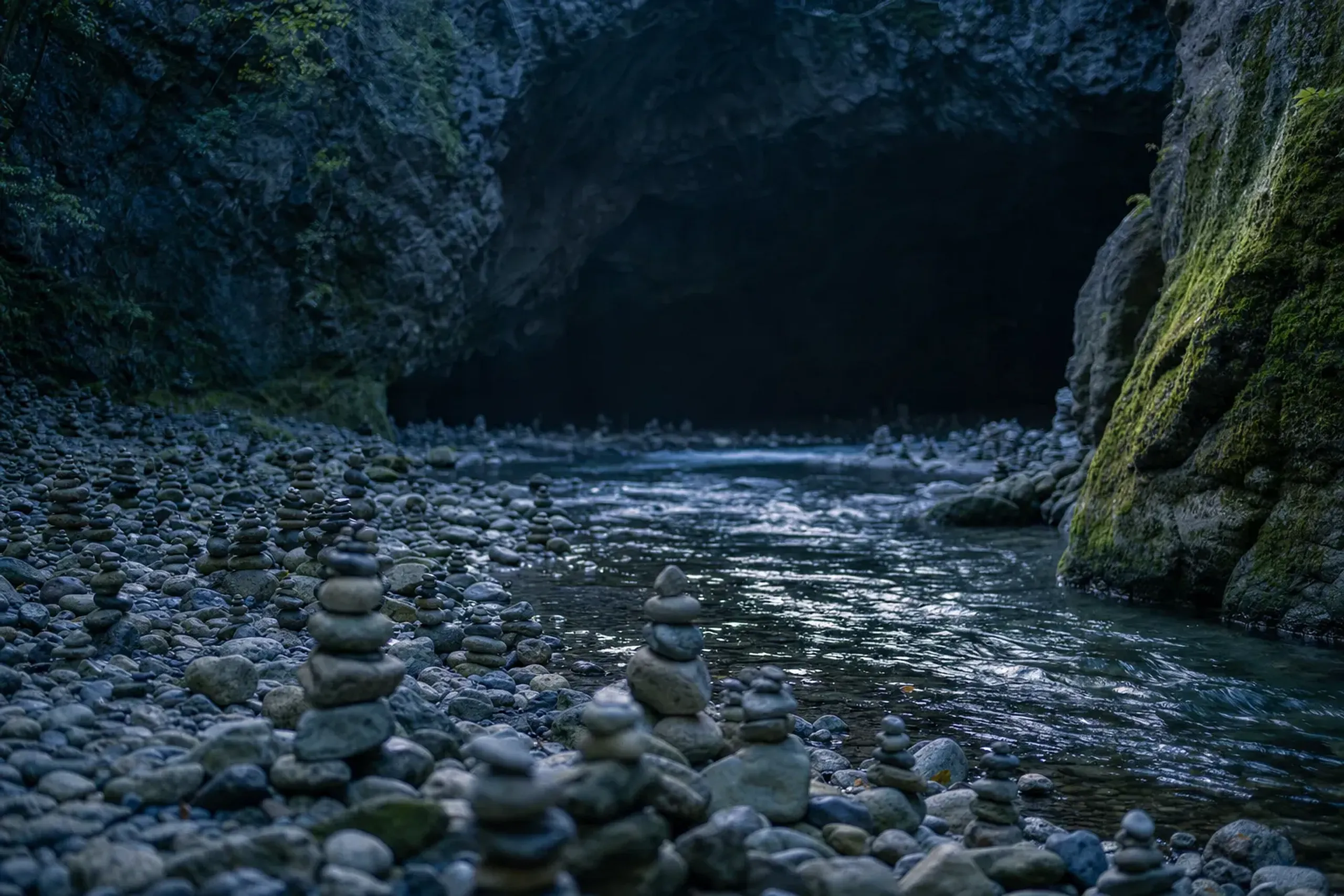
Amano Yasukawara is the riverside place where, by legend, the assembled gods convened to decide how to lure Amaterasu from the cave, and most visitors spend about 30–60 minutes including the walk.
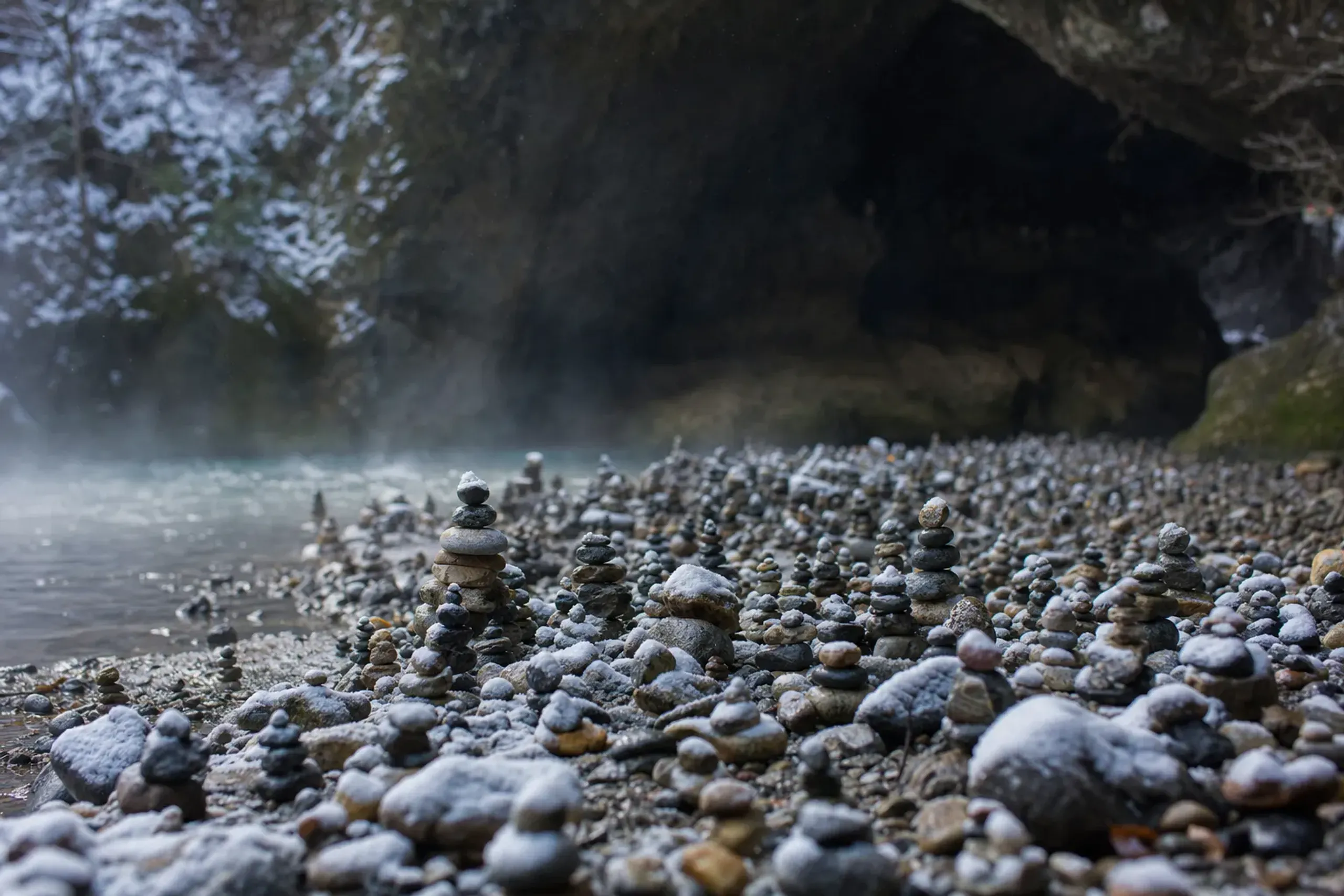
The walk follows the same river system that frames the cave viewing. The space is simple. That is the point. You are not meant to be entertained.
Often you will see stacked stones left by visitors. The practice is common, but the mood of the place still leans toward quiet concentration rather than spectacle. Slow down. Let other groups move on.
If you are traveling as a couple or a small family, this is a natural place to reset before the evening. A short pause. A longer breath.
Takachiho Shrine And The Nightly Kagura: A True Excerpt, Not The Whole Cycle
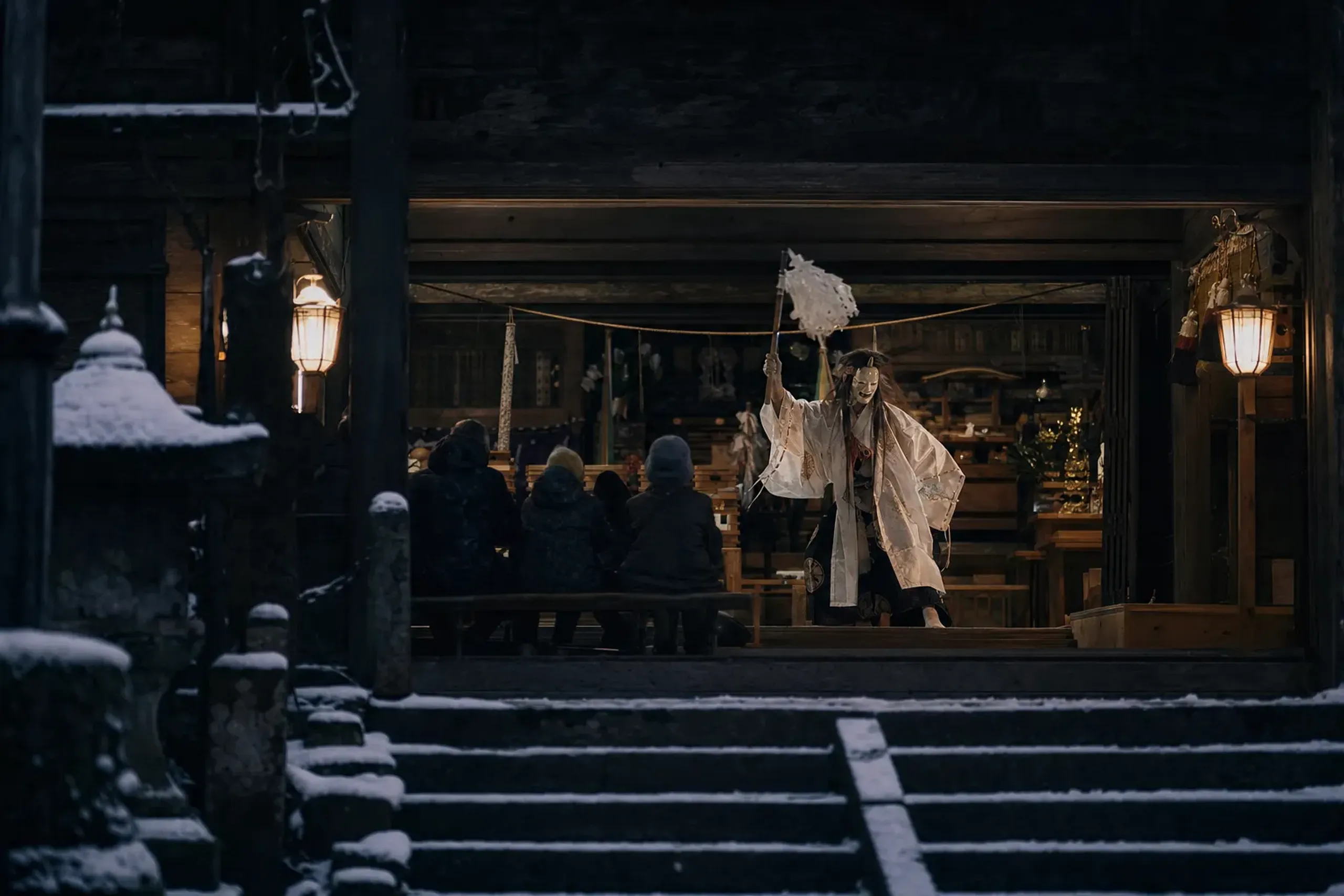
Takachiho Shrine hosts a nightly abbreviated kagura performance year-round, presenting four excerpts from the full 33-dance Yokagura cycle.
There is a reason this matters for a luxury traveler. You are not being sold a “show.” You are being offered a respectful entry point, in a controlled setting, into a tradition that can otherwise be difficult to access without context.
The official Takachiho tourist map describes the nightly program as four dances drawn from the 33 Yokagura dances. Names are published there, but what you should carry into the evening is simpler: this is a curated fragment designed to be shareable without emptying the ritual of meaning.
Expect a small hall.
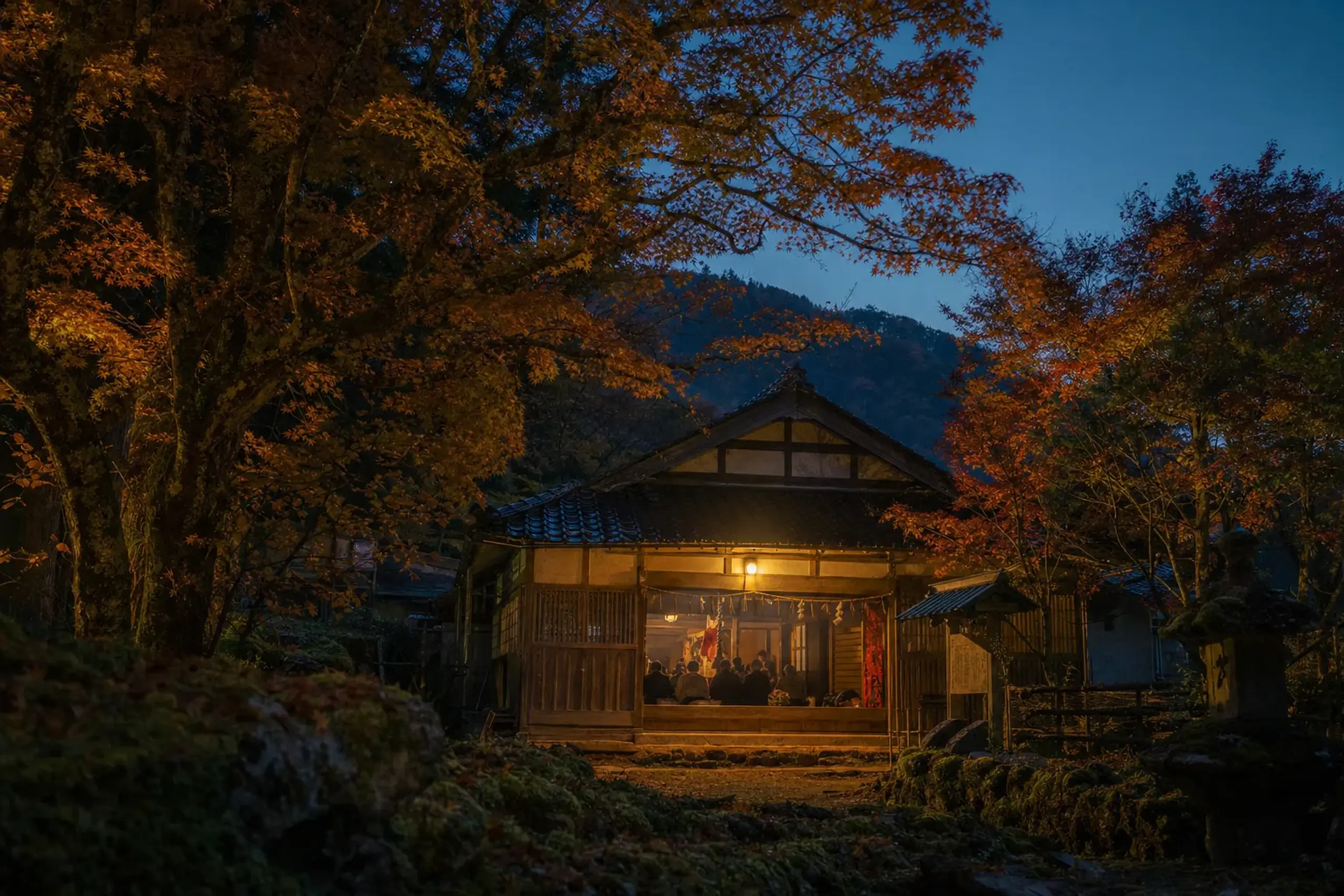
Expect close distance. Expect an audience that includes locals and travelers. At night, the valley feels different. The air cools. The day’s gorge-light fades from your mind.
What Is The Full Yokagura Season In Takachiho, And Is It Worth Planning Around?
The full, un-abbreviated Yokagura in Takachiho runs from mid-November to early February as an all-night community ritual, rotating across villages, and it was designated an Important Intangible Folk Cultural Property in 1978.
This is the version people misunderstand. The full Yokagura is not “the longer show.” It is a night that belongs to a community. The performers are local residents. The setting is not theatrical. The rhythm is human: dusk to dawn, sustained by attention, fatigue, and shared duty.
Dates and locations are set by each village, typically finalized around October, and schedules are published by local bodies. If you want to attend, you plan with advance inquiry and flexibility. That is not a sales line. It is the nature of a living calendar.
For HNW travelers, the challenge is not appetite for culture. It is comfort without intrusion. Warm clothing. A realistic plan for late-night transport. A place to rest afterward. And a clear etiquette briefing, so your presence does not bend the room.
When the season aligns, the reward is rare: you are not watching “heritage.” You are witnessing continuity.
Etiquette And Restrictions That Matter In Takachiho’s Sacred Sites
Takachiho’s sacred sites are not fragile because they are old. They are watchful because they are active.
The right approach is practical.
- At Amano Iwato Shrine: follow the priest-led guidance, and do not attempt to photograph the sacred cave.
- At Amano Yasukawara: keep voices low; do not block the path for long photos.
- At kagura: arrive with time, sit with composure, and let the room stay focused.
Discretion belongs here. Not just for privacy, but for mood. In our experience, the most meaningful Takachiho visits are the ones that feel almost understated in the telling afterward.
What A Well-Paced Day In Takachiho Actually Looks Like
Takachiho rewards an order that feels obvious only after you do it once: nature in daylight, myth in place, then ritual at night. Reverse it and you spend the day chasing time.
Morning: Gorge Light, Water Level If Possible
Start with Takachiho Gorge while the day is still clean. If boats are operating and you have a slot, this is when the basalt walls feel tallest and the water reads clearest. If boats are unavailable, the promenade still gives you the cliff geometry and the falls without the pressure.
Keep the morning uncramped. Big mistake: trying to “do” the gorge in a tight window and then driving on.
Midday: Shrine Visit With A Clear Mind
Visit Amano Iwato Shrine when you are not hungry, rushed, or overstimulated. The cave viewing is structured for a reason. You want enough mental quiet to receive the explanation, even if you are relying on translation support or prior briefing.
Then walk to Amano Yasukawara. Let the river carry the story’s second half.
Do not force it into a checklist.
Evening: Takachiho Shrine’s Night Kagura
Return to town, eat early, and go to Takachiho Shrine for the nightly kagura. The shortened program is typically held in the evening and lasts roughly an hour, but we avoid locking your plan to a single published time unless we have confirmed it close to your date.
Afterward, you will know whether you want the full Yokagura one day. Some guests do. Others prefer the excerpt, and that is fine.
How Far Is Takachiho, Really? Honest Travel Planning From Kyushu Gateways
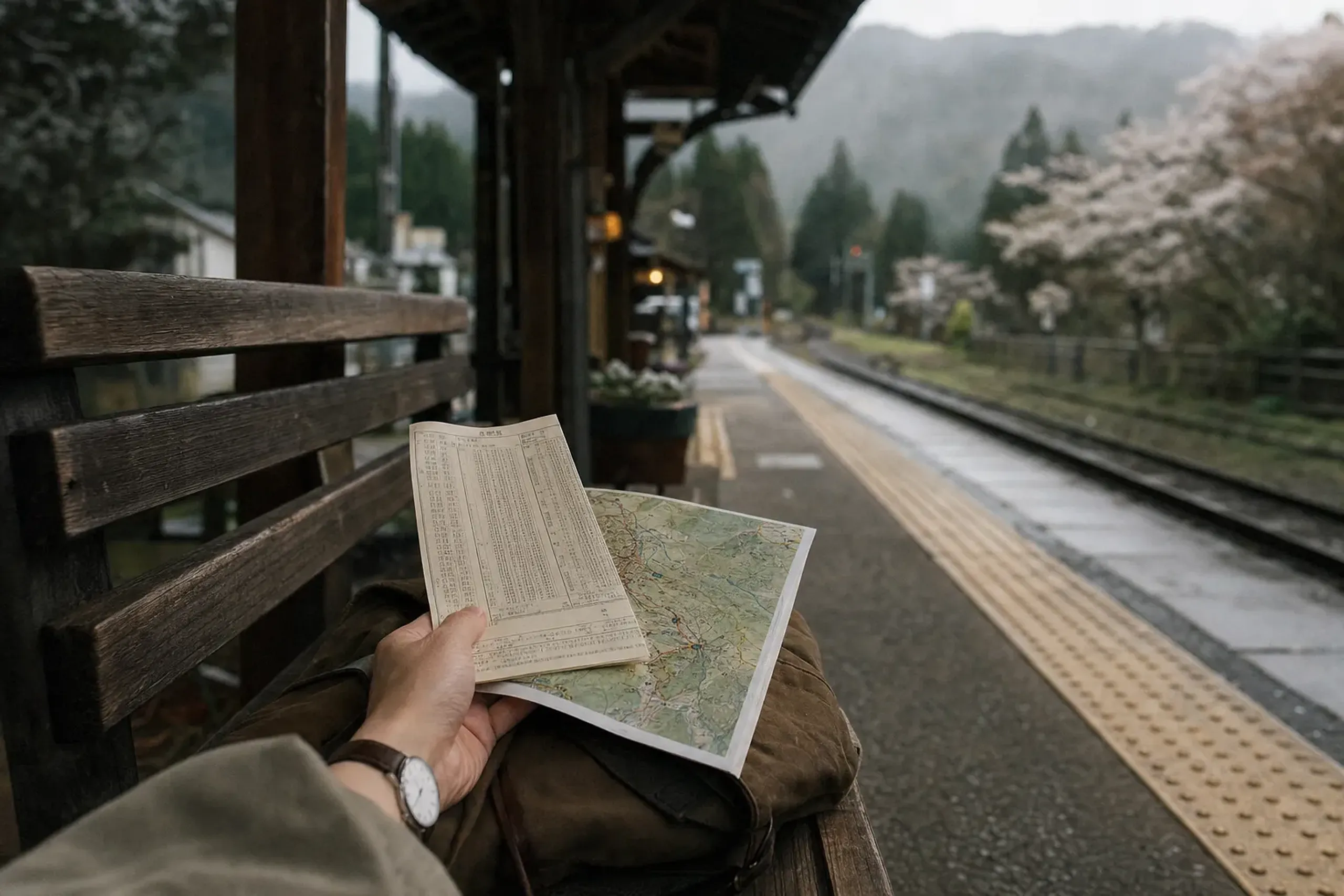
Takachiho sits in the mountainous northwestern corner of Miyazaki Prefecture, near the Kumamoto and Oita borders, and reaching it is a deliberate journey rather than a casual add-on.
That single fact explains most visitor stress. People underestimate rural Kyushu distances. They assume train links like central Honshu. They end up arriving late, tired, and oddly impatient at places that ask for stillness.
In our experience, Takachiho works best when you give it at least one night nearby, so the evening kagura is not followed by a long drive into darkness. It is also how you keep the day from feeling like a transfer disguised as sightseeing.
If you are building a broader Kyushu itinerary, treat Takachiho as its own region with its own tempo. It is not “near” northern Kyushu’s city pattern. It is a different Kyushu.
Season Notes: When Takachiho’s Ritual Calendar Becomes The Itinerary
Some places in Japan are best planned around scenery.
Takachiho can be planned around dates. That is a different kind of luxury.
Amano Iwato Shrine’s official site lists annual events including a public festival on November 3 and Winter Solstice rites in December. If you care about seeing Takachiho as living devotion, those anchors can justify the extra travel time better than any viewpoint.
The full Yokagura season—mid-November to early February—adds another layer, with village-by-village scheduling published locally. We treat those schedules with respect: they are community decisions, and they can shift.
If you are not traveling in that window, the nightly kagura at Takachiho Shrine remains the cleanest way to meet the tradition without turning it into a chase.
Practical Notes For A Calm Visit: Crowds, Weather, And Backups
Takachiho is popular for good reasons, and the gorge concentrates people in a narrow corridor. The calm approach is not to “avoid everyone.” It is to time your concentration.
- Boat uncertainty: plan the day so the gorge is meaningful with or without the boat.
- Weather: mist and rain change visibility and footing; bring proper shoes and a light layer even in warmer months.
- Access updates: official bodies sometimes publish access status news for Takachiho Gorge; we keep an eye on advisories as your date approaches.
Discretion belongs in logistics too. When you travel with a private chauffeur, the day stops being a public puzzle and becomes a private rhythm. The first time we mention private transportation, we’ll keep it practical: private transportation can reduce fatigue in rural Kyushu where connections are slower and choices are fewer.
How To Place Takachiho Inside A Tailor-Made Kyushu Itinerary
A thoughtful Takachiho trip is rarely a standalone “day trip.” It is usually a chapter inside a tailor-made itinerary that respects the night element: kagura.
We often frame it as a three-part arc: gorge and river in daylight, Amano Iwato and Amano Yasukawara for the myth’s center, then Takachiho Shrine at night. It is simple. It is enough.
If you want a wider Sacred Japan thread, we keep it geographically honest. For a very different kind of devotion in the same island chain, our team has written about Munakata Taisha and its shrine network around a closed island. And if you are mapping Kyushu’s southern mythology farther afield, our Takachiho piece pairs well with our guide to Takachiho Gorge—another angle on the same landscape.
Frequently Asked Questions
Can You Enter The Amano Iwato Sacred Cave Or Take Photos?
No—Amano Iwato’s sacred cave is not accessible to visitors, and photography of the cave is prohibited; it is viewed only from a designated platform on a priest-led guided visit.
This restriction is not a tourism device. It reflects how a goshintai is treated, and it shapes the entire tone of the visit.
Is The Nightly Kagura At Takachiho Shrine The Same As The Full Yokagura?
No—the nightly program at Takachiho Shrine is a shortened set of four dances presented as excerpts from the full 33-dance Yokagura cycle.
If your goal is the all-night community ritual, plan for the mid-November to early February season and be ready for village-set dates and settings.
How Do I Check Whether Takachiho Gorge Boats Are Operating?
The official Takachiho Town Tourism Association boat page posts daily operating status updates, typically around 8:00 each morning.
Advance reservations are handled online within the published window, and same-day tickets—when available—are sold at the boat reception on the morning of the visit.
How Many Hours Do I Need In Takachiho If I Want The Gorge, The Cave Viewing, And Night Kagura?
Plan for a full day plus an evening, ideally with one overnight, so the gorge, Amano Iwato area, and the night kagura can be experienced without rushing.
Takachiho is not built for fast transfers. The best days feel unhurried and quiet, especially around the sacred sites.
Why Choose Japan Royal Service
Takachiho is beautiful, but beauty is not the hard part. The hard part is doing it with steadiness: boat rules that change by day, priest-led cave viewing with clear restrictions, and a night ritual that deserves preparation rather than improvisation. That is where our team at Japan Royal Service is most useful.
We build Takachiho around three pillars that matter here: discretion in how you move and how you are handled, wabi-sabi in respecting what is intentionally limited, and hidden-Japan in reaching a rural region that most itineraries skip because it takes real planning.
For private coordination, reach our team privately via WhatsApp or LINE, or contact us here.