In this guide
Most visitors walk straight past it. They cross the river toward Kiyomizu-dera or Sanjūsangen-dō, cameras ready, and never glance at the quiet compound a few hundred metres north. That is their loss. Hōkō-ji is one of the most consequential temples in Kyoto — a place where ambition, faith, and a single misread inscription nearly rewrote the country's history.
At Japan Royal Service, we send our discerning guests here precisely because it is overlooked. No turnstiles. No queues snaking around a souvenir hall. Just stone, bronze, and the weight of four centuries. This is the Kyoto that Google's first page tends to forget — and exactly the kind of place we like to introduce.
Here is what Hōkō-ji actually is, why it matters, and how to experience it with the calm it deserves.
The Temple Toyotomi Hideyoshi Built To Outshine Nara
Hōkō-ji sits in the Higashiyama district of Kyoto, a short walk from the better-known Sanjūsangen-dō. It was commissioned in 1586 by Toyotomi Hideyoshi, the warlord who finally pulled a fractured Japan back into one piece after decades of civil war.
Hideyoshi did not think small. He wanted a Great Buddha — a Daibutsu — larger than the famous bronze giant in Nara. The hall built to house it was colossal for its time, a statement of power dressed as an act of devotion. The two motives were never really separate.
The original statue, made partly of wood and lacquer, was finished around 1595. A massive earthquake destroyed it the very next year. What followed reads almost like a curse: fire, recasting, collapse, more fire. Successive Toyotomi heirs and later patrons rebuilt the Buddha and its hall again and again, only to watch each version fall.
Key fact: The Great Buddha hall that once stood here was among the largest wooden structures in Japan. Today the original colossus is gone — but the temple's bronze bell survives, and it carries one of the most dramatic stories in the country's history.
The Bell That Helped Topple A Dynasty
The single object most worth seeing at Hōkō-ji is its bell. It was cast in 1614, and it is enormous — among the great temple bells of Japan, weighing in the range of dozens of tonnes. Standing beneath it, the scale registers in your chest before your eyes catch up.
What makes the bell extraordinary is not its size. It is the inscription cast into its surface. The text included the characters for Hideyoshi's family ambitions, and one phrase — read a certain way — split the name of Tokugawa Ieyasu, the man who would soon become shōgun.
Ieyasu chose to take offence. He treated the wording as a deliberate curse against him. That accusation became the pretext for the Siege of Osaka, the campaign that crushed the Toyotomi line and secured Tokugawa rule for the next two and a half centuries.
So a temple bell — a sacred object meant to summon prayer — became the spark for the war that ended one of Japan's most powerful families. The disputed characters are still visible. Our local guides can point them out and walk you through the politics, the rivalries, and the moment a foundry's inscription changed the country.
What To Look For At The Bell
- The contested inscription, where the name of Ieyasu was said to be deliberately broken
- The sheer mass of the bronze — cast in a single, technically remarkable pour for its era
- The bell house itself, a quiet wooden structure that frames the giant within
- The deep, carrying tone that gives these bells their reputation across long distances
The Word "Hoko" Beyond The Temple
Travellers searching for "hoko" often find more than one Kyoto landmark, because the word threads through Japanese culture in surprising ways.
In folklore, the Hōkō is a tree spirit — described in old texts as a creature resembling a black dog, said to dwell within ancient camphor trees. It reflects a very old Japanese instinct: that great age, in a tree or a temple, deserves reverence.
There is also the everyday word 方向 (hōkō), meaning "direction" or "orientation." Pleasingly, that sense of finding one's path sits comfortably beside the Buddhist setting of Hōkō-ji itself.
The Hoko Floats Of Gion Matsuri
The most spectacular "hoko" in Kyoto are not at the temple at all. They are the towering festival floats of Gion Matsuri, the city's grand July celebration. These wheeled structures rise several storeys high, draped in heirloom textiles, and are pulled through the streets by neighbourhood teams during the Yamaboko Junkō procession.
Each hoko belongs to a specific district and carries generations of pride. The procession is recognised by UNESCO as part of Japan's intangible cultural heritage. For guests in Kyoto during July, we can arrange discreet, well-placed vantage points away from the crush — a far more civilised way to watch.
| Hoko Float | Distinguishing Feature | Note |
|---|---|---|
| Naginata Hoko | A glaive blade at its peak | Traditionally leads the procession |
| Kikusui Hoko | Chrysanthemum motif | Revived in the mid-20th century |
| Tsuki Hoko | Crescent moon decoration | Muromachi-period roots |
| Fune Hoko | Built in the shape of a ship | One of the most distinctive forms |
What Remains, And Why The Quiet Matters
Do not arrive expecting the Great Buddha. It is long gone. What you find instead is restraint — and that is the point.
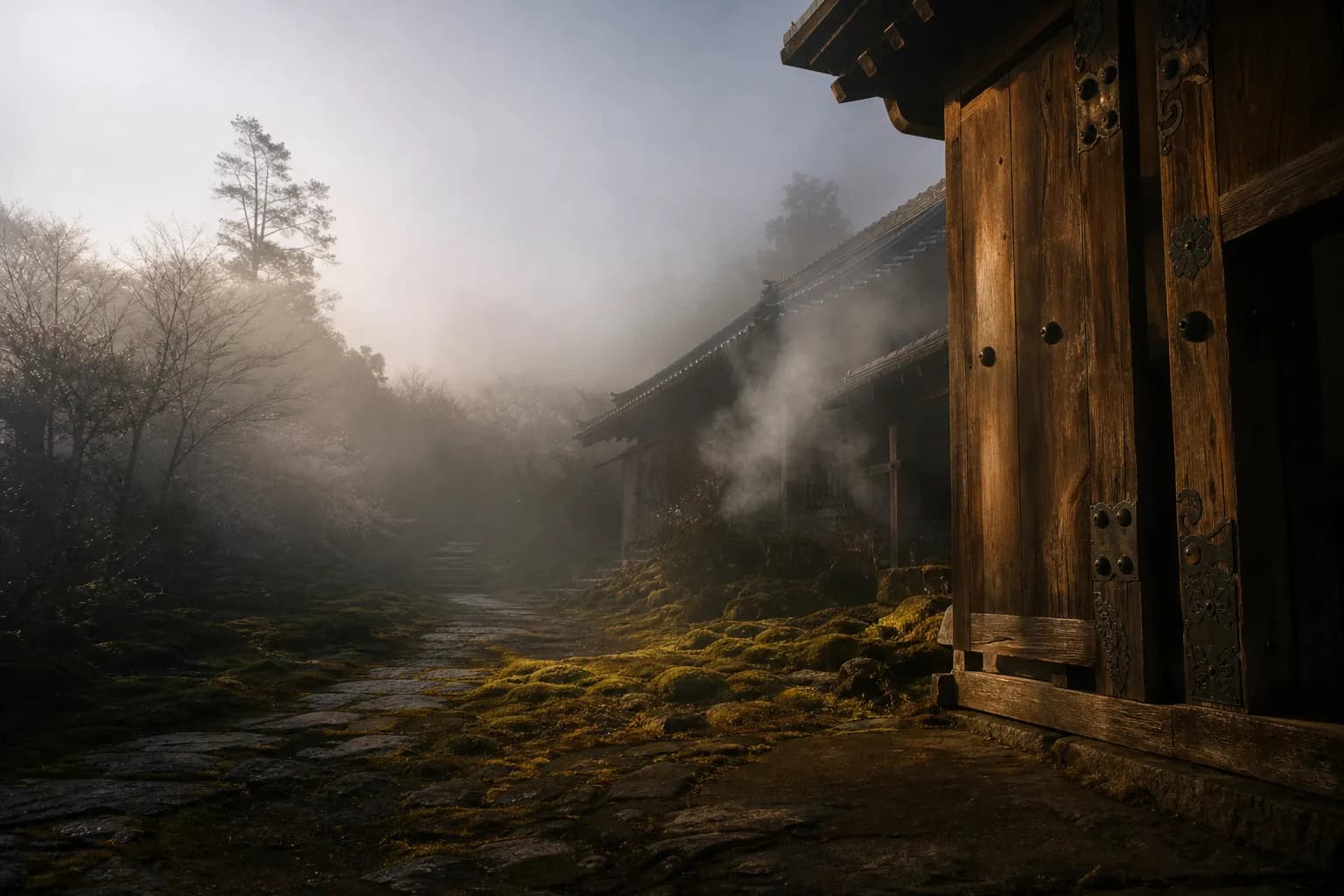
The temple grounds hold the bell house, surviving stone foundations, and the imposing footprint of what once stood here. The architecture follows the Momoyama-period instinct for scale, softened now by time. Curved eaves, weathered timber, moss between the stones. There is a stillness here that the famous temples cannot offer, simply because the crowds have not found it.
This is the aesthetic the Japanese call wabi-sabi: beauty in what has aged, weathered, and gone slightly imperfect. A toppled colossus leaves behind a kind of dignity that an intact monument rarely achieves. We have stood in this compound on a grey winter morning, the bell silent overhead, and found it more moving than sites a hundred times more visited.
Best Times To Visit
- Early morning on a weekday offers near-solitude and the softest light on the bronze
- Spring brings cherry blossom to the wider Higashiyama district nearby
- Late November sets the maples of eastern Kyoto alight — pair Hōkō-ji with the surrounding temples
- Winter rewards the patient with snow on the bell-house roof and an empty compound
How To Build Hōkō-ji Into A Refined Kyoto Day
Hōkō-ji works best as a deliberate pause inside a fuller Higashiyama itinerary, not a rushed tick on a list. Its location makes the pairing easy.
A short walk away stands Sanjūsangen-dō, the long wooden hall lined with over a thousand gilded Kannon figures — one of the most quietly overwhelming interiors in Japan. Continue toward the slopes and you reach Kiyomizu-dera, Kōdai-ji, and the lantern-lit lanes of Ninen-zaka and Sannen-zaka.
In our experience, the smart move is to begin at Hōkō-ji before the city wakes, then let a private chauffeur carry you to the headline sites once you have had the rare gift of an empty temple to yourself. Our Kyoto chauffeur service exists precisely for this rhythm — no taxi hunting, no parking, no wasted minutes between stops.
For guests basing themselves in the new wave of Kyoto openings — the Imperial Hotel, Kyoto in Gion, which opened in March 2026, or Capella Kyoto, which debuted the same month — Hōkō-ji sits within easy reach as a morning excursion before the crowds gather elsewhere. The hotel is your calm base; the overlooked temple is the part of the day no one else thought to plan.
A Few Words On Etiquette
- Move quietly; this remains an active place of worship
- Photography is generally welcome on the grounds, but follow posted guidance near sacred objects
- Bow lightly at the gate, as locals do, before entering
- Let a knowledgeable guide unlock the history — the bell's story is invisible without context
Questions Travellers Ask About Hōkō-ji
Is Hōkō-ji worth visiting?
Yes — particularly for travellers who value history and quiet over photogenic crowds. Its bell carries one of the most consequential stories in Japan's history, and the compound offers a stillness rare among Kyoto's major sites.
Where is Hōkō-ji located?
It stands in the Higashiyama district of eastern Kyoto, a short walk north of Sanjūsangen-dō and within reach of Kiyomizu-dera.
Can I still see the Great Buddha?
No. The original colossus and the later versions were destroyed by earthquakes and fire over the centuries. What survives is the great bell, the bell house, and the stone foundations of the former hall.
What is the connection to the Siege of Osaka?
An inscription on the temple bell, cast in 1614, was interpreted by Tokugawa Ieyasu as an insult to his name. He used it as a pretext for the Siege of Osaka, which destroyed the Toyotomi family and cemented Tokugawa rule.
Are the Gion Matsuri hoko floats related to the temple?
No — they share the word "hoko" but are separate. The floats are towering festival structures paraded through Kyoto each July during Gion Matsuri.
Why Choose Japan Royal Service
Anyone can find Kiyomizu-dera. Far fewer know to stand beneath the Hōkō-ji bell at dawn and read the characters that ended a dynasty. That difference is what our team at Japan Royal Service exists to provide.
We design Kyoto days around the places that reward attention rather than attract queues. Our private chauffeurs move you between sites with no friction. Our local guides carry the historical depth that turns a stone foundation into a story you will not forget. And we hold our guests' identities and itineraries in complete confidence — a discretion our clients value as much as the access itself.
For travellers who want introduction-only dining, private artisan sessions, or quiet morning access while the city sleeps, we build each itinerary by hand. The famous hotels become your calm base. The overlooked temple becomes the part of the journey no guidebook handed you.
If a thoughtful, unhurried Kyoto appeals to you, we would be glad to begin a conversation. Reach our concierge through the Japan Royal Service contact form or directly via WhatsApp for private, tailored guidance.