In this guide
- 01Why December, And Why This Region
- 02What "Private" Actually Means Here
- 03Bathing Etiquette, Plainly
- 04Tattoos, Honestly
- 05What A Ryokan Stay Actually Involves
- 06Two Or Three Nights, Not A Week
- 07Getting There, And Why Proximity Matters
- 08Who Should Choose Differently
- 09Questions We Are Asked
- 10Why Choose Japan Royal Service
You want an onsen retreat. What you do not want is to sit in hot water beside strangers. Maybe you have never bathed communally and would rather not learn on the trip you paid for. If that is you, the word "private" is doing a lot of work, and it means at least four different things that are not interchangeable.
This guide sorts them out. Our team at Japan Royal Service designs winter retreats near Tokyo for clients who prize discretion, so we will be plain about what each private-bathing format gives you, what it costs you in comfort or choice, and who should book something else entirely.
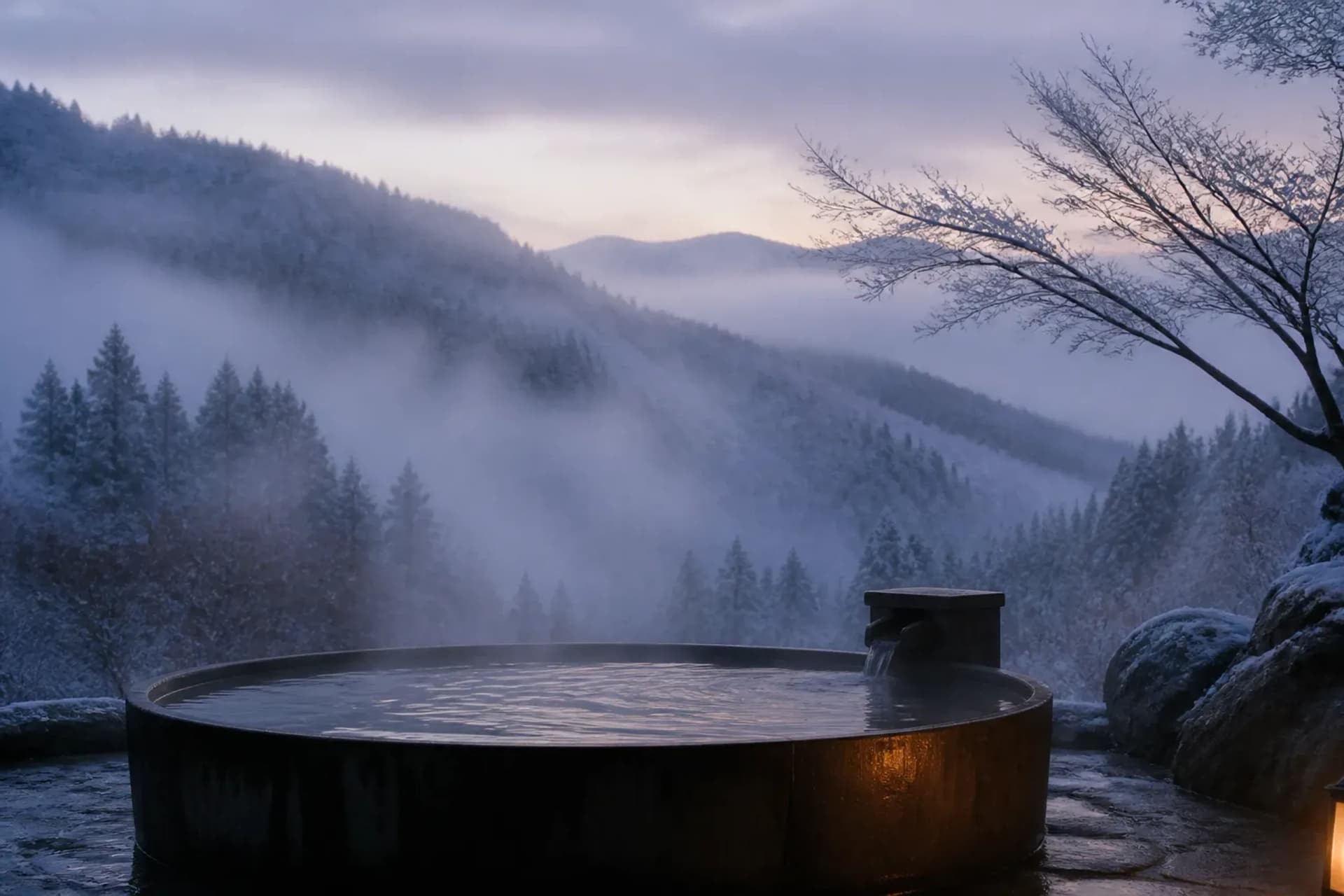
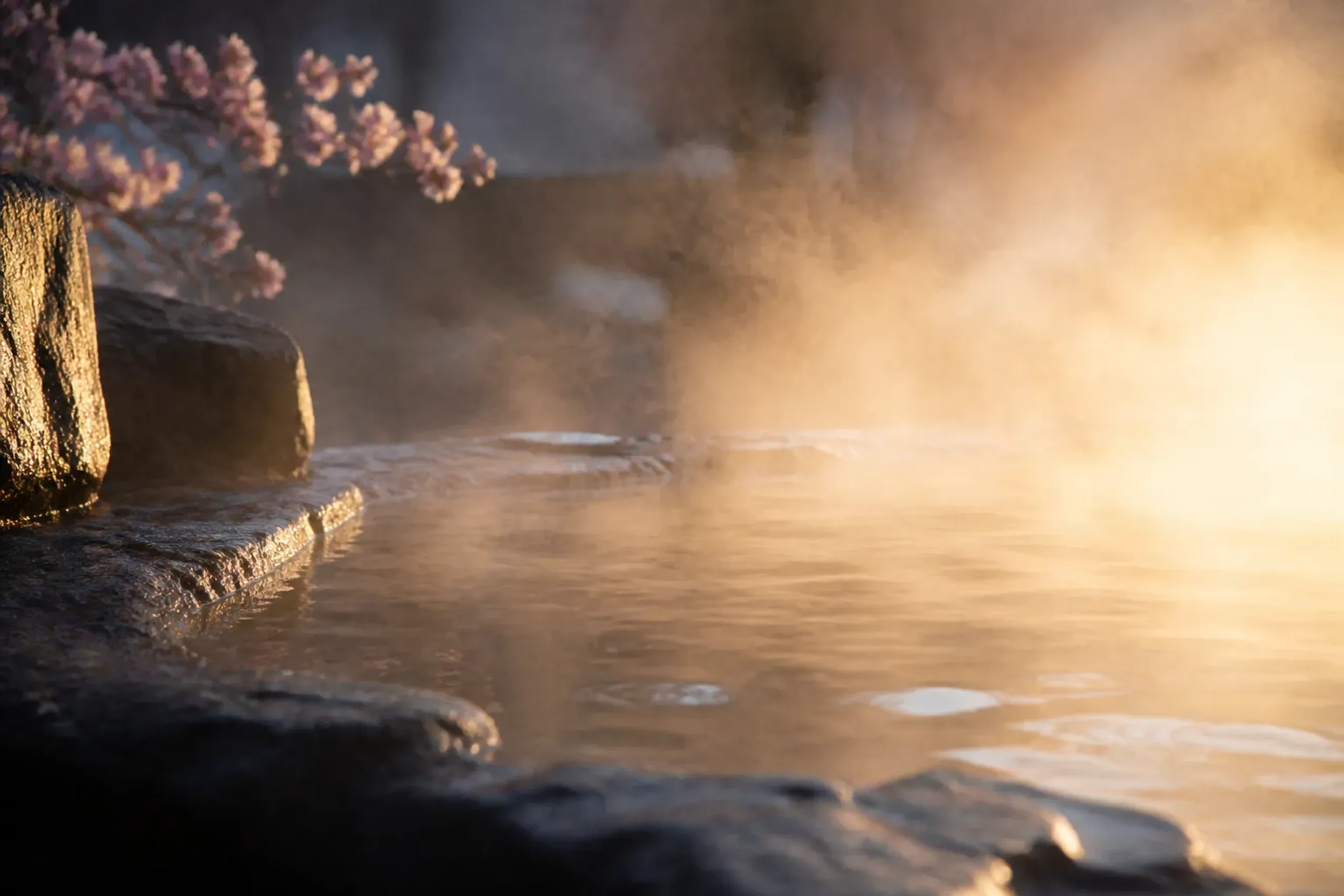
A note on atmosphere, since the genre is saturated with it. An outdoor bath in December is a specific sensation: your shoulders read cold air while the water holds you at a steady heat, and steam rises fast enough that you lose the far edge of the bath in it. That contrast is the whole appeal. Everything else in this article is mechanics.
Why December, And Why This Region
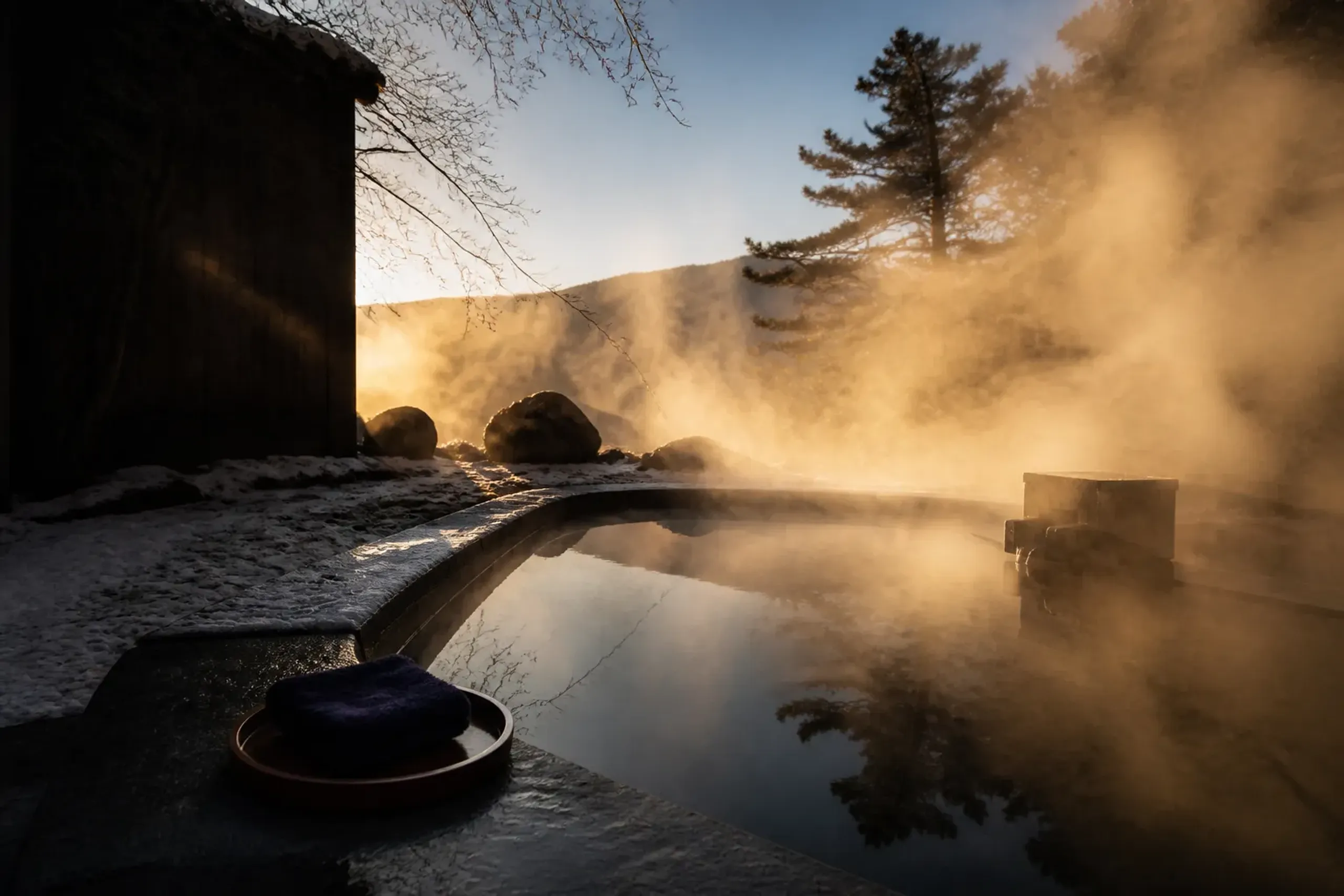
Winter is when the Kanto onsen country is at its best, and it is also when foreign visitors thin out. Cold air makes the outdoor bath work. The heat reads sharper against it, and the low, dry light of a Kanto winter suits the landscape more than the humid haze of summer.
There is a timing argument underneath this. Our published guide, Japan Royal Service's "The Calm Windows," makes the case in detail: certain weeks carry far lighter crowds than the peak, and December sits in one of them for this kind of trip. We will not re-derive that here. The short version is that the season you want for privacy and the season you want for the bath itself happen to be the same one.
The region matters because it is close. An onsen area within a short private transfer of Tokyo suits a client who wants few transitions and no long transit day. That proximity is a planning tool, not a compromise, and we return to it near the end.
What "Private" Actually Means Here
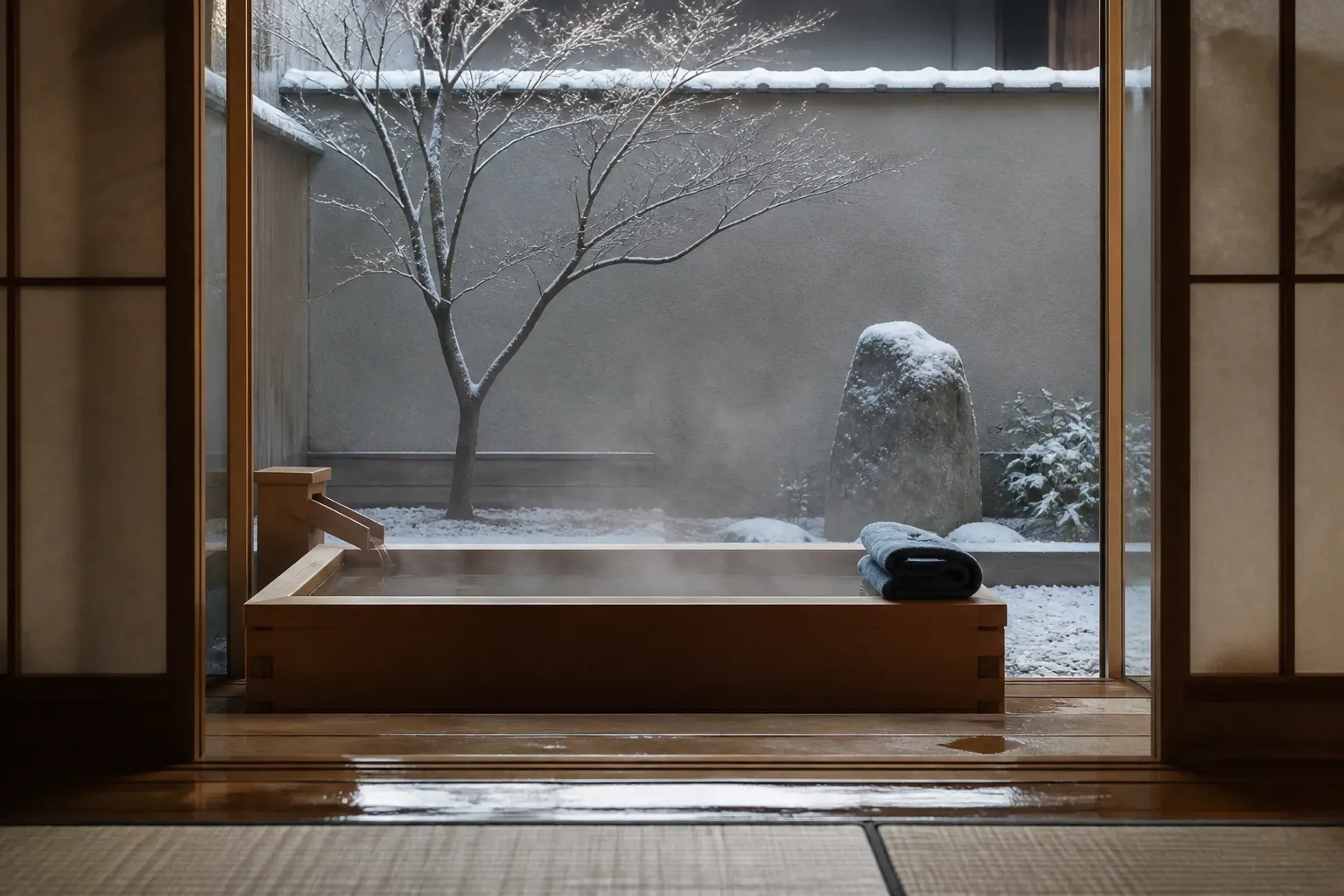
Onsen bathing is communal by default. Most ryokan have gender-separated indoor and outdoor baths shared by all guests. When a property or a guide says "private," it is describing one of the following, and the differences are large enough that choosing the wrong one can undo the whole point of the trip.
Option One: A Reserved Bath By The Hour (Kashikiri)
A kashikiri bath is a communal-style bath reserved for your party alone, usually in a fixed time slot. You book it, you use it privately, then it returns to the schedule for the next guests. The Japan Tourism Agency notes that some ryokan offer exactly this: private, reserved onsen baths that any guest can arrange.
What it gives you: genuine privacy without needing the most expensive room in the house. Many properties offer it, so your choice of ryokan stays wide.
What it gives up: time. The slot is finite, often 45 minutes to an hour, and you leave when it ends. You may also share the property with many other guests everywhere except the bath. The bath itself is frequently smaller than the main communal one, because the grand outdoor bath is usually the shared one.
Option Two: An In-Room Open-Air Bath (Rotenburo)
Here the bath is attached to your room. It is yours for the length of the stay, day or night, with no slot and no booking. Black Tomato notes that at Hakone Ginyu, for instance, each room has its own open-air onsen, which is the clearest form of this arrangement near Tokyo.
What it gives you: the thing most private-onsen seekers actually want. You bathe when you wake, before dinner, after dinner, at two in the morning if you like. No strangers, no clock, no walking a corridor in a robe. Scott Dunn observes that ryokan guests often bathe several times across a stay, on arrival, after dinner, and again the next morning, and an in-room bath is the only format that makes that effortless.
Key point: An in-room open-air bath is usually smaller than the property's communal bath, and the water may be heated tap water rather than natural spring water in some rooms. If natural spring water in the room matters to you, confirm it property by property before you commit.
What it gives up: rate and range. Rooms with a private rotenburo are the pricier rooms, and fewer properties offer them, so your shortlist narrows. And the bath is smaller. You trade the drama of a large communal outdoor bath for the freedom of a small private one. That is a real trade, not an upgrade.
Option Three: Single-Party Or Whole-Property Booking
At the far end, a small ryokan can sometimes be taken in full, or booked so that your party is the only one present. Every bath becomes effectively private because no other guests exist for the duration.
What it gives you: the widest privacy of all. The large communal outdoor bath, the indoor bath, the common spaces, all yours. This is the format for a family or a small group that wants the whole rhythm of a ryokan without another face in it.
What it gives up: availability and rate, obviously, and it only works at genuinely small properties. It also asks that your party be large or comfortable enough to fill the space you have taken.
Option Four: A Quiet Hour At A Communal Bath
This one is not privacy. It is timing. Communal baths are emptiest very early and very late, and a well-timed soak at 6 a.m. can feel solitary without being private in any booked sense.
What it gives you: the best bath in the building, usually the large outdoor one, at little or no extra cost, with a good chance of having it to yourself.
What it gives up: certainty. Someone else may have had the same idea. If bathing beside a stranger is a hard no for you, this is not your option, and you should read the etiquette section below anyway, because you may still want the communal bath at some point.
- Kashikiri (reserved by the hour): Full, but time-limited. Main trade-off: Finite slot; often a smaller bath.
- In-room rotenburo: Full, any time. Main trade-off: Higher rate; smaller bath; fewer properties.
- Single-party / whole property: Total. Main trade-off: Availability; suits small properties only.
- Quiet hour, communal: None (timing only). Main trade-off: No certainty of solitude.
Bathing Etiquette, Plainly
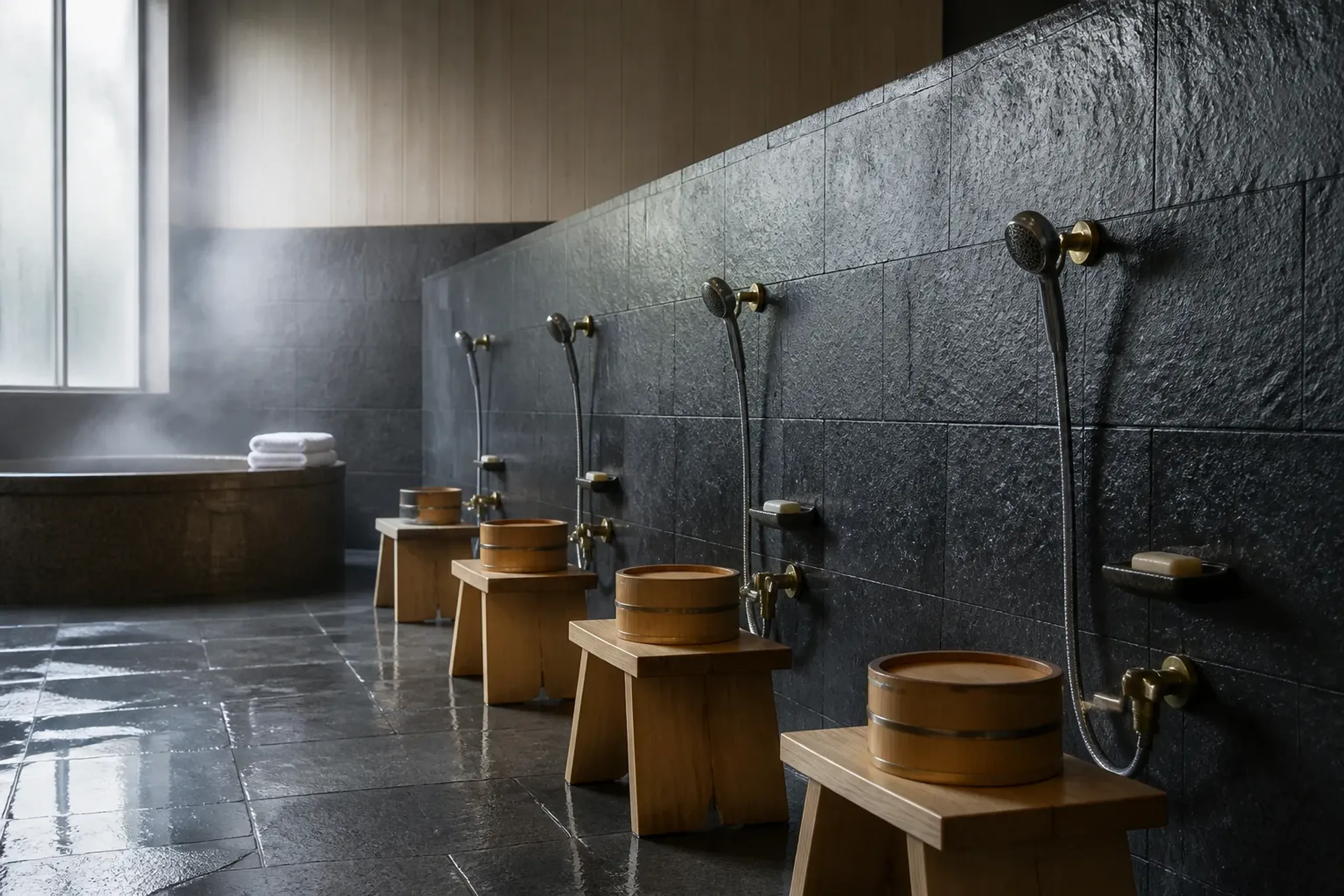
None of this is a test, and none of it is mysterious. It is plumbing hygiene with a few conventions attached. Even if you book a private bath, knowing the rules removes the low hum of uncertainty, and you may want the communal bath at some point.
- Wash before you enter. There are seated washing stations with a stool, a handheld shower, and soap. Sit, wash thoroughly, rinse off all soap, then get into the bath clean. The bath is for soaking, not cleaning.
- You bathe with no swimsuit. Communal onsen bathing is done unclothed. This surprises some first-timers; it is standard.
- The small towel does not go in the water. You are given a small towel. Use it for modesty walking to the bath and for drying after. Set it on the rim or fold it and rest it on your head. Keep it out of the water.
- Tie long hair up. Hair should not touch the water. A tie is usually easiest.
- Keep it quiet and still. No swimming, no splashing, low voices. The pace is slow on purpose.
That is the whole of it. For general Japanese etiquette beyond the bath, our published "The Quiet Traveler" covers the rest; bathing lives here because it is specific to this setting.
Tattoos, Honestly
Tattoos are a real planning constraint for onsen travel, not a footnote, and the honest answer is that policy varies by property. There is no single national rule.
The Japan Tourism Agency notes that tattoo policies differ between facilities, with some adopting different approaches in recent years. The Japan National Tourism Organization reports that the number of tattoo-friendly onsen and sento is growing, and cites a 2015 Japan Tourism Agency study finding that roughly 30 percent of surveyed hotels and inns permitted tattooed guests in communal baths. JNTO's own guidance suggests choosing a private onsen bath where communal access is difficult.
If you have any tattoo: treat it as a planning variable from the start. Do not assume the policy at any given property, and do not treat one ryokan's rule as the region's rule. A private-bath format sidesteps the question entirely, which is one more reason it may suit you.
If you have a tattoo and want a communal bath specifically, that is worth telling us early, because it changes the shortlist meaningfully. If a private in-room or reserved bath is fine with you, the constraint largely disappears.
What A Ryokan Stay Actually Involves
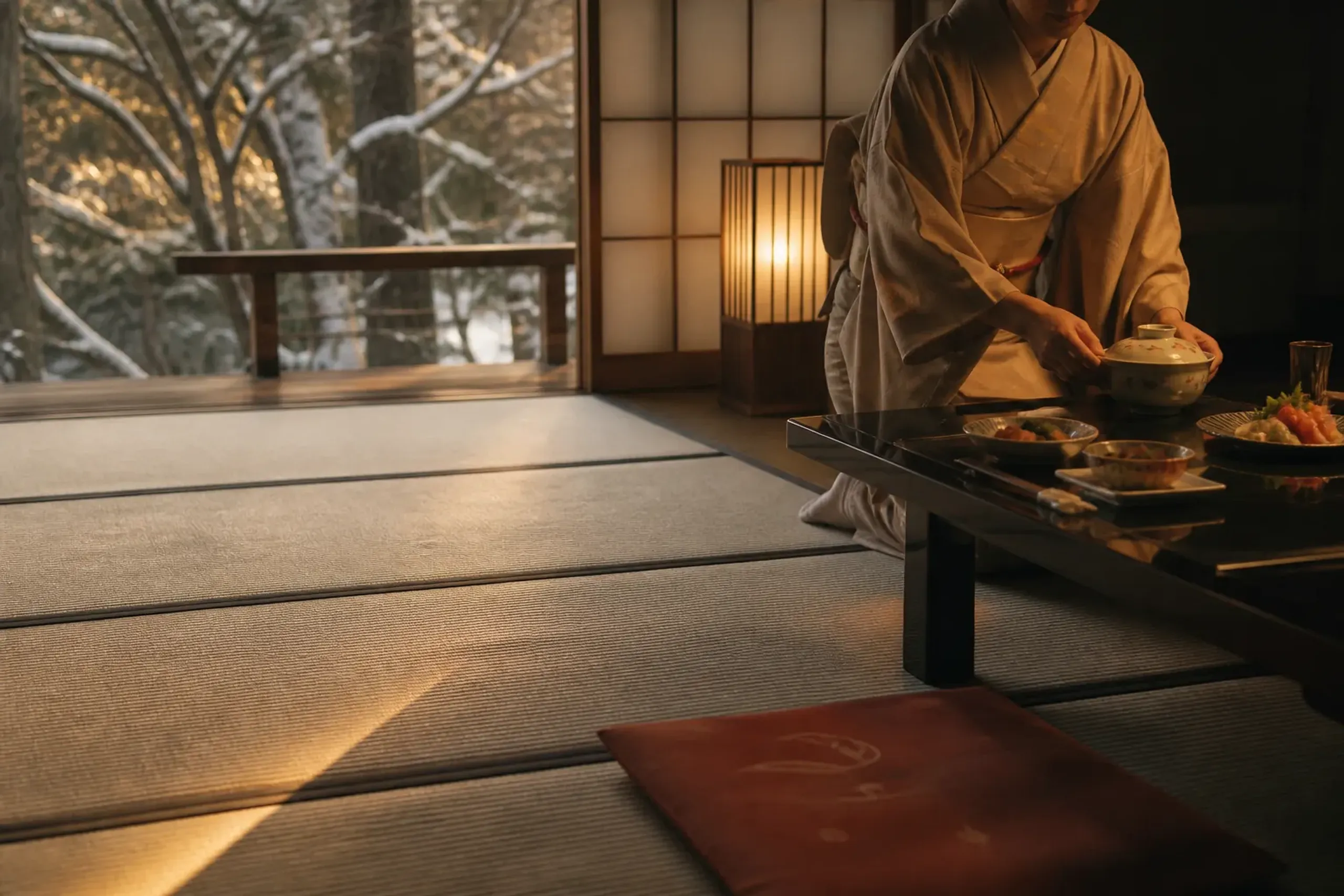
A ryokan is not a hotel with a hot bath. The format has a rhythm, and first-time guests are sometimes caught off guard by it. Know this before you book, because it decides whether the stay suits you.
- Meals are at fixed times. Dinner and breakfast are usually served in set windows, not on demand. Kaiseki dinner in particular is a sequence with its own pace.
- Meals are often in your room, or in a private dining space. Staff bring and clear multiple courses. This is intimate and it is also a series of interruptions to your evening, by design.
- Staff enter your room. They lay out and clear meals, and in traditional rooms they may lay out the futon bedding in the evening and put it away in the morning. If having staff enter your space unsettles you, ask about the arrangement in advance.
- The evening has a shape. Arrive, bathe, dinner, bathe again, sleep, bathe, breakfast, depart. That loop is the point of the stay. Scott Dunn notes guests commonly bathe on arrival before dinner, after dinner, and again the next morning.
If you want room service at 11 p.m. and no one in your space, a ryokan will frustrate you, and a hotel with an in-room bath is the better call. If the fixed rhythm sounds restful rather than restrictive, it is exactly right.
Two Or Three Nights, Not A Week
This kind of retreat is short by design. Two or three nights is the realistic length, and here is why. The rhythm that makes a ryokan restful, the bathe-eat-sleep loop, is a decompression, not a base for exploring. By the third or fourth day, most guests want to move.
Book two nights if you want the reset and little else. Book three if you want a full unhurried day in the middle with a private drive to a nearby sight and dinner back at the ryokan. Longer than that, and you are better off pairing the onsen stay with a separate leg of the trip rather than stretching the retreat itself.
Getting There, And Why Proximity Matters
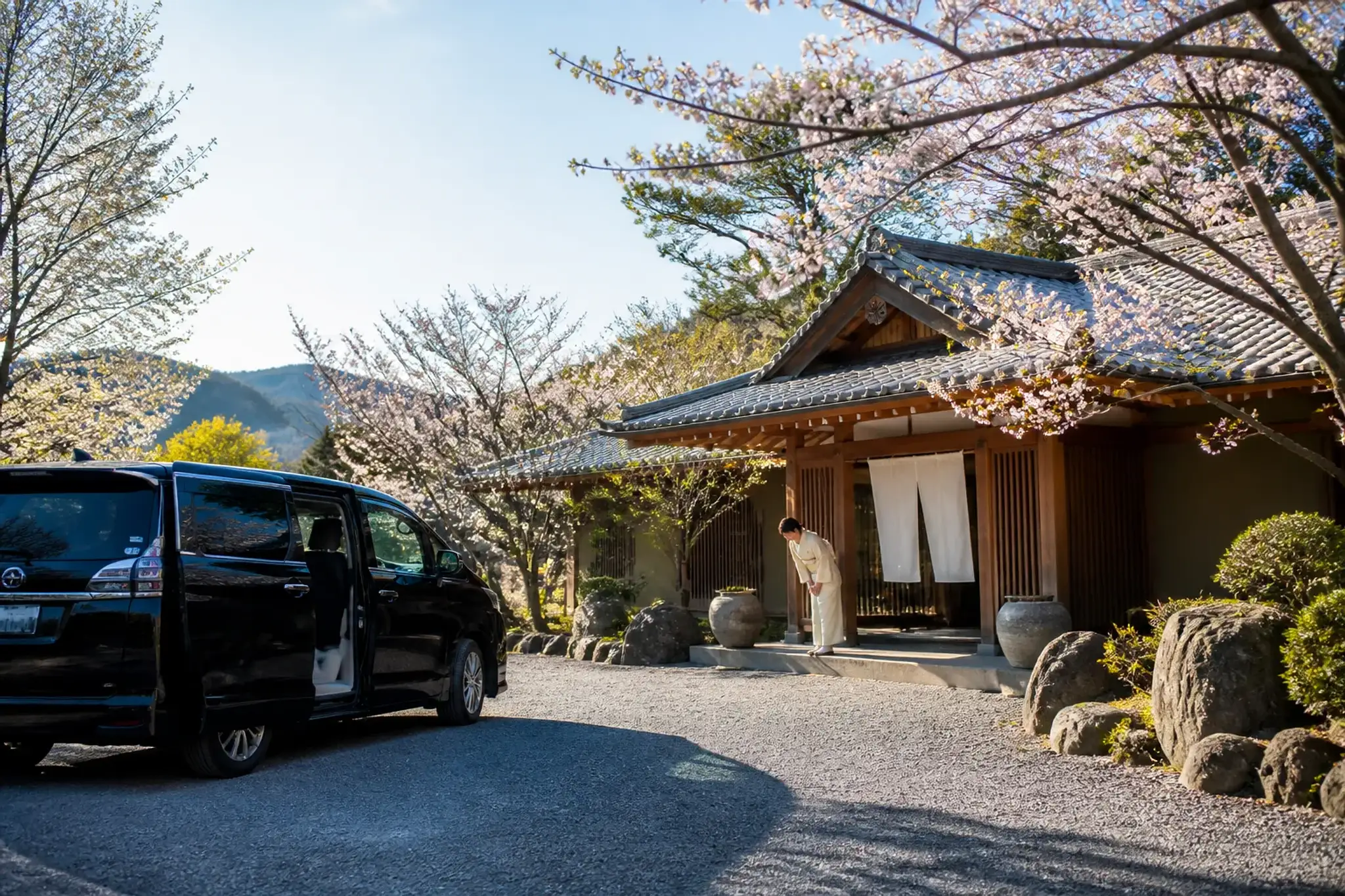
The practical argument for a near-Tokyo onsen is few transitions. A client who has just landed, or who is closing a Tokyo stay, wants to arrive at the bath without a long transfer day in between. A short private drive out of the city does that. You leave in the morning and you are soaking by afternoon.
Our private chauffeured transfer makes this seamless in a practical sense: door to door, your luggage handled, no station changes, no waiting. For a retreat built around few transitions, a car door at your hotel and a car door at the ryokan is the shape you want.
Some clients build a single Tokyo night into the front of this trip, closing with an evening of the city's winter illuminations before the drive out. Tokyo's official travel guide publishes a Winter Illumination Guide for the season, and the Tokyo Metropolitan Government has announced TOKYO LIGHTS 2026, a light festival in Nishi-Shinjuku. One curated evening of light, then countryside quiet, is a clean way to hold both moods without Christmas kitsch.
Who Should Choose Differently
This retreat is not for everyone, and it is worth saying so plainly.
- If you want a base for daily sightseeing, a ryokan's fixed meals and slow rhythm will fight you. Stay in a city hotel and day-trip to the onsen instead.
- If you cannot sit in very hot water for long, the bath is a smaller part of the appeal than you may expect, and a design hotel with a spa may serve you better.
- If having staff in your room is genuinely uncomfortable, look at properties with in-room dining you serve yourself, or a hotel format, rather than a traditional ryokan.
- If you are traveling as a large group that wants late nights and flexibility, the fixed-time, quiet-evening format is the wrong fit.
For a lower public footprint across the whole trip, from arrivals to entrances, our published "Discreet Japan" covers the logistics; we will not restate them here.
Questions We Are Asked
What is the difference between kashikiri and an in-room onsen?
Kashikiri is a communal-style bath reserved for your party in a fixed time slot, then returned to the schedule. An in-room onsen is attached to your room and yours for the whole stay, with no slot. Kashikiri is available at more properties; an in-room bath costs more and comes on fewer rooms.
Can I visit an onsen with a tattoo?
It depends on the property. Policies vary, some facilities admit tattooed guests and some do not, and the number of tattoo-friendly baths is growing. A private in-room or reserved bath avoids the question. Tell us early if you have a tattoo, as it shapes the shortlist.
How long should a winter onsen retreat be?
Two or three nights. The ryokan rhythm is a reset, not a base for exploring, and most guests want to move by the fourth day.
Is winter a good time for an onsen near Tokyo?
Yes. Cold air sharpens the outdoor bath, and December draws fewer foreign visitors to this kind of trip. Our "The Calm Windows" guide sets out the timing case.
Why Choose Japan Royal Service
Getting a private onsen retreat right is a matter of matching one specific format to one specific party. In our experience, the mistake first-time guests make is booking the word "private" without knowing which of its four meanings they actually wanted. A kashikiri slot disappoints the person who wanted an in-room bath. A whole-property booking overshoots the couple who only needed a quiet hour.
Our concierge team designs the trip backward from your answer to a few questions: your privacy threshold, your tattoo situation, how many transitions you will tolerate, whether kaiseki in your room appeals or a restaurant setting suits you better. We hold your identity and your itinerary in confidence throughout, and we build a tailor-made itinerary around few transitions and a short, private drive out of Tokyo. We do not resell property packages; we match the format to the party.
Tell us your dates and your party, and we will propose the private-bathing format that fits. Reach our team privately via WhatsApp or LINE, or contact us here.