In this guide
- 01How Does Lake Suwa Compare To Tokyo’s Sumida River Fireworks Festival?
- 02Why Suwako Matsuri Kojō Fireworks Has Weight Beyond Entertainment
- 03Why Do The Fireworks Sound Different At Lake Suwa?
- 04What Is Suijō Starmine, And Why Is It Unique To Lake Suwa?
- 052026 Date And Time: What To Expect On August 15 At Lake Suwa
- 06Where Is The Launch Site, And How Do You Get There?
- 07Which Paid Seating Areas Are Usually Offered, And What Do They Feel Like?
- 08How Do You Apply For Official Paid Seating For Suwa Fireworks?
- 09The Second, Quieter Option: Suwako Summer Night Fireworks (Late July To Late August)
- 10Kamisuwa Onsen: The Most Natural Pairing With Lake Suwa Fireworks
- 11A Concierge-Grade Plan For August 15: Timing, Dinner, And The Exit
- 12Frequently Asked Questions
- 13Plan Your Evening On Lake Suwa
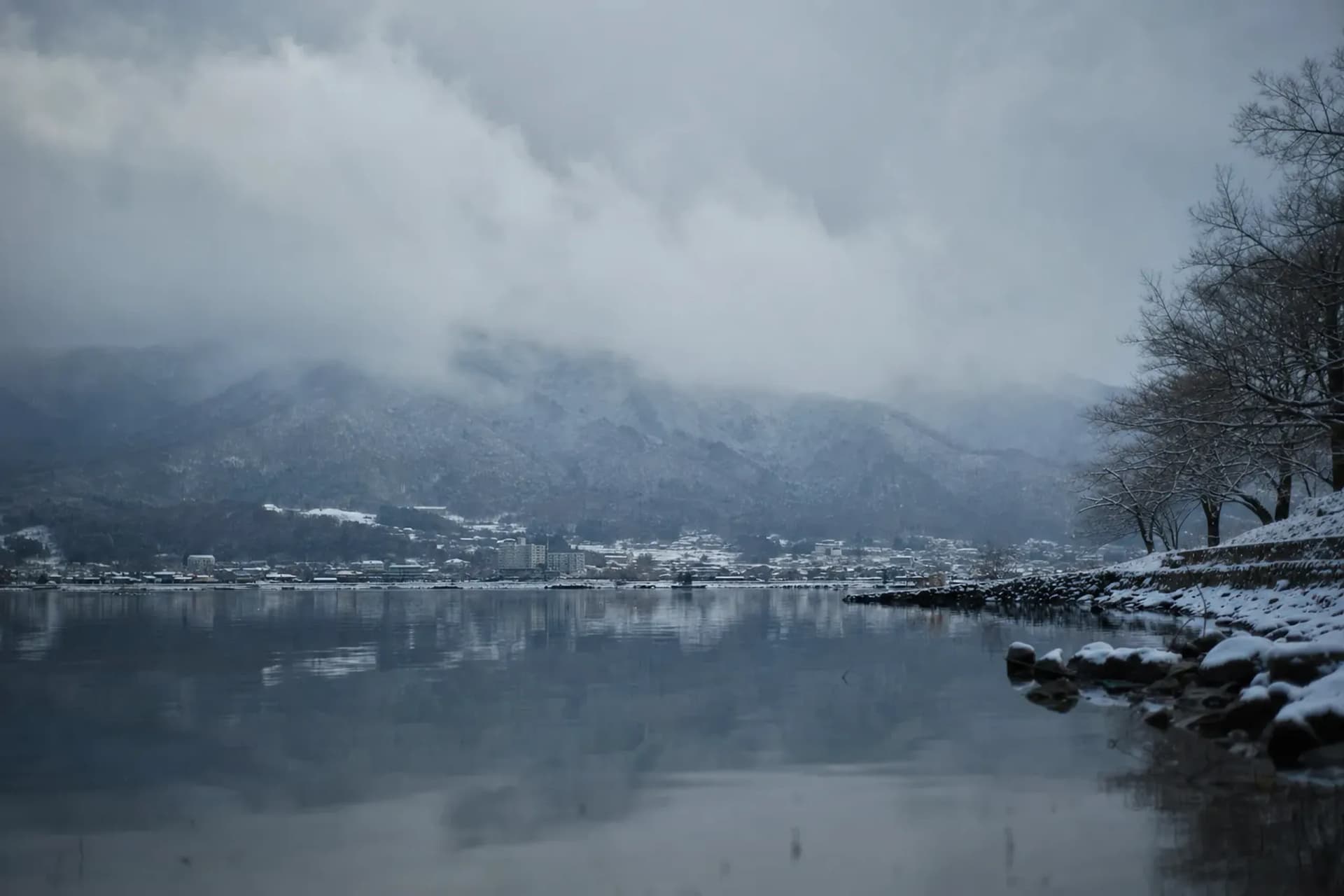
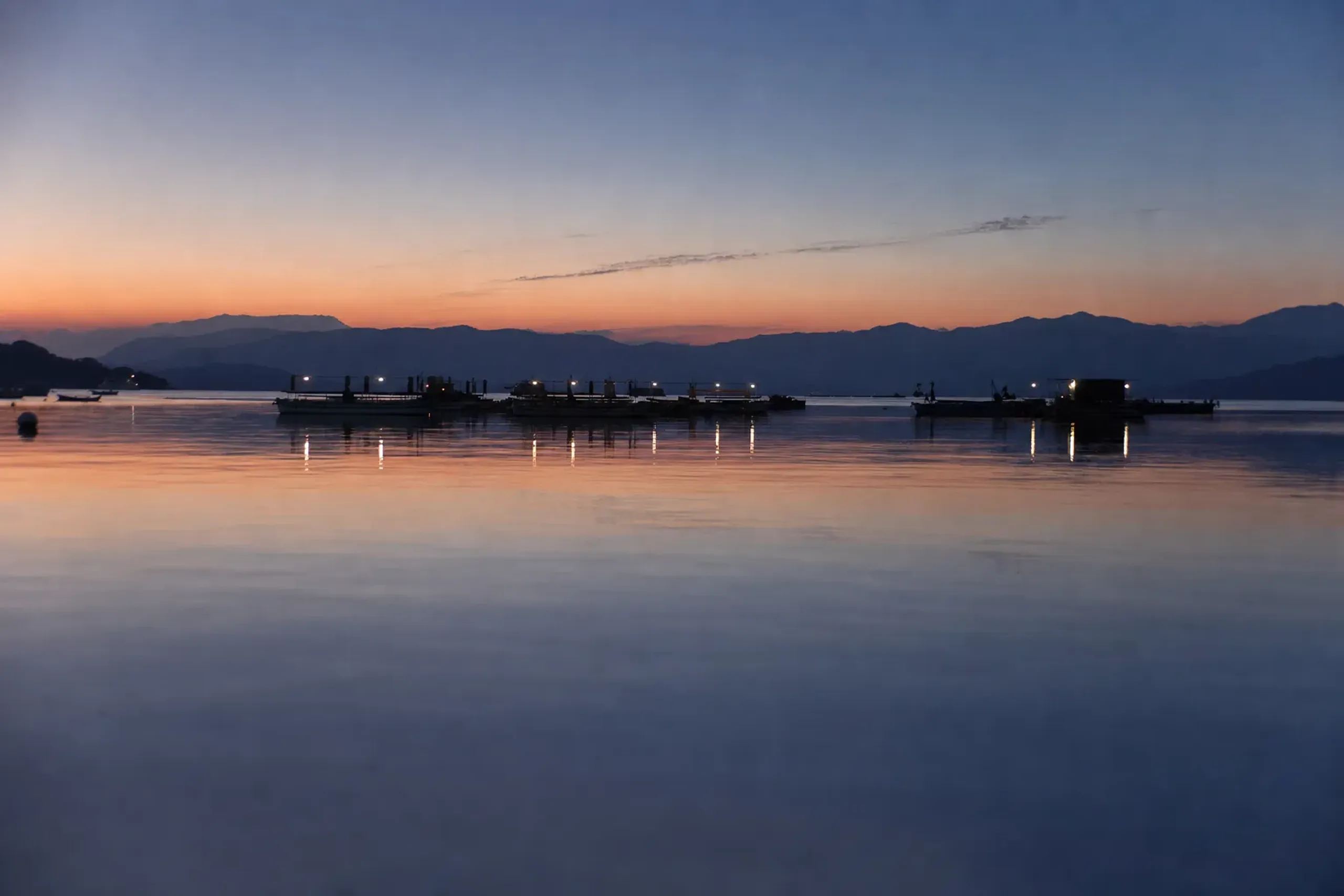
Dusk settles over Lake Suwa. The water turns ink-dark. Across the surface, small launch platforms sit low and still, clustered near Hatsushima like patient boats that refuse to drift.
Then the first shell rises. A second later, the sound arrives. Not a single crack, but a rolling, layered report that bounces off mountains on every side and returns to you with a slight delay. It feels physical—less something you watch than something you stand inside.
If you know Tokyo’s Sumida River Fireworks Festival, you already know what “big” looks like in Japan. Lake Suwa’s August 15 display is the rare case that can stand beside Sumida and make the comparison useful rather than exaggerated. Our team at Japan Royal Service turns to Suwa when clients want scale, meaning, and a setting that changes the very way fireworks sound.
How Does Lake Suwa Compare To Tokyo’s Sumida River Fireworks Festival?
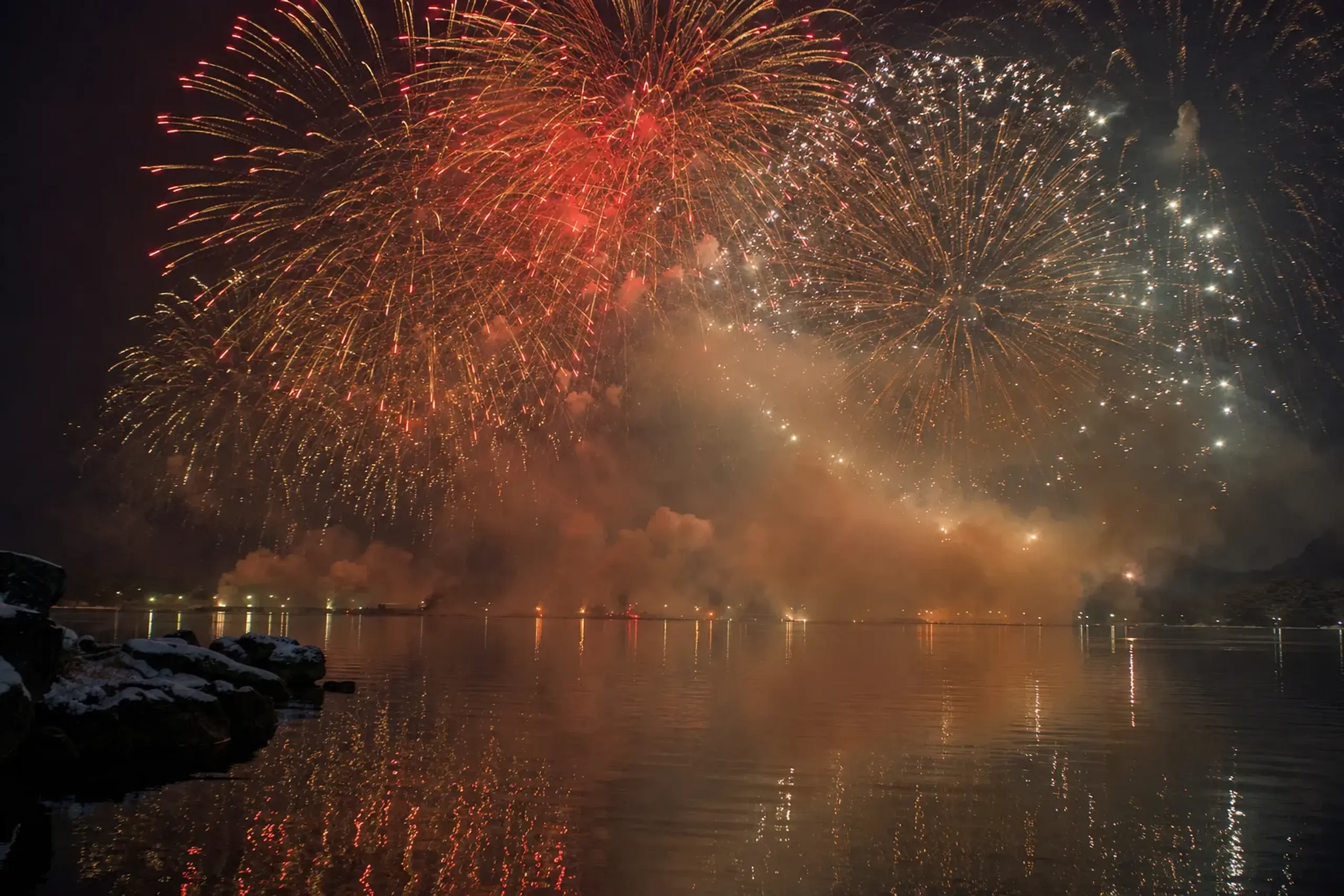
Tokyo’s Sumida River Fireworks Festival launches about 20,000 shells, while Lake Suwa’s August 15 display is widely reported at around 40,000—close to double, though current-year totals are not officially published.
This is why Suwa matters for the discerning international traveler. “Largest in Japan” can be a slippery claim, because festivals count shells differently or publish different kinds of totals. Suwa sidesteps the vagueness by leaning on something simple: sheer volume, repeated across many sources, even when the precise figure is not finalized publicly each year.
What you feel on the ground is not only quantity—it’s density. Over Lake Suwa, bursts layer quickly, filling the sky in sustained waves that can make city fireworks feel as though they pause for breath.
Plan for the psychology of it. If you arrive thinking “a nice regional show,” you will under-pack your patience for the crowds and underestimate how early you should settle into place.
Why Suwako Matsuri Kojō Fireworks Has Weight Beyond Entertainment
The first Suwako Matsuri Kojō Fireworks Display was held in 1949 to mourn war victims and to pray for the region’s post-war recovery.
That origin changes the tone entirely. You still have festival food, summer humidity, families in yukata. But the date—August 15—sits on Japan’s calendar with an inherited seriousness, and Suwa’s event grew from that specific moment of remembrance rather than from any tourism campaign.
The festival has continued on August 15 every year since. Steady, unbroken. In 2026 it is widely reported as the 78th edition, though sources disagree on whether it should be counted as the 77th or 78th depending on how the earliest years are tallied.
If you want the evening to feel like Japan—not a spectacle merely dropped into Japan—Suwa is one of the cleanest examples we know. There is a quiet gravity here that no amount of gold-leaf grandeur could manufacture.
Why Do The Fireworks Sound Different At Lake Suwa?
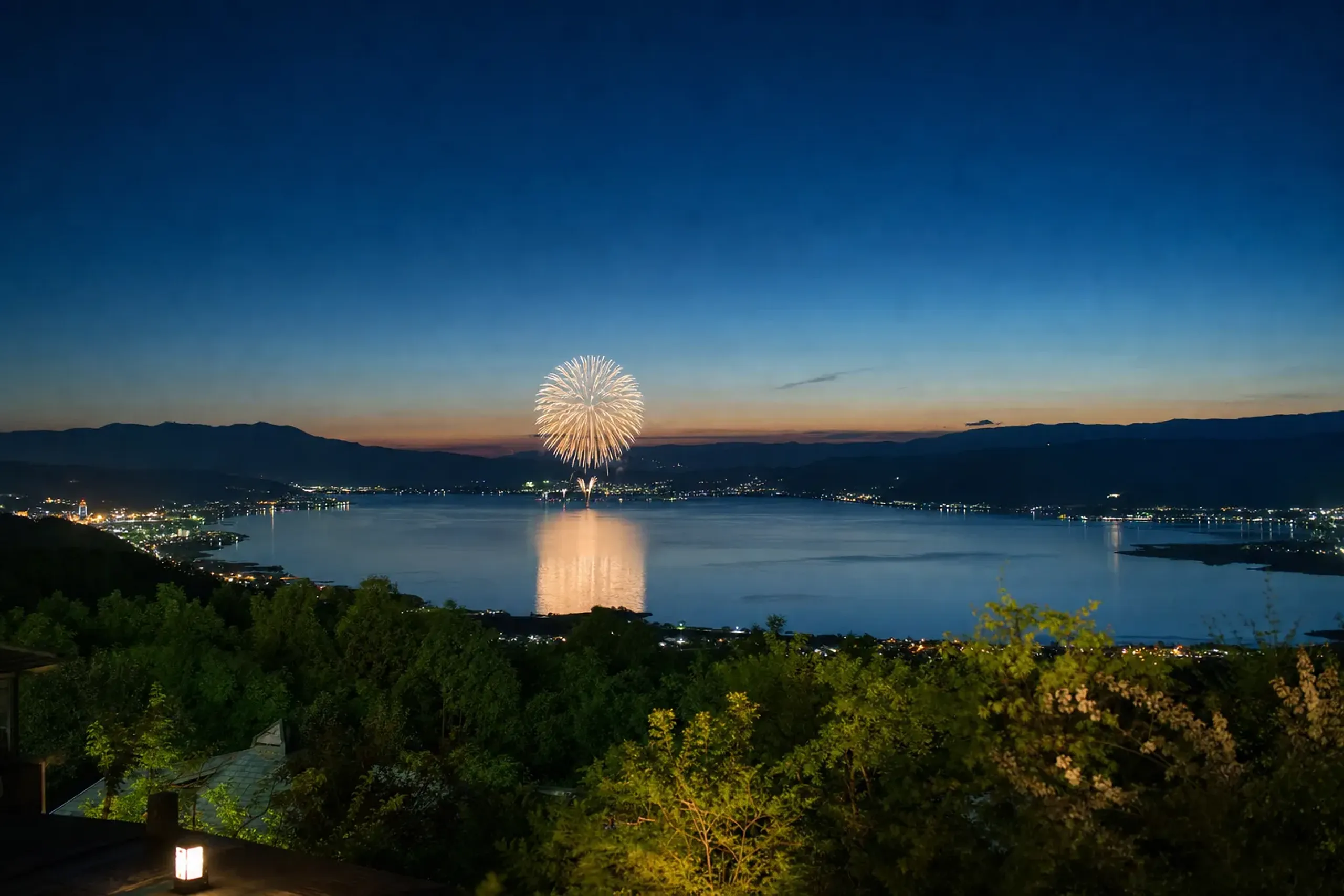
Lake Suwa is ringed by mountains and measures roughly 16 kilometers around, so each blast reflects off the surrounding peaks and returns in layers that create a three-dimensional echo.
This is not a poetic metaphor. It is geography. You are standing inside a natural bowl, and the sound behaves accordingly.
In Tokyo, sound disperses into streets and buildings. At Suwa, it comes back to you. Some guests describe it as “thunder” even on clear nights, because the reverberation carries a long tail.
One practical note. If you are sensitive to loud sound, bring ear protection and use it early—not after you already feel overwhelmed.
What Is Suijō Starmine, And Why Is It Unique To Lake Suwa?
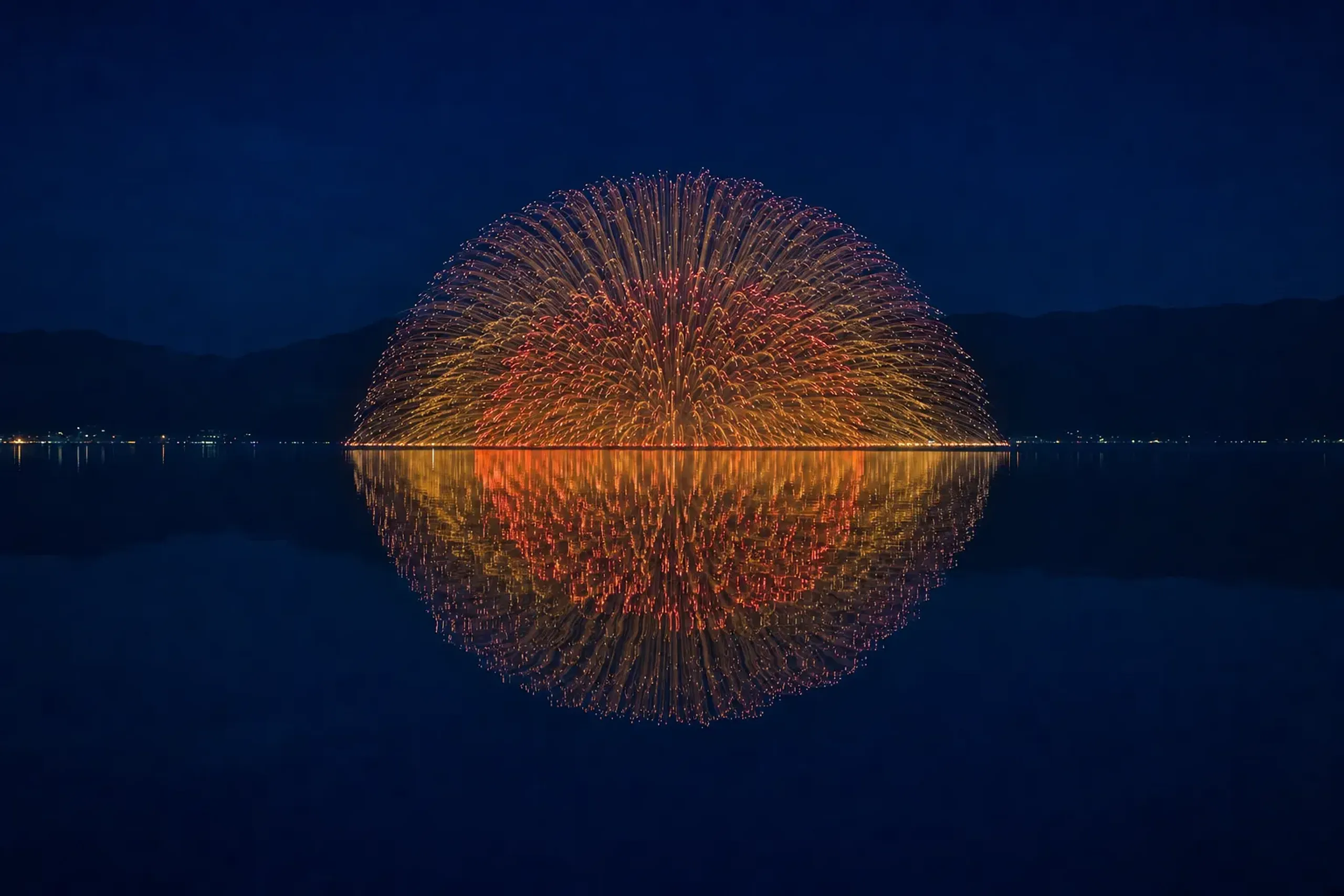
Suijō Starmine is a water-launched firework sequence set off from platforms on Lake Suwa, creating hemispheric blooms that spread outward from the water, with the color mirrored back on the lake’s surface.
The platforms sit centered near Hatsushima, a small island within the lake. In the darkness, you can sometimes make out their outlines just before the show begins.
The shape is the point. Land-launched fireworks “grow” upward into the sky. Water launches feel as if the horizon itself is opening, as if the lake is producing the light. The reflection doubles it—sky above, sky below.
If you care about photography, this is where Suwa rewards restraint. A slower shutter can catch reflection and sky together, but you will need a stable position and a plan for the crowds jostling around you.
2026 Date And Time: What To Expect On August 15 At Lake Suwa
The Suwako Matsuri Kojō Fireworks Display is held on August 15 each year, and in 2026 the launch is scheduled to begin at 19:00 and run to about 21:00 as an expected timeline.
We keep the language precise on purpose. The start time is published in official updates. The end time and the shell count are generally presented as planned figures—not something you should treat like a flight arrival time.
Rain does not cancel the event. It proceeds as scheduled regardless of weather, based on multiple sources and the festival’s standard operating approach. Bring a thin rain layer that won’t flap loudly in the wind.
Gates typically open in the early afternoon. That matters, because the best “value” for comfort is often not a single seat type, but having time to move slowly, find your landmark, and avoid the last-minute squeeze.
Where Is The Launch Site, And How Do You Get There?
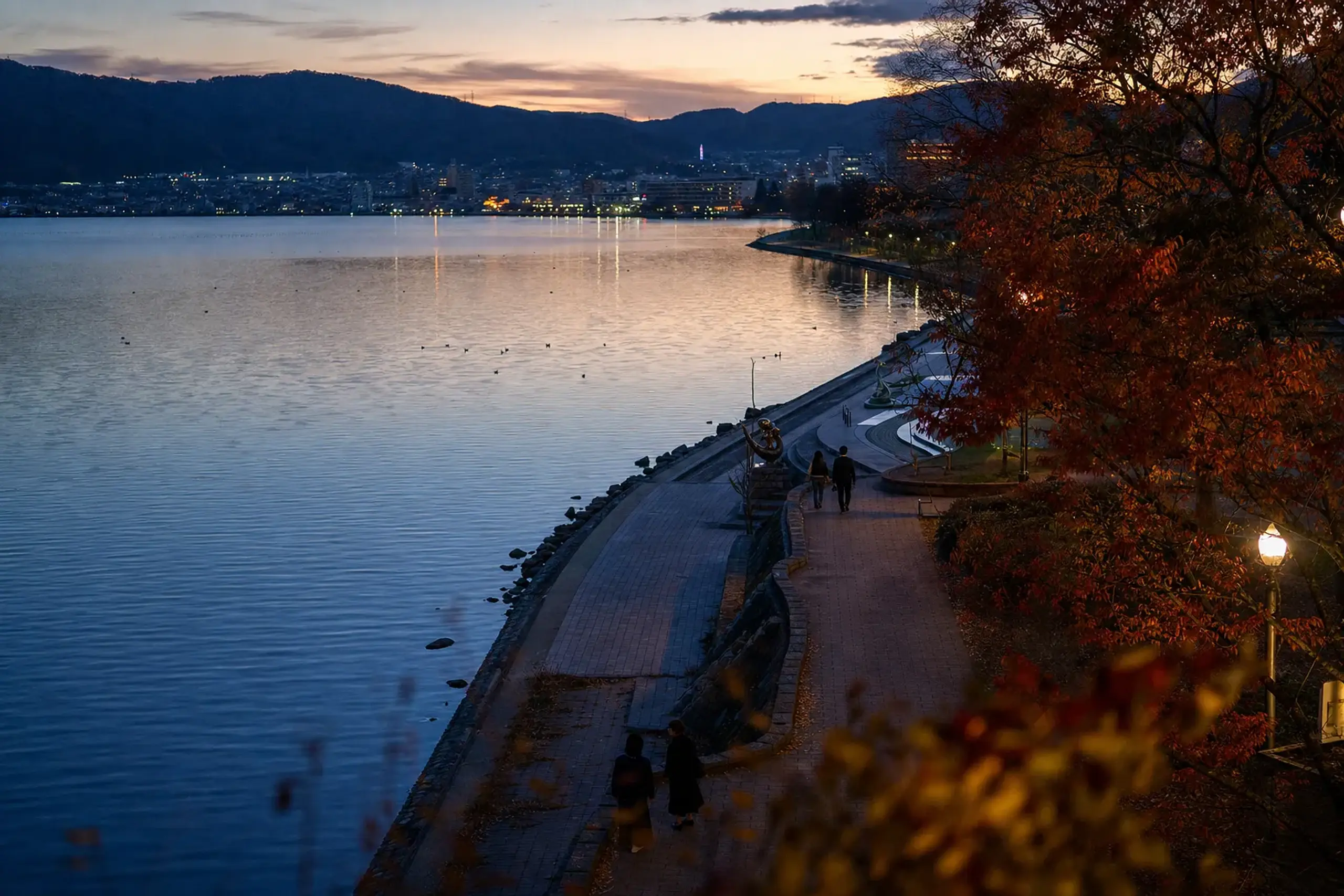
The fireworks are launched over the lake in front of Kohan Park in Suwa City, about a 10-minute walk from JR Kami-Suwa Station under normal conditions.
On August 15, “10 minutes” becomes a different number entirely. Crowds compress the sidewalks and crossings. Make your plan with buffer—a great deal of it.
By car, Suwa is roughly 15 minutes from the Suwa Interchange on the Chūō Expressway in normal traffic. On the festival day, significant congestion is expected, especially as the show ends and everyone moves at once. This is precisely where a discreet private chauffeur arrangement earns its place, sparing you the crush at the exact moment it peaks.
Key fact: The hardest part of Suwa is not arriving. It is leaving without turning the night into a three-hour slow crawl.
This is where private planning earns its keep. Our clients typically prefer to stay overnight in Kamisuwa Onsen rather than attempting a late return to Tokyo, because the lake deserves a morning after.
Which Paid Seating Areas Are Usually Offered, And What Do They Feel Like?
Official paid seating typically includes lakeside pair seating, lakeside chair seating, geyser-area chair seating, and food court seating—each with a distinct viewing angle and level of comfort.
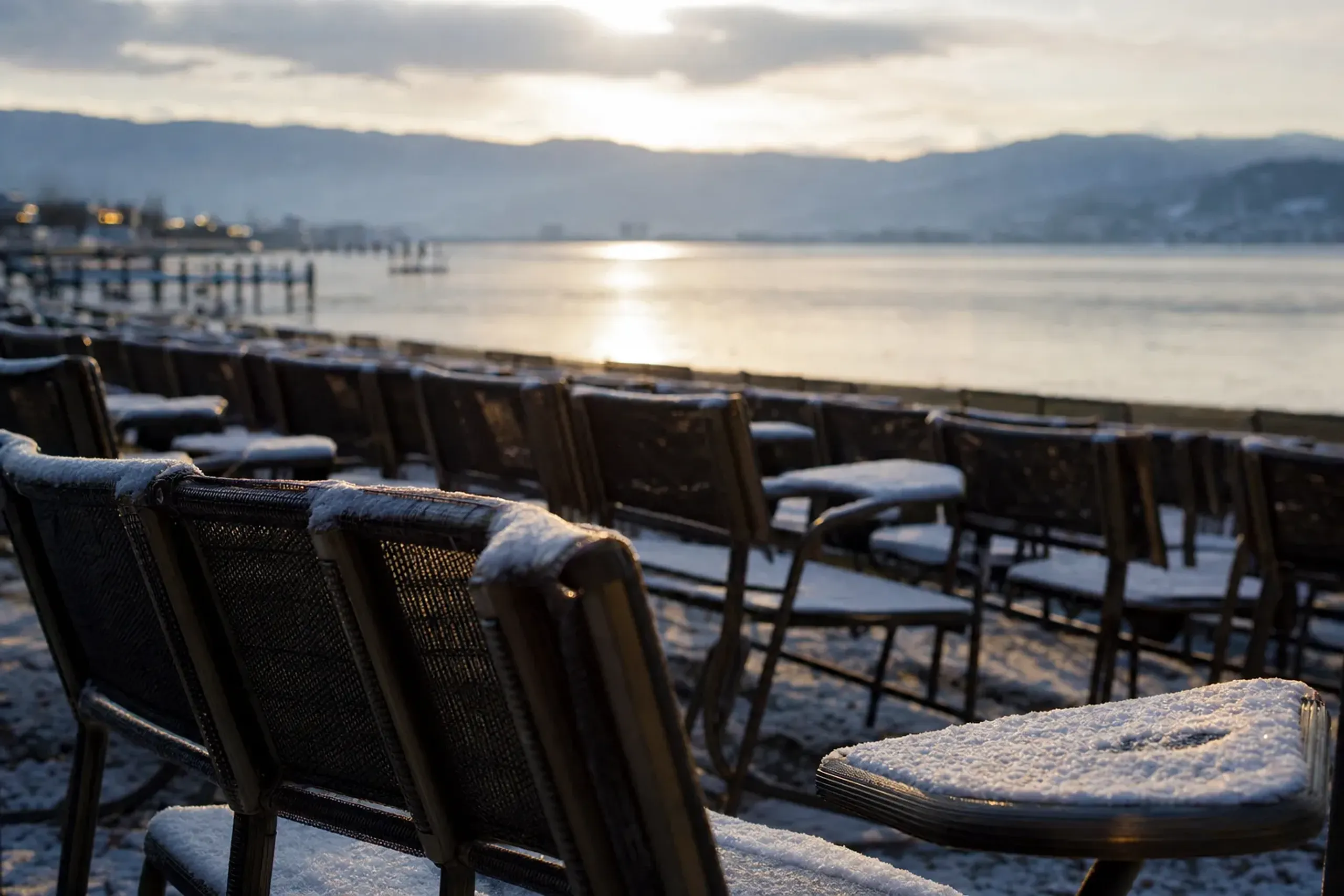
We avoid pretending there is a single “best” seat. The right choice depends on what you value: open sightlines for the Suijō Starmine, personal space, easy access to restrooms, or the ability to stand up without disturbing a line of strangers.
Use the seating labels as clues. “Lakeside” tends to prioritize immersion and reflection. “Food court” tends to prioritize convenience. The geyser-area seats can feel different again, depending on how the official map is drawn that year.
In our experience, comfort is not only the chair. It is the approach route, the nearest exit path, and how early you can settle in without feeling rushed.
How Do You Apply For Official Paid Seating For Suwa Fireworks?
Paid seating is typically handled via a June lottery, with results announced later that month, and some years include a separate first-come ticket allocation through a rail company’s ticketing platform in mid-to-late July.
The key word is “typically.” Suwa has tightened its operational guidance in recent years, and 2026 updates were posted on the official site and in Suwa City materials, including wristband or ticket notes and on-the-ground rules. Treat each year as its own playbook.
What we suggest to our clients is simple: decide early what “success” looks like. Is it the main August 15 show at any cost of effort? Or is it “Lake Suwa fireworks, with breathing room,” which might point you instead toward the nightly series?
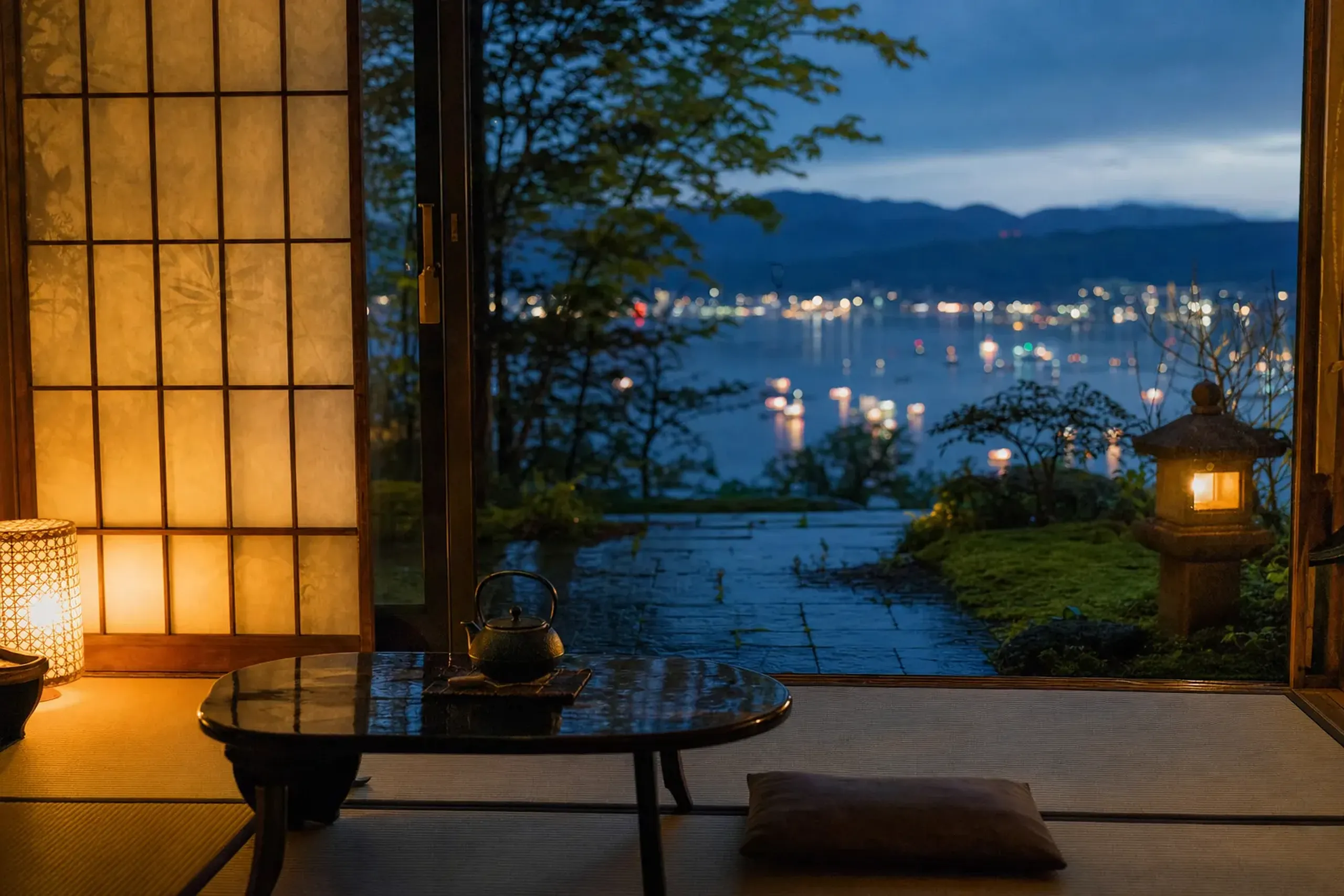
For the finer details, our concierge team can quietly verify the current-year seating application windows and any first-come allocations before you travel, weaving them into a tailor-made itinerary built around your pace rather than the crowd’s.
The Second, Quieter Option: Suwako Summer Night Fireworks (Late July To Late August)
Suwako Summer Night Fireworks run nightly from July 24 to August 23 at about 20:30 for roughly 10 minutes, excluding August 15.
This is the version of Suwa that many of our travelers actually enjoy more. Less waiting. Less crowd pressure. You can finish dinner, step outside, and simply let the lake do what it does.
Because it is short, you can watch casually from the lakeside lawns, from a room facing the water, or from a beer-garden atmosphere without feeling you must build your entire day around the event. The lake becomes part of your evening rhythm rather than its centerpiece.
Within this nightly series, a related event showcases experimental work by younger pyrotechnicians and is judged on artistic merit rather than sheer scale. If you like the idea of seeing what Japan’s next generation of shokunin-like craft looks like rendered in fire, this is the gentler doorway in.
Kamisuwa Onsen: The Most Natural Pairing With Lake Suwa Fireworks
Kamisuwa Onsen sits directly on the lakeshore, and several ryokan face the water—making it possible to watch the nightly fireworks, or even the main event, from a hot-spring setting if your room is lake-facing.
This is not about flashy luxury. It is about placement, and the wabi-sabi pleasure of restraint over spectacle: a quiet room, a sliding door, the scent of mineral water on your skin, and then light breaking over the lake.
For August 15, staying in Kamisuwa also helps with the exit problem. When the last shell fades, you can walk away from the densest flow and return to rest instead of joining a mass departure. This is the kind of quietly anticipated care—omotenashi in its truest sense—that turns a crowded night into a private one.
Our team at Japan Royal Service can also advise on pacing: a slow afternoon, an early and simple meal, and a post-show plan that keeps you comfortable rather than stranded.
A Concierge-Grade Plan For August 15: Timing, Dinner, And The Exit
For August 15, the winning strategy is arriving early, eating before the show, and treating the post-fireworks hour as a managed transition rather than a spontaneous scramble.
Here is a practical flow that works for many guests. Adjust it to your own tolerance for crowds, and be honest with yourself as you do.
- Early afternoon: Arrive while the gates are opening, locate your viewing area, and identify the closest restroom and the calmest walking route back.
- Late afternoon: Take a quiet break away from the densest promenade, hydrate, and keep your evening bag light.
- Early evening: Eat before 19:00. The big mistake is trying to do dinner during the peak pre-show crush.
- 19:00–21:00: The show. Protect your ears if needed. Keep your phone charged, but don’t live through the screen.
- After 21:00: Decide in advance whether you will wait out the first wave, walk to a calmer point, or return to your accommodation on foot.
When clients ask us what we “arrange” publicly, we keep it plain: guiding and transfers, handled with complete discretion.
Nothing more needs to be promised in an article. The real value is the judgment—knowing what to do when conditions shift on the day, and doing it without ever putting your name or your movements on display.
Frequently Asked Questions
Is Lake Suwa Really Japan’s Largest Fireworks Display?
Lake Suwa’s August 15 display is widely described as Japan’s largest by total shell count, often cited around 40,000, but the exact current-year number is not always officially published.
We treat the claim with care. The useful comparison is that it is consistently reported at close to double Tokyo’s Sumida River festival (about 20,000), which most travelers already recognize as major-scale.
What Time Do The Suwa Fireworks Start And End On August 15, 2026?
On August 15, 2026, the fireworks are scheduled to start at 19:00 and are expected to run to around 21:00.
Plan the end time as approximate, not fixed. Build buffer into your transport and don’t schedule tight connections right after the finale.
Does Rain Cancel The Suwako Matsuri Kojō Fireworks Display?
Rain does not cancel the Suwako Matsuri Kojō Fireworks Display; it proceeds as scheduled regardless of weather.
Bring a compact rain layer and shoes that can handle wet pavement, because you may be standing for long stretches.
Is There A Less Crowded Way To Experience Lake Suwa Fireworks?
Yes—Suwako Summer Night Fireworks run nightly from July 24 to August 23 at about 20:30 for roughly 10 minutes, excluding August 15.
You trade scale for comfort. Many guests prefer this balance, especially when paired with a lakeside stay in Kamisuwa Onsen.
Plan Your Evening On Lake Suwa
The difference between a crowded night and a private one at Lake Suwa comes down to placement, timing, and quiet judgment on the day—the seat that faces the reflection, the ryokan room above the water, the departure that avoids the crawl. If you would like us to shape August 15, or the quieter nightly series, around your own pace, contact us here for a confidential, tailored proposal.