In this guide
- 01What a temari is, and what it is made of
- 02Cotton, and the Sanuki sanpaku
- 03What a temari meant to a family
- 04The geometry problem
- 05How the craft nearly disappeared, and was rebuilt
- 06The society today
- 07What a session involves
- 08What can be bought or ordered
- 09Carrying it home
- 10What we arrange
- 11One thing to decide early
- 12Frequently Asked Questions
- 13A closing note
A maker seats herself, draws the wound ball into her lap, and begins to count. There is no template in her hands, no printed diagram on the table — only a needle threaded with cotton she or a colleague dyed by hand, and the sphere itself, already divided into invisible sections she holds in her head. The first stitch goes down, then the next, and slowly a straight-line pattern begins to close across a curved surface. In a converted former kindergarten on Kankō-dōri in Takamatsu, this quiet arithmetic has been going on for decades — a craft that came very close to vanishing entirely, worked back into life stitch by stitch.
A Sanuki kagari temari is a ball of cotton thread wound over a core of rice husks and stitched — kagari means precisely this stitching — into a geometric pattern. It is small enough to sit in the palm, light enough to forget you are holding it, and quietly one of the crafts of Kagawa Prefecture that you can genuinely carry home.
What a temari is, and what it is made of
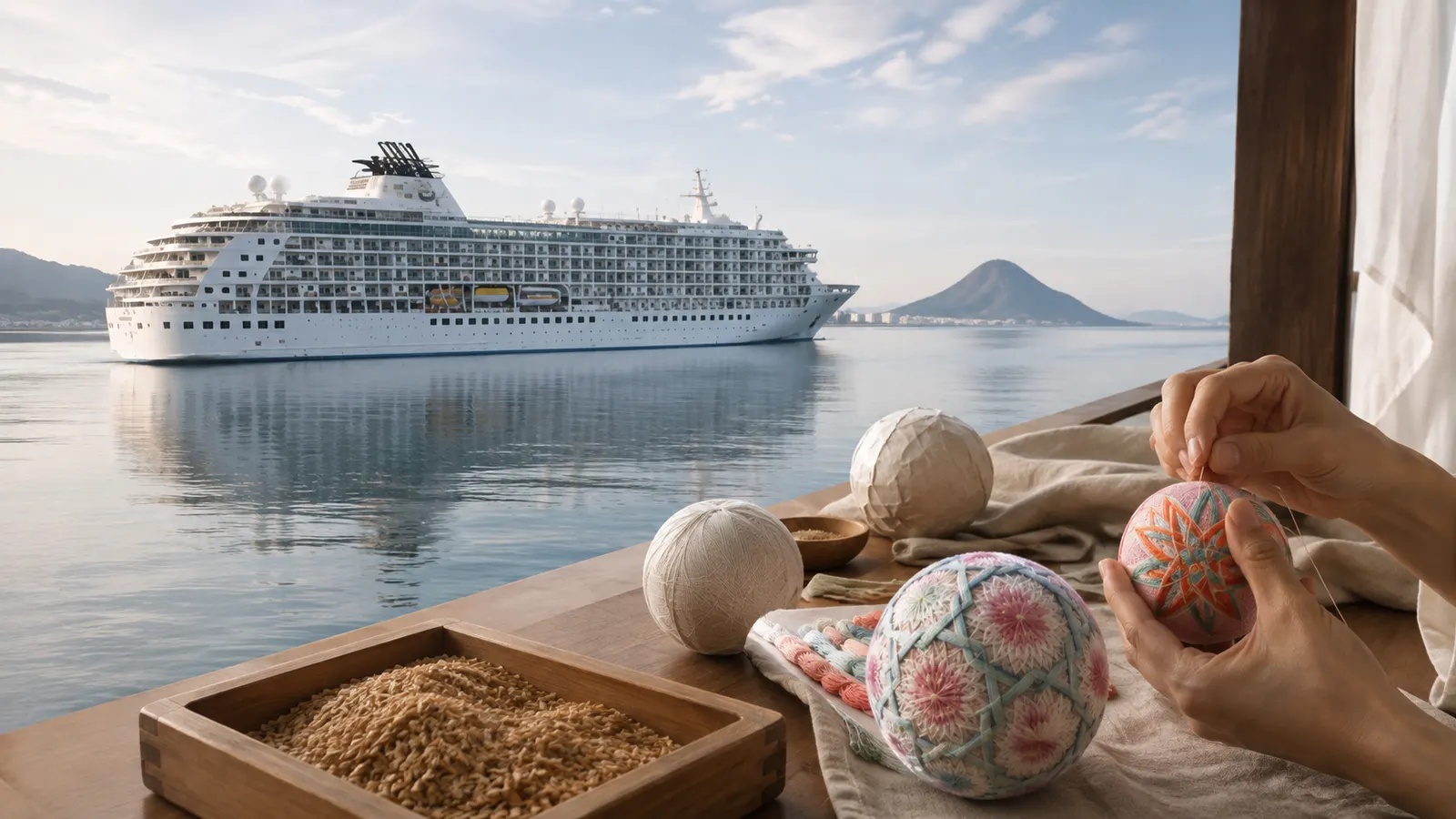
The construction is disarmingly simple. Rice husks are wrapped in washi paper to form a firm base ball. Cotton thread is wound over that core until the sphere is smooth and even. Then the surface is divided — into eight, ten, sixteen — and the stitching begins, worked by eye and by count until an interlocking geometric pattern emerges. The results read as kaleidoscopic; the same pattern rendered in different thread colours produces an entirely different object, which is where the real range of the craft lies.
Four materials, then: rice husk, washi, cotton, plant dye. None of them costly. Assembled into something that takes a day to make at the simplest level and decades to master. That contrast is the whole of it.
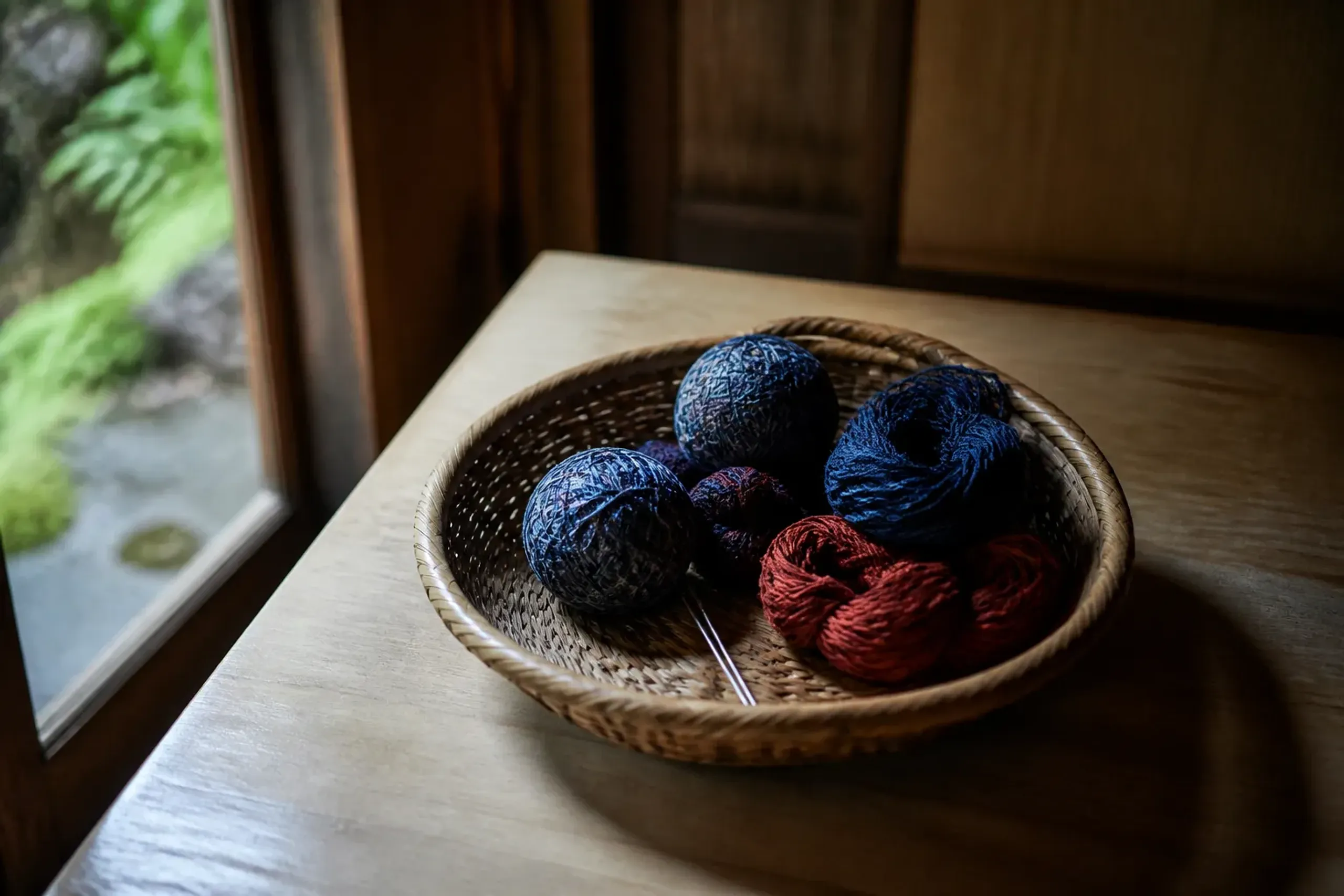
What separates the Sanuki version from temari made elsewhere in Japan is the thread. It is cotton, and it is dyed with plants alone — by the methods used before chemical dyes existed — which means the colours are muted, faintly uneven, and completely unlike the synthetic brilliance of a modern craft-shop ball. The Sanuki Kagari Temari Preservation Society, which produces the work, uses natural materials throughout and works its dye baths to exhaustion rather than discarding them. Indigo, madder, gardenia, onion skin — a restraint of colour that suits an aesthetic of quiet more than one of display.
Cotton, and the Sanuki sanpaku
Cotton was grown in this province, and that is not incidental to the craft — it is the reason it exists. Cotton was one of the Sanuki sanpaku, the three white products that made the old province's name in the Edo period: cotton, salt and sugar. All three white, hence the name. Mothers and grandmothers wound the leftover thread into balls for children to play with, and because a plain ball is dull, they stitched patterns into them.
What a temari meant to a family
A temari was never only a toy. The form is said to have been made first for the daughters of noble houses before spreading more widely, and it carried meaning wherever it went. A temari was traditionally given to a daughter at her birth, in the hope she would grow up healthy, and carried with her when she married — a charm against misfortune and a token of happiness. In time it became an auspicious ornament as well, thought to draw good fortune into a home.
The stitching was the labour that made the wish serious. A ball given to a child carried a hope that her life would run round and smooth, and the hours of counting and stitching were the proof of it. This is why the object still means something today, well beyond the toy it began as.
The geometry problem
The patterns are geometry — divisions of a sphere into eight, ten, sixteen — worked by eye and by counting, without a template. And here is the difficulty that the finished object hides: these are straight-line patterns stitched onto a curved surface. Getting a straight run of thread to sit true across a sphere, and to close cleanly against the next, is a genuine technical problem. It is why the craft is harder than it looks, and why the divisions must be exact before a single decorative stitch goes in. Get the arithmetic wrong at the start and nothing after it will resolve.
How the craft nearly disappeared, and was rebuilt
Temari were a girls' plaything, and when cheap rubber balls arrived, production collapsed. In Sanuki the craft came close to dying out altogether after the war.
It was recovered — not merely continued, but reconstructed — through roughly thirty years of research: the dyeing, the winding, the stitch counts, all of it worked back out. The name Sanuki kagari temari was given in 1977, and a preservation society was founded in the 1980s by the late Araki Kazuo and his wife Yaeko. The craft was subsequently designated a traditional craft of Kagawa Prefecture, with the society recognised as its sole designated producing body.
A craft rebuilt from near-loss is a better story than an unbroken lineage — and here it happens to be the true one.
The society today
The Preservation Society today numbers around a hundred members, mostly women living in Kagawa, working under a representative who holds certification as a Traditional Craftsperson. Many work from home; the workshop itself occupies a repurposed former kindergarten building on Kankō-dōri in Takamatsu. Alongside the traditional patterns, the society develops new designs intended to sit in contemporary homes. It is a small working society, not a luxury house — and that is precisely its interest.
What a session involves
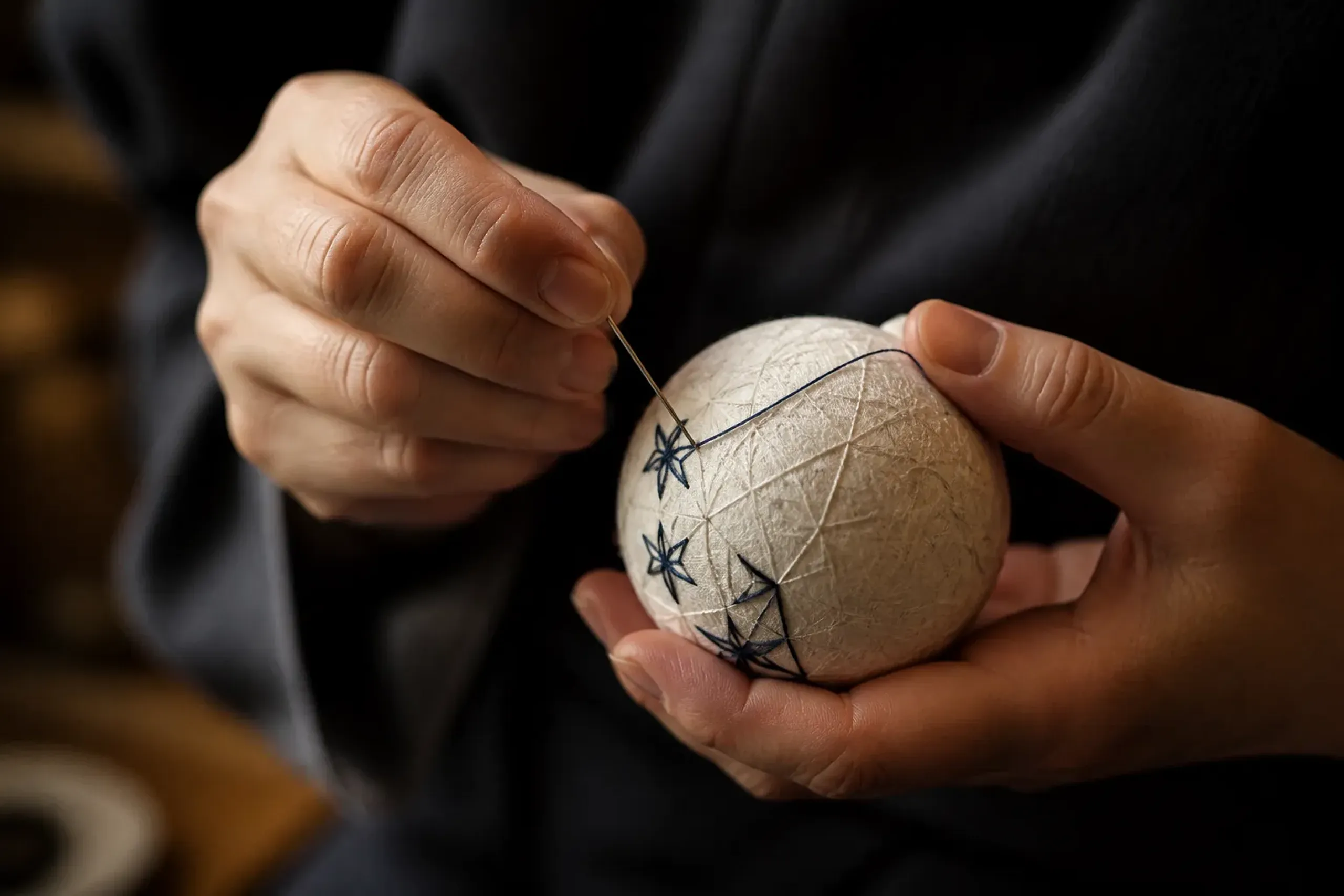
You are given a wound core, a needle, and thread that somebody dyed by hand, and you are shown how to divide the sphere. Then you count, and stitch, and it goes wrong, and you learn why the divisions have to be exact before a single decorative stitch goes in.
Instruction is given by working makers — the people who actually produce the pieces — rather than by a demonstrator. The society offers a full-day class and a shorter taster session for visitors with limited time, with durations from roughly ninety minutes. It suits guests who are tired of being shown things and would rather do one.
A pattern often proposed for beginners is asanoha, the hemp leaf — interlocking hexagons, one of the oldest geometric motifs in Japanese design. Hemp grows fast and straight and needs no tending, so the pattern has carried a wish for a child's healthy growth for centuries, and it appears on kimono, on paper, on lacquer. It is also a genuinely demanding first pattern, which is the point: the divisions have to be right before the decoration means anything.
Crucially, a beginner completes a real piece. This is not a demonstration with a souvenir handed over at the end — you leave with the ball you made. A great deal of what is offered to visitors in Japan produces either a photograph or an object somebody else made; this does neither.
Hours, and one thing to check
The office and shop keep hours of 10:00 to 17:00, closed Sundays and public holidays. For a port call that lands on a Sunday, that closure matters — say so early. Sessions require advance arrangement, and current class formats, durations and hours should be confirmed at the time of planning, as they change.
What can be bought or ordered
If you would rather own a temari than make one, that can be arranged. Finished pieces can be purchased, and work can be commissioned. The object most guests end up wanting is the kō-temari — a temari with incense held inside it, so that the ball carries scent as well as pattern and meaning.
Carrying it home
This is where the temari earns its place. Kagawa's other crafts resist leaving. A Kinashi pine bonsai cannot travel without two years in a registered nursery and a phytosanitary certificate. An Aji stone piece is heavy and expensive to ship. A temari is cotton thread the size of a fist.
But we will not overclaim, because the qualification is what makes the rest credible. The core of a temari is rice husks, and some countries restrict husks and straw as plant material. So the honest statement is this: a temari is far simpler to carry than a tree or a block of granite, but the customs position should be confirmed for your particular destination before you count on carrying one across a border. We would rather tell you that now than have you learn it at a counter.
What we arrange
Japan Royal Service arranges studio visits, hands-on sessions, and the purchase or commissioning of pieces, working directly with the Sanuki Kagari Temari Preservation Society — the sole designated producer of the craft. We will not promise that any individual maker will personally receive you; instruction is given by the society's working makers, and that is its own guarantee of quality. Arrangements are made quietly, in Japanese, with people the society already knows. We can pair a session with private transportation so that it folds into an afternoon you are already spending in Takamatsu, and we build the whole of it into a single tailor-made itinerary.
One thing to decide early
If your time in Kagawa already includes lacquer, stone or ceramics, we will ask a plain question: do you want a fourth object in your hands, or is one enough? The honest answer is often one. One craft done properly beats four sampled — and we would rather say that than sell you four.
Frequently Asked Questions
What makes Sanuki temari different from temari elsewhere?
The thread. It is cotton, dyed with plants rather than synthetics, which gives a muted and slightly uneven colour. The province grew cotton — one of the three Sanuki sanpaku — and the craft grew out of the leftovers.
How long does a session take?
From roughly ninety minutes, seated, with a full-day class also available. You leave with the piece you made, which is not true of most craft experiences offered to visitors in Japan.
Should we do this if we are already doing another craft?
Often not, and we will say so.
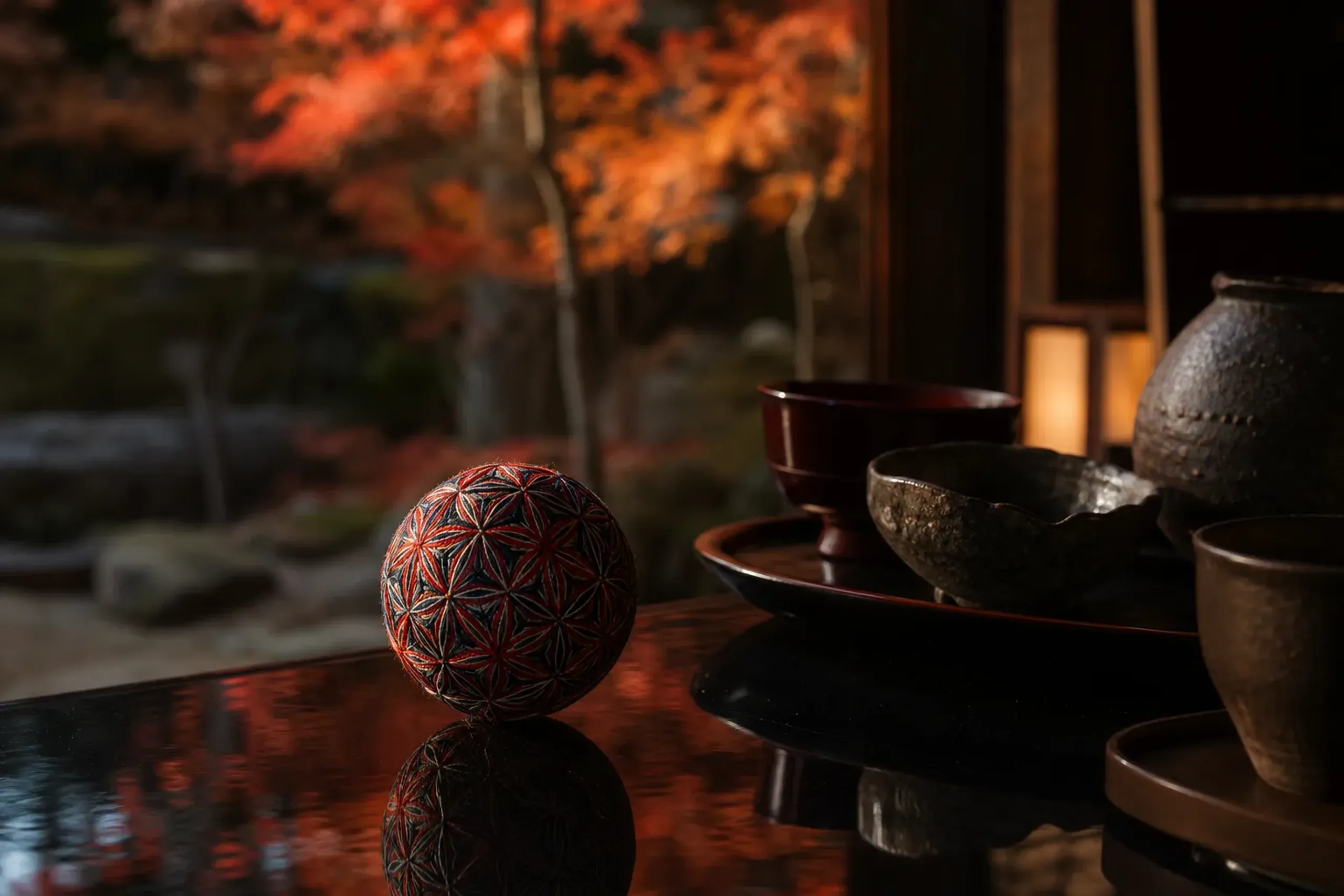
If your call already includes lacquer, stone or ceramics, one craft done properly beats four sampled.
Can I really take one home?
Far more easily than a bonsai or a stone piece — a temari is a fist of cotton thread. But its core is rice husks, which some countries restrict, so confirm the position for your destination before you rely on it.
A closing note
A temari is a small thing: four humble materials, a needle, and the patience to make straight lines close on a curve. That it nearly disappeared, and was brought back by a hundred or so people working quietly across one prefecture, is what gives it weight. To arrange a private session, a studio visit, or a commissioned piece, contact us here. We do not publish our clients, our itineraries, or our rates.