In this guide
- 01Why Is Kusatsu Onsen’s Water “Too Hot,” And Why Don’t Locals Dilute It?
- 02How Does Yumomi Work At Kusatsu Onsen Today?
- 03A Walk-Through Kusatsu’s Cooling System: From Yubatake To Your Bath
- 04What Makes Kusatsu Onsen Water Distinctive (Without The Hype)?
- 05Kusatsu’s Named Experiences: The Places To Soak, Not Just “Things To Do”
- 06What Is Jikan-Yu In Kusatsu, And Should You Try It?
- 07Kusatsu Onsen At Night: A Quiet Route For First-Timers
- 08How Do You Get To Kusatsu Onsen From Tokyo (And What Should You Watch For)?
- 09When Should You Visit Kusatsu Onsen For The Most Refined Feel?
- 10Kusatsu Vs Hakone: Which Onsen Base Fits A Luxury Traveler Better?
- 11Where To Stay In Kusatsu: What Matters More Than A Star Rating
- 12How To Plan A Two-Night Kusatsu Stay (A Step-By-Step Template)
- 13Kusatsu Onsen Etiquette For HNW Travelers Who Value Privacy
- 14Kusatsu As One Of Japan’s Three Great Springs (And Where To Read Next)
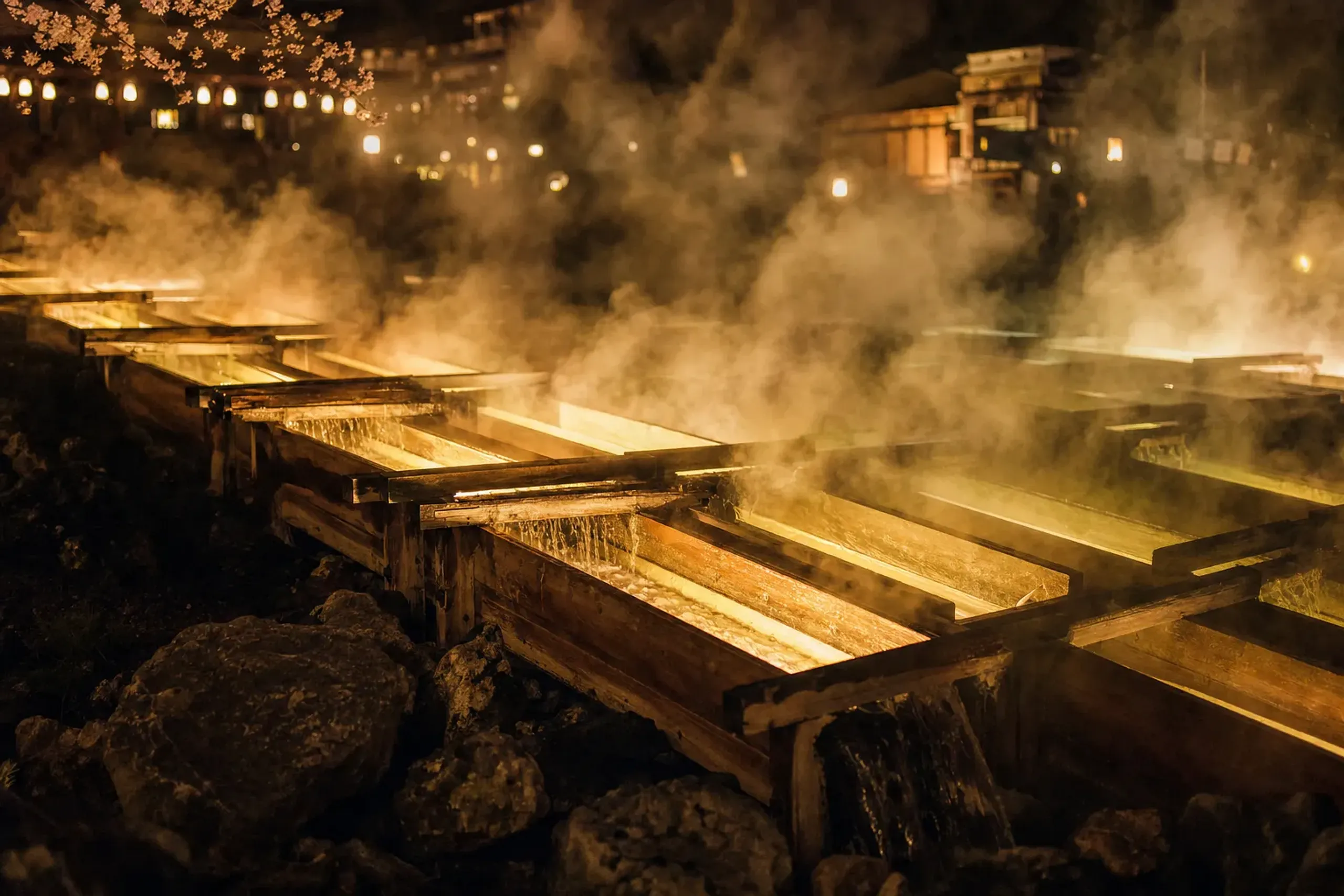
At the Yubatake, night feels alive. Steam climbs in thick ropes, catches the lights, then thins into the mountain air. You hear the wooden water channels before you see them—a soft, endless rush. A town built around a sound.
Kusatsu Onsen’s water surfaces at extreme temperatures—often far beyond what your skin can accept—and the obvious fix, adding cold water, would thin out the very minerals that make Kusatsu distinctive. So the town chose a stubbornly elegant solution. Not chemistry. Not shortcuts. Motion.
That choice—cooling by paddling, not dilution—is why Kusatsu still feels like a place with its own rules, unbent by convenience. Our team at Japan Royal Service uses that single mechanism to shape the whole stay: when you arrive, where you soak, how you move, and how to keep the experience quiet rather than crowded.
Why Is Kusatsu Onsen’s Water “Too Hot,” And Why Don’t Locals Dilute It?
Kusatsu’s spring water rises at roughly 50–90°C, and locals refuse to add cold water because dilution would weaken the water’s character. Instead, they cool it through wooden channels and yumomi paddling—a slower, prouder method.
This is the core logic of Kusatsu. The water comes up hot. Very hot. And it arrives in volume.
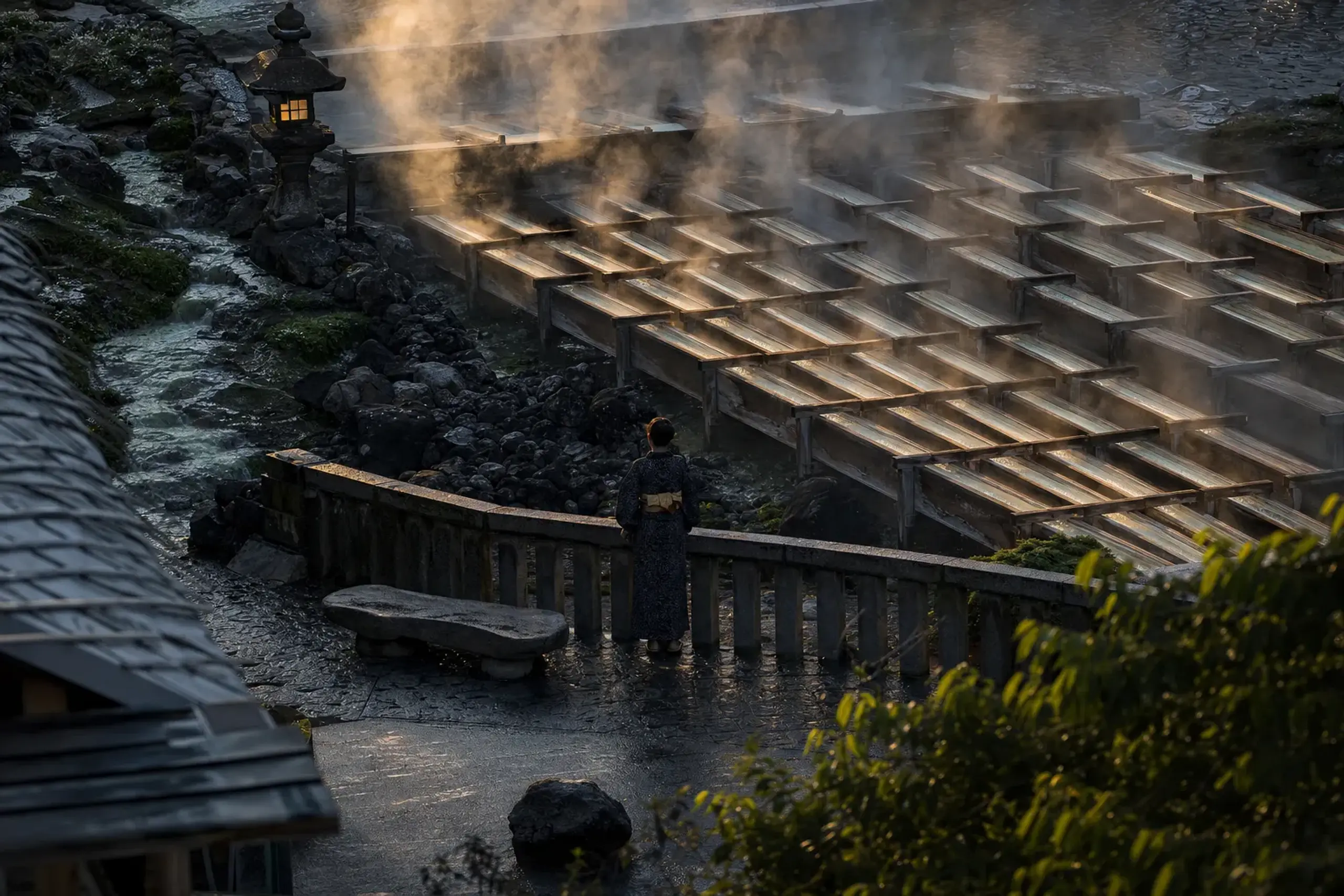
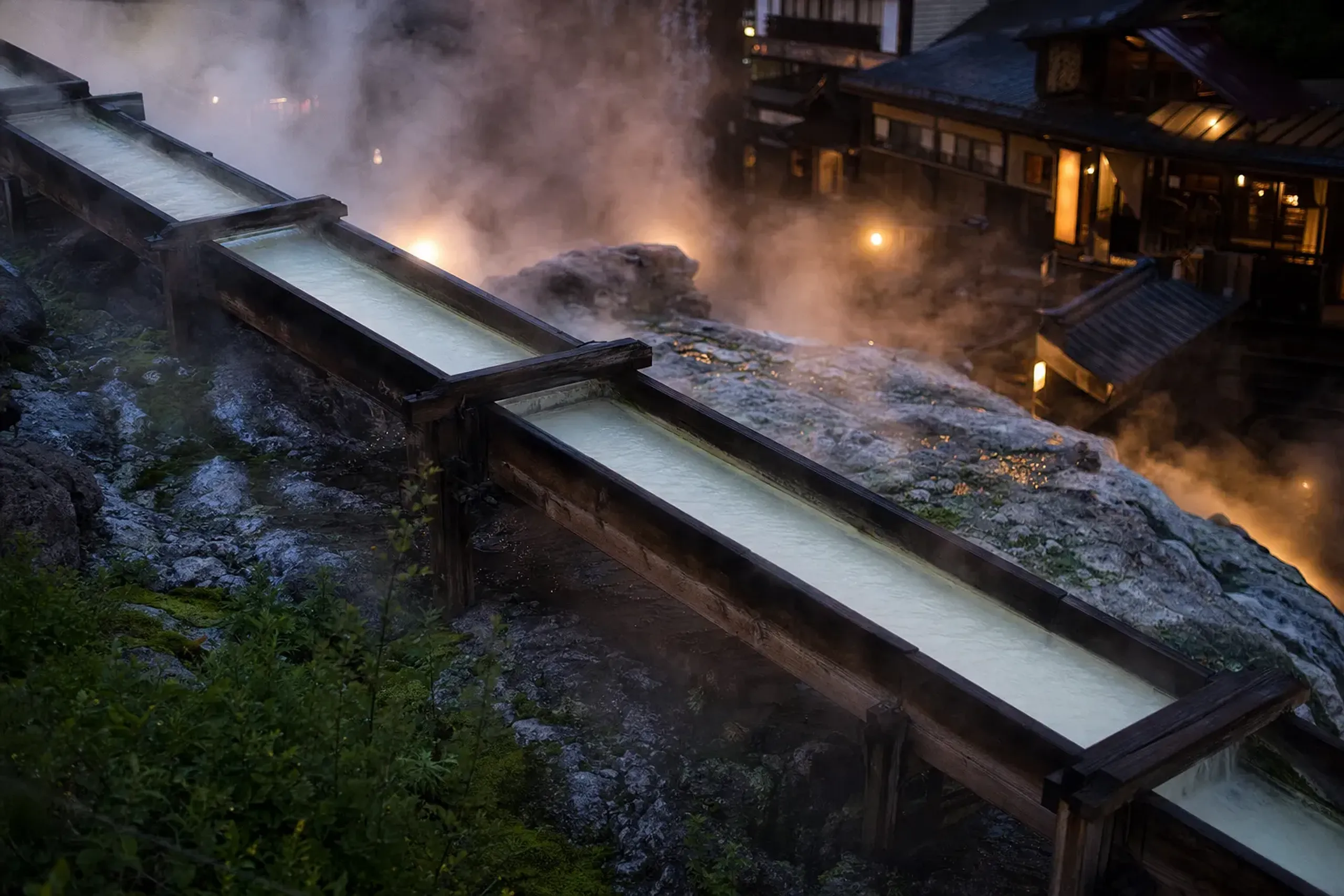
You’ll see that volume made visible at the Yubatake (“hot water field”), the town’s central source and symbol. Water pours through wooden conduits, and mineral sediment (yunohana) forms as it cools along the way. It’s practical. It’s also strangely theatrical.
In our experience, Kusatsu rewards travelers who understand the system before they arrive. Once you grasp the mechanism—cooling without dilution—everything else in town stops feeling like a tourist performance and starts reading like old-fashioned engineering, refined by daily use over generations.
How Does Yumomi Work At Kusatsu Onsen Today?
Yumomi cools Kusatsu’s hot spring water by kneading it with long wooden paddles, lowering the temperature through agitation and evaporation rather than adding a single drop of cold water.
The paddles are large—about 180cm—and the movement is steady, not frantic. The goal is simple: cool the bath, even out the mineral concentration, and make the water usable without “weakening” it. It began as a Meiji-era solution to a physical constraint, not an ancient rite—though a century of repetition has given it the weight of ritual.
Today, trained practitioners perform yumomi with a call-and-response chant that keeps the tempo. It carries across the hall. Even if you don’t understand the words, you understand the purpose.
For visitors, the most straightforward place to see and experience a demonstration is Netsu no Yu (熱乃湯), near the Yubatake. Schedules can change by season, so we treat timing as part of the plan, not an afterthought.
Key fact: Netsu no Yu publishes seasonal performance timetables (including winter changes), and payment conditions can be limited (cash or PayPay). Check close to travel.
A Walk-Through Kusatsu’s Cooling System: From Yubatake To Your Bath
Stand at the railing by the Yubatake and watch the water travel. It doesn’t rush. It’s guided.
From the central source, hot water is channeled through wooden troughs (yudoi). These long runs cool the water passively in stages before it reaches ryokan and public baths. Quiet work. Constant work.
This is why Kusatsu feels so cohesive at night.
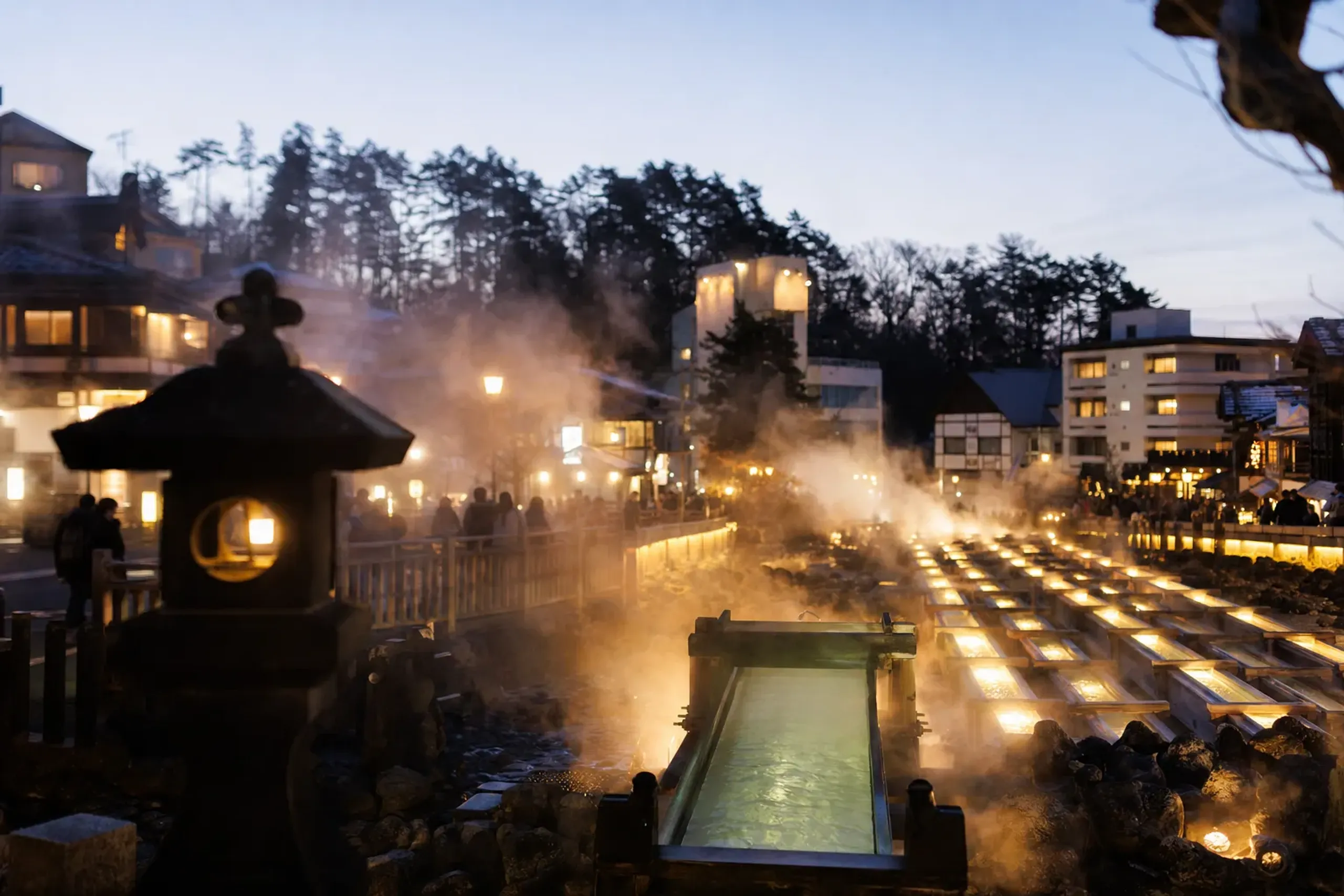
The town is small. The steam is everywhere. And the center holds.
If you’re walking from the Yubatake to Sainokawara Park, the distance is short—about 12 minutes on foot from the center area, per Gunma’s official tourist guidance. Easy. Even in a light snow.
What Makes Kusatsu Onsen Water Distinctive (Without The Hype)?
Kusatsu is defined by three checkable traits: extreme natural flow volume, high temperatures at the source, and unusually acidic water at the Yubatake (around pH 2.1).
Start with scale. Kusatsu’s natural flow volume is often cited as the highest in Japan, over 32,300 liters per minute, which is why so many facilities can offer genuine source-flow bathing—used once, then drained, rather than recirculated or reheated. That matters. You feel it in the freshness of the water against your skin.
Then the acidity. The Yubatake is measured around pH 2.1, among the most acidic hot spring waters in Japan. A common demonstration is an iron nail left in the water, corroding dramatically over about ten days until it thins toward wire. It’s not a legend. It’s an observable reaction.
And yes, the water is hot. The Yubatake water surfaces at over 70°C, then cools as it moves through the wooden conduits. Kusatsu-Shirane, the volcano associated with the area, rises to 2,160 meters. The landscape explains the intensity.
Kusatsu’s Named Experiences: The Places To Soak, Not Just “Things To Do”
Kusatsu is walkable, but it’s not one-size-fits-all. The best bathing choice depends on your comfort with heat, crowds, and outdoor exposure.
Sainokawara Rotenburo (Sainokawara Park)
This is the famous open-air bath in Sainokawara Park.
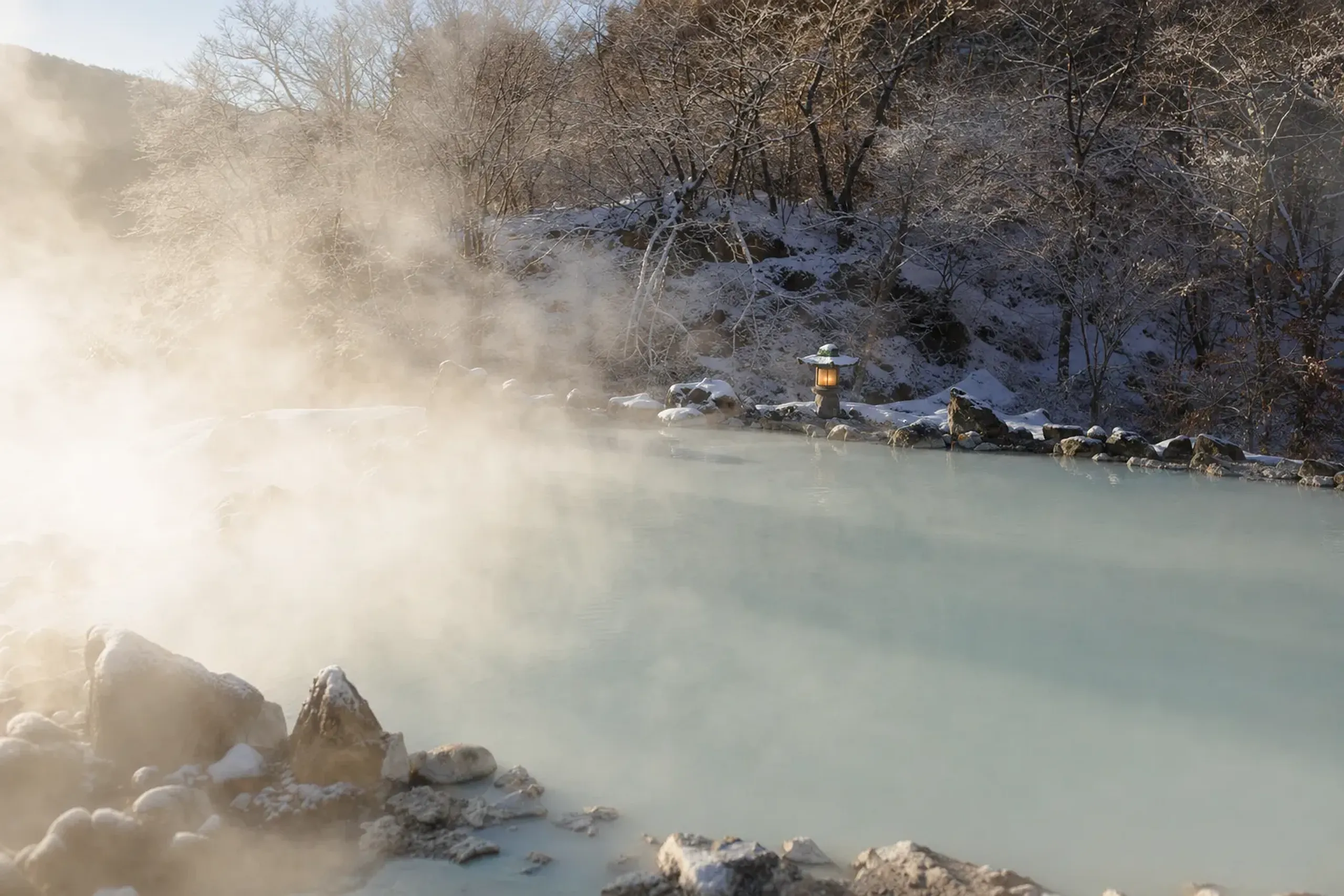
Big. Very big—described as one of Japan’s largest, able to accommodate more than 100 bathers.
On a winter evening, it can feel like stepping into a white landscape painting: bare branches, drifting steam, snow settling on the rim of the stone. On a busy weekend, it can feel communal in a way some discerning travelers would rather avoid. Know yourself—and let us know your preference, so we can place you there in the right hour.
Shirahata no Yu
Shirahata no Yu is a communal bath tied to one of Kusatsu’s historic sources, and it’s the only main source known for a naturally cloudy, white appearance. The whiteness comes from sulfur flower mixing with the water and air—an effect no engineering can imitate.
Local tradition links its discovery to Minamoto no Yoritomo and the white banner (shirahata) of the Genji clan. Whether you come for the story or the color, it’s a distinct stop, and one that carries a whisper of the Japan that guidebooks tend to flatten.
Goza-no-Yu (Near Yubatake)
Goza-no-Yu is often chosen for proximity. You can move from a night stroll at the Yubatake to a bath without logistical drag.
For couples or friends traveling together, we often plan it as a “late slot” after the town center calms down. Less noise. More steam.
What Is Jikan-Yu In Kusatsu, And Should You Try It?
Jikan-yu is a traditional timed-bathing method in which bathers enter very hot water (around 47°C) for exactly three minutes under an instructor’s guidance.
This is not a casual soak. It’s brief. It’s intense. And it’s specific to Kusatsu’s bathing culture—an inheritance you won’t find replicated elsewhere.
If you’re curious, treat it like a formal practice, not a dare. Remove jewelry, tie up hair, and be honest about your tolerance for heat.
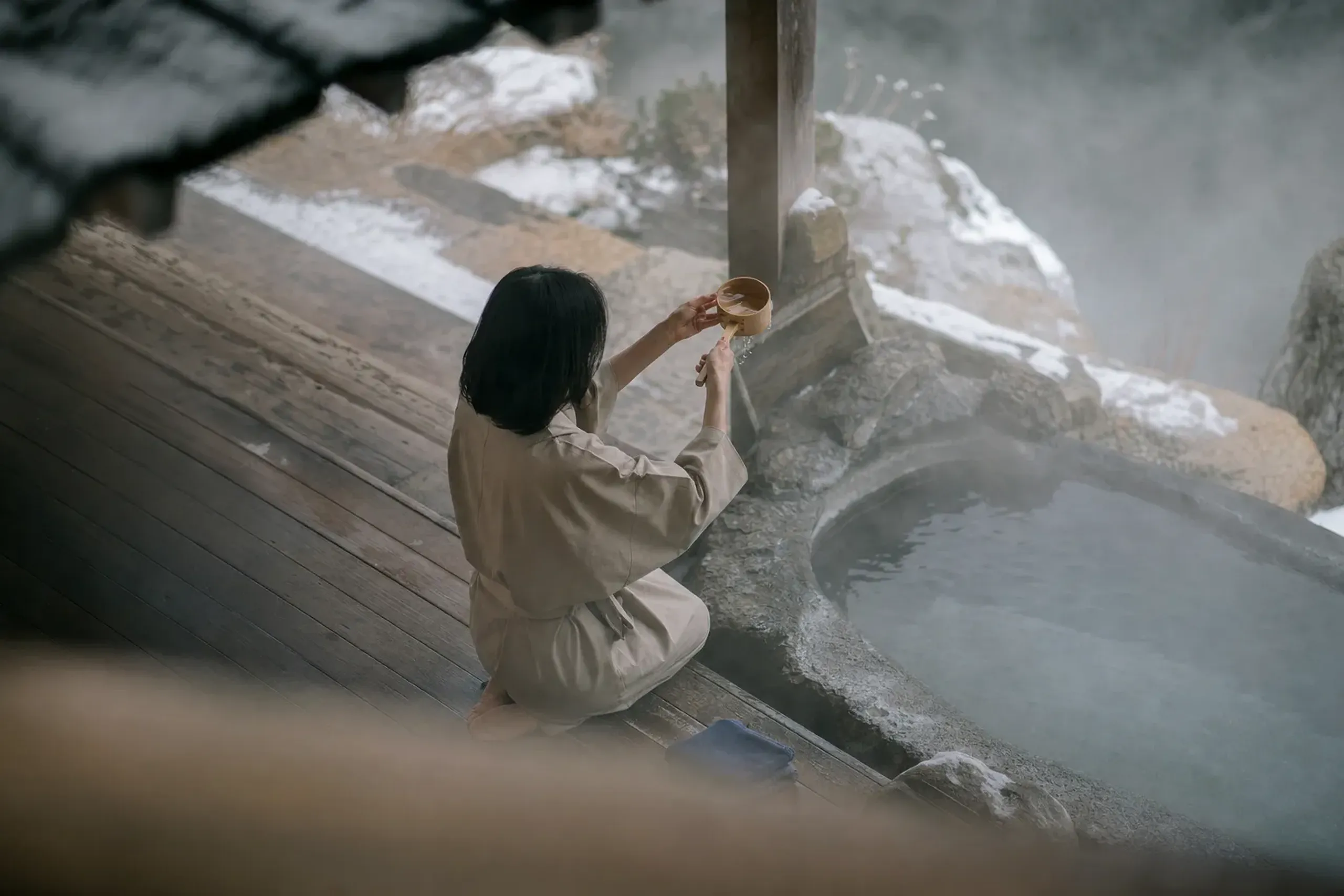
In our experience, the guests who enjoy jikan-yu are the ones who approach it with restraint.
Kusatsu Onsen At Night: A Quiet Route For First-Timers
Begin at the Yubatake after dusk. The steam looks thicker under light. It also photographs well, though the best moments are usually the ones you don’t post.
From there, walk to Netsu no Yu if you’re aiming for a yumomi performance. Keep your timing sharp. Seats fill.
Then slow down. A short walk, a warm drink, and a return toward your ryokan for a private bath slot if your property offers it. The best luxury in Kusatsu is often a closed door and a bath you don’t share—the quiet, anticipatory care of a ryokan that has readied everything before you ask.
How Do You Get To Kusatsu Onsen From Tokyo (And What Should You Watch For)?
Most travelers reach Kusatsu via Naganohara-Kusatsuguchi Station, then take the JR Bus Kanto service bound for Kusatsu Onsen.
Gunma’s official guidance is clear: train to Naganohara-Kusatsuguchi, then bus onward. Some JR passes can cover the train segment and the JR Kanto bus segment, depending on the pass rules. Read the fine print before you count on it.
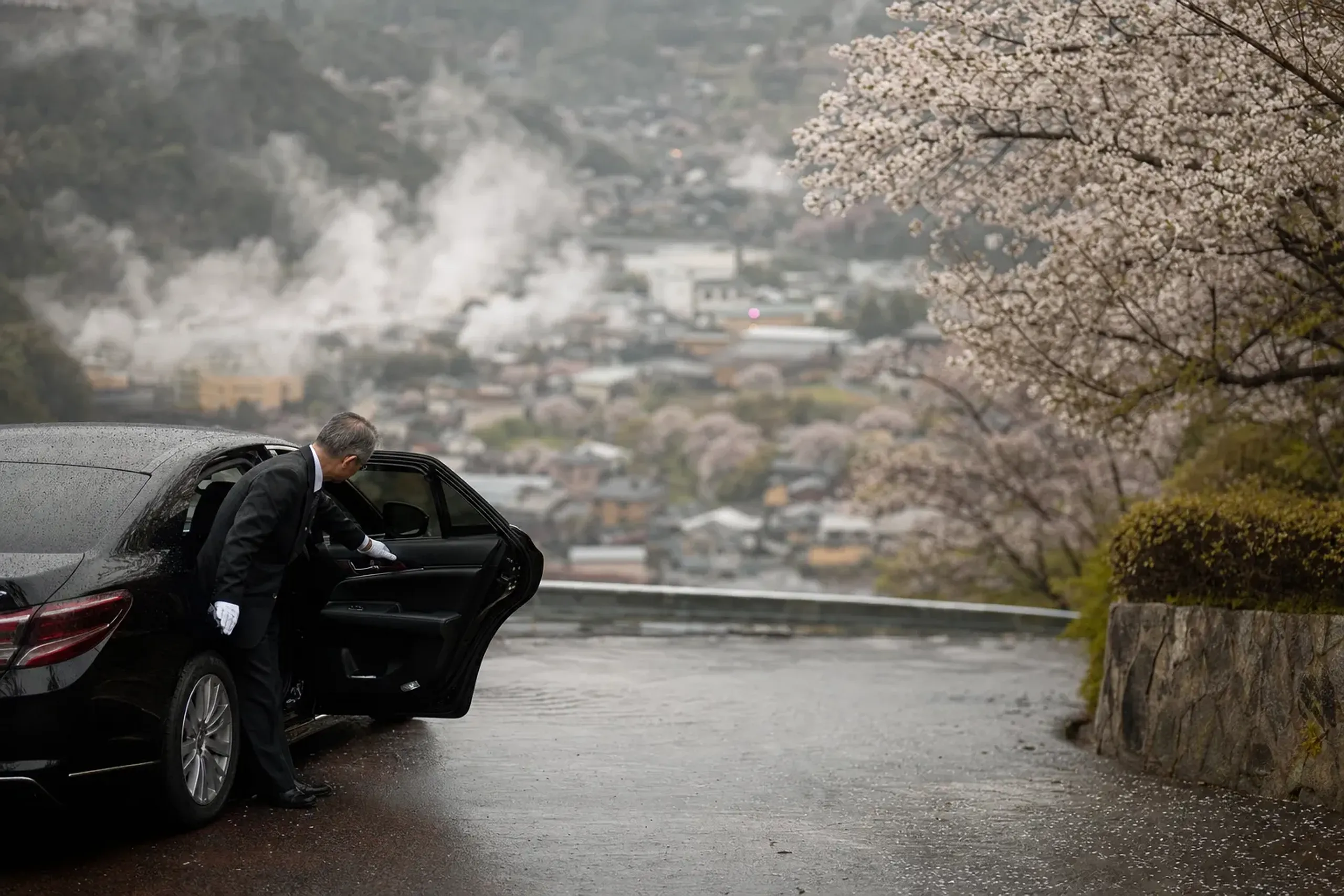
For discerning travelers, the friction point is rarely the train itself. It’s the transfer: luggage, weather, and timing when buses thin out. This is where a private car becomes more than comfort. It becomes control.
When our guests prefer a door-to-door approach, we plan routes and pacing around a private transportation day with a professional chauffeur—especially for families, older parents, or anyone who simply wants to arrive composed.
When Should You Visit Kusatsu Onsen For The Most Refined Feel?
For a calmer, more refined Kusatsu, aim for weekdays and shoulder seasons, and build your schedule around evenings at the Yubatake rather than peak weekend afternoons. Knowing exactly which month rewards which experience is a large part of what we quietly manage on your behalf.
Kusatsu has strong winter appeal because steam and cold air amplify each other. Summer has its own draw, especially when cultural programming increases demand.
If you’re traveling around August, Kusatsu can intersect with the Kusatsu International Summer Music Academy & Festival, which publishes its own ticket-sales updates (the 46th festival announced sales news dated 2026-06-01). It’s a clean pairing: a concert, then a slow walk back through the steam.
One practical note. Facility operations can change. Otakinoyu, for example, has posted renovation notices in 2026, which is why we treat “what’s open” as a last-mile check.
Kusatsu Vs Hakone: Which Onsen Base Fits A Luxury Traveler Better?
Kusatsu suits travelers who want a compact onsen town with extreme water character and strong local rituals; Hakone suits travelers who want a broader resort area with museums, lake views, and easier linkage to Tokyo’s standard routes.
Luxury travelers compare these two for good reason. Both are credible. They just feel different in the bones.
| Decision Point | Kusatsu Onsen (Gunma) | Hakone (Kanagawa) |
|---|---|---|
| Town Feel | Walkable onsen town centered on Yubatake | Spread-out resort area with multiple zones |
| Signature Culture | Yumomi at Netsu no Yu, jikan-yu tradition | Art museums, lake cruise, ropeway circuits (varies by season) |
| Water Character | High-volume, very hot, notably acidic (Yubatake pH ~2.1) | Varied springs by area; less defined by one central source |
| Best For | Travelers who want onsen intensity and a tight evening rhythm | Travelers who want onsen plus sightseeing breadth |
If you’ve done Hakone before, Kusatsu can feel like the more focused second chapter.
Less sprawl. More cadence.
Where To Stay In Kusatsu: What Matters More Than A Star Rating
Room placement matters. A quiet wing can change the entire trip.
For many of our guests, the “right” ryokan in Kusatsu is defined by three practical filters: how private the bathing options are, how you enter and exit without a crowded lobby moment, and how close you are to the Yubatake for night walks. Not glamorous questions. Essential ones. This is also where discretion earns its keep—a stay arranged so that neither your name nor your itinerary travels beyond the people who need it.
Kusatsu’s luxury lodging supply is also changing. Hoshino Resorts has announced KAI Kusatsu (KAI brand) opening on June 7, 2026, a meaningful signal that Kusatsu belongs on a luxury traveler’s shortlist, not only as a day-trip add-on.
We avoid loud claims about availability in public. Privately, our concierge team helps you choose a property and a room type that fits your rhythm—sometimes a ryokan that rarely opens its finest rooms to outside enquiry—then builds the rest of the trip around it.
How To Plan A Two-Night Kusatsu Stay (A Step-By-Step Template)
Two nights is the sweet spot for first-timers. One night is a rush. Three can be perfect, but only if you like repetition.
Night 1: Arrive Late, Keep It Soft
Arrive before dinner if you can.
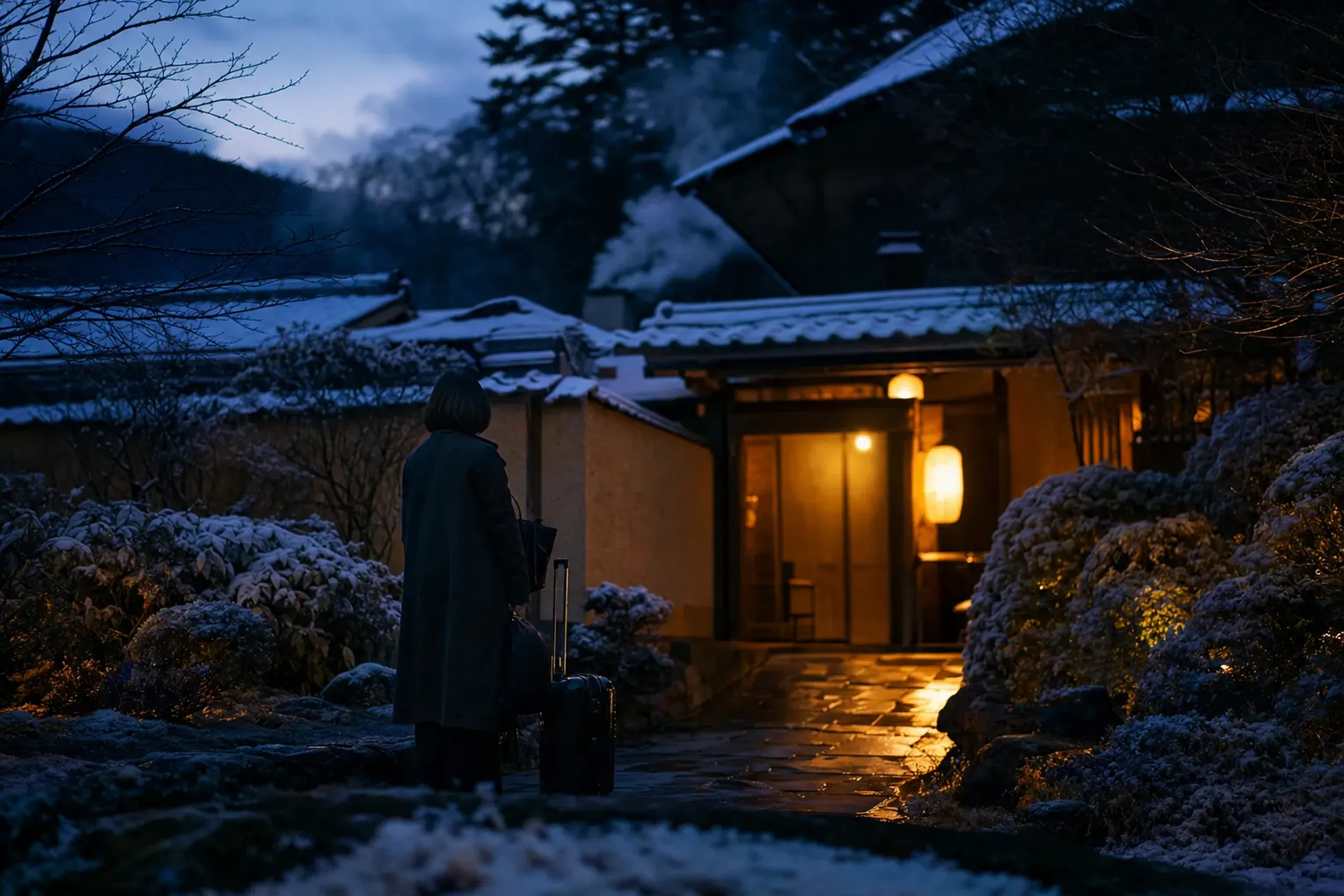
If not, arrive for the bath.
- Check-in: keep luggage minimal for the final approach; Kusatsu is compact, and short walks happen.
- After dark: Yubatake walk first, bath second. It sets the tone.
Day 2: Yumomi, Then A Long Soak
Place Netsu no Yu earlier in the day to avoid compressing your evening. Your body will thank you.
- Morning: town stroll; observe the conduits and yunohana along the Yubatake channels.
- Midday: Netsu no Yu yumomi demonstration (confirm timetable close to travel).
- Afternoon: choose one major bath—Sainokawara Rotenburo for scale, or a quieter communal bath for character.
Day 3: A Clean Departure
Pack early. Take one final short soak. Leave before the town thickens.
If you’re continuing elsewhere in Japan on a tailor-made itinerary, we like to place Kusatsu as a reset between big-city days. Tokyo feels sharper after steam and silence.
Kusatsu Onsen Etiquette For HNW Travelers Who Value Privacy
Privacy in Kusatsu is less about being hidden and more about choosing the right moments.
Go early. Or go late. Avoid the obvious peak hour and the obvious doorway.
And keep your voice low. Baths amplify sound. A whisper can feel like a broadcast.
One more thing: with highly acidic water, leave delicate jewelry out of the bath area. It’s a simple precaution, based on the water’s observable corrosive strength.
Kusatsu As One Of Japan’s Three Great Springs (And Where To Read Next)
Kusatsu Onsen is traditionally counted among Japan’s Three Great Springs, alongside Arima Onsen and Gero Onsen—a lineage that hints at how much refinement sits beneath its plain wooden channels.
The mechanism is simple; the mastery around it is not. Should you wish to experience Kusatsu the way it deserves to be experienced—the right ryokan, the right hour at the Yubatake, a private bath waiting after the town has quieted—contact us here and we will compose a stay tailored entirely to you, in complete confidence.